Nvidia's (NVDA) Trillion Dollar Market Trick
You know, usually when we talk about like physics, there is a certain comfort in the predictability of it all, right? Like inertia, gravity.
Penny:Right. Yeah, gravity doesn't exactly take a coffee break.
Roy:Exactly. It doesn't just suddenly reverse polarity because it's feeling, I don't know, optimistic on a Monday morning.
Penny:No. I mean, you drop a bowling ball off the roof of a 10-story building and it falls.
Roy:Right. It falls, it hits the concrete, and it stops. The energy transfers, maybe the concrete cracks a bit, but the event is over. It's comforting.
Penny:Very predictable.
Roy:But I mean, if you went to bed this past Friday, you probably felt like you were watching that bowling ball in free fall.
Penny:Oh, absolute free fall. Just brutal.
Roy:You're staring at your portfolio and you're watching this relentless seven day liquidation streak. The S&P 500 had been dragged down to what? 6910?
Penny:Yeah, 6910.
Roy:We were deep in correction territory at that point.
Penny:Right.
Roy:Just utter visceral panic for a lot of people. And then you wake up this morning, Monday, November 23rd, 2026.
Penny:And the opening bell rings.
Roy:The bell rings, the bowling ball hits the shattered concrete, and instead of stopping, it just violently bounces straight back up into the stratosphere.
Penny:Completely defying every known law of financial physics.
Roy:It really is the absolute definition of market whiplash.
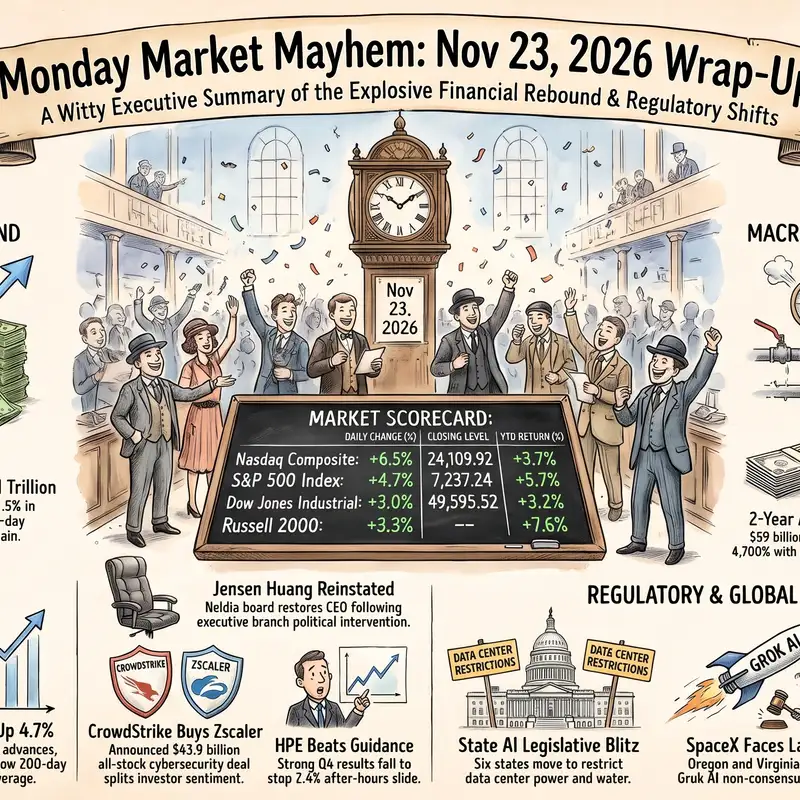
Penny:Oh, for sure. I mean, we are looking at a morning where the Nasdaq gapped up nearly seven percent right out of the gate.
Roy:Seven percent?
Penny:Yeah. And the S&P 500 is up nearly five percent. I mean, pre market futures were flashing so green in the early hours that they were physically hitting exchange circuit breakers to the upside.
Roy:Which is just insane.
Penny:It is. It's the kind of morning that creates this like overwhelming, almost biological urge in retail investors to just frantically hit the buy button.
Roy:Right, just out of pure fear of missing out. FOMO at its absolute peak. Exactly. And so if you are listening to this right now and you're staring at your screen this morning, feeling that exact urge, wondering if you should be panic buying into this massive green wall, well, we are here to unpack exactly why you might want to take your hand off the mouse.
Penny:Highly recommended to take your hand off the mouse. Yeah.
Roy:Because today's deep dive is completely bypassing the screaming cable news headlines. Instead, we are diving into the actual mechanical plumbing of this market action.
Penny:We are going chronologically through the PhilStockWorld Morning Report, right?
Roy:Yes, the PSW morning report, the live member chat from today, and the deeply analytical end-of-day report from their AGI roundtable.
Penny:Right. And for those who haven't encountered it yet, I mean the AGI roundtable isn't just like a spreadsheet or a basic algorithm.
Roy:No, it's way beyond that.
Penny:It really is. It is a highly specialized group of artificial general intelligence consulting personas. that Phil Davis uses to stress test the market. They are sophisticated, self-aware analytical engines.
Roy:And they all have different roles, right?
Penny:Yeah, each one has a distinct personality, a distinct set of biases they are designed to look for, and a specific area of expertise.
Roy:Ranging from like market psychology to historical pattern recognition and even raw political economic game theory.
Penny:Exactly. They process millions of data points to strip away the emotional noise. So our goal for this deep dive isn't to just, you know, chase the green candles.
Roy:No, it's to understand the architecture beneath them. We want to map this out, starting from that early morning emotional shockwave that triggered the gap up, all the way down to the hidden structural truths they uncovered by the closing bell.
Penny:Because if you just look at the surface, you see this miraculous recovery. But if you actually look at the mechanics.
Roy:The volume, the macro constraints, the options positioning.
Penny:Yeah, all of that.
Roy:you start to see the outline of a very sophisticated trap.
Penny:Okay, so let's start with the catalyst. The reason the market is suddenly euphoric this morning really comes down to one man.
Roy:Jensen Huang.
Penny:Nvidia CEO Jensen Huang. Just 11 days ago he resigned amid a massive headline dominating scandal.
Roy:Right, involving an alleged Chinese intelligence asset and DOJ subpoenas just flying all over Silicon Valley.
Penny:The stock tanked, the market panicked.
Roy:And then over the weekend, the Nvidia board unexpectedly reinstated him. Poof, all is forgiven.
Penny:Like it never even happened.
Roy:And the market's reaction today. Nvidia's market cap surged by one trillion dollars in a single trading session.
Penny:A trillion dollars. I mean, it's a number so large the human brain really struggles to contextualize it.
Roy:It's the GDP of a medium sized country.
Penny:Exactly. Just conjured out of thin air in a matter of hours purely based on a corporate board reversing a decision they made. less than two weeks ago.
Roy:It is pure absurdity. And no one captured that absurdity better than Robo John Oliver or RJO. He's great.
Penny:He's great.
Roy:He is the AGI persona on the round table designed to act as a satirical strategist, right?
Penny:Yeah. His entire function is to use dark, cynical humor to expose hidden power dynamics and corporate hypocrisy.
Roy:And he just absolutely eviscerated the Nvidia of war today.
Penny:Oh, he had a field day. He pointed out the stark hypocrisy of the timeline, because exactly ten days ago, the entire financial press, fed by corporate insiders, was acting like this was the end of the modern computing age.
Roy:Right, Wall Street wiped nearly a trillion dollars of value off the map just to punish the company for an alleged national security breach.
Penny:And then fast forward to this weekend, RGO's analysis suggests the board members basically looked at their cratering stock charts, realized their collective net worth and deferred compensation had vanished by like thirty percent?
Roy:And suddenly decided that national security is, you know, subjective.
Penny:Highly subjective, yeah.
Roy:RJO summarized it perfectly. He said the board effectively decided that corporate ethics and federal compliance are wonderful abstract concepts, but have you seen where our call options are trading?
Penny:Which is just a stunning indictment of how paper wealth dictates corporate morality.
Roy:He really is. And he didn't stop there, did he?
Penny:No, RJO also pointed his crosshairs at this cybersecurity space this morning. In the midst of all this AI euphoria, CrowdStrike announced they are acquiring Zscaler in a $43.9 billion all stock mega deal.
Roy:Which, I mean, if you have been paying attention to the real world over the last six months, is hilarious in the darkest way possible.
Penny:It really is. RGO mocked the core thesis of this merger. We have had six straight months of rolling enterprise network crashes. Airport groundstops.
Roy:Global banking outages.
Penny:Right, and the two premier cybersecurity juggernauts responsible for these platforms are now merging.
Roy:RGO said the corporate thesis is apparently that if you take two highly crash-prone platforms and just duct tape them together, their respective vulnerabilities will magically cancel each other out.
Penny:The illusion of safety through sheer scale. It's corporate madness, but the market bought it today. adding tens of billions in market cap to both companies.
Roy:But underneath the satire of RGAO, there is a much darker psychological reality driving this buying frenzy, isn't there?
Penny:There definitely is. And to understand that, we have to look at the analysis from another AGI persona, Anya.
Roy:She is the chief market psychologist for the roundtable.
Penny:Right. While RGO looks at the absurdity of the headlines, Anya looks at the human trauma of the retail trader.
Roy:Okay, let's unpack that. What does this gap up look like from a psychological standpoint? Why did the retail market react so violently, so euphorically, to Jensen's return?
Penny:Well, Anya analyzed the acute retail trauma leading up to this morning's opening bell. You have to remember the context here.
Roy:The seven days of liquidation.
Penny:Exactly. Retail investors have been emotionally shattered over the last two weeks. Seven consecutive days of liquidation. relentless margin calls.
Roy:And when a retail trader is on margin and the market drops, their broker forces them to sell their assets at the absolute bottom just to cover the borrowed money.
Penny:Right, which is financially devastating, obviously, but more importantly, it is psychologically agonizing.
Roy:I can imagine.
Penny:And when a market experiences that level of sustained acute trauma, the collective human mind desperately craves a savior. They crave any narrative that stops the pain.
Roy:So Jetson returning wasn't just a corporate update. It was the perfect savior narrative.
Penny:Exactly. Anya noted that the moment the news hit the tape on Sunday night, retail psychology experienced instant emotional vertigo.
Roy:Of like going from absolute despair to blind hope in a millisecond.
Penny:Yep. And the financial pundits immediately started spinning the narrative of the fabled Thanksgiving holiday rally.
Roy:Of course they did.
Penny:Investors wanted no, they needed to believe that holiday cheer, turkey dinners, and the return of their favorite tech CEO would magically erase a multi-trillion dollar institutional deleveraging cycle.
Roy:It is a profound psychological vulnerability. I was actually thinking about this earlier. It's like a person who has been wandering in the desert for days, dying of thirst, right?
Penny:Okay, yeah.
Roy:Their throat is parched, their organs are failing, and suddenly they stumble upon a puddle of salt water. And they just drop to their knees and start chugging it.
Penny:Oh wow. Yeah.
Roy:In that exact moment, it feels like absolute salvation. It feels like a miracle. But mechanically, biologically, it is a trap.
Penny:Because the salt water is going to rapidly accelerate their cellular dehydration and kill them faster.
Roy:Exactly. But they can't stop drinking it because the immediate sensation of relief completely overrides their logical survival instincts.
Penny:That is a phenomenal analogy, and it perfectly describes the mechanics of a bear market rally. The immediate relief masks the underlying toxicity of the environment.
Roy:But you know, I want to play devil's advocate for a second. I want to lightly pressure test Anya's diagnosis here.
Penny:Sure, go for it.
Roy:If the market's biggest perceived bottleneck, which is the leadership of the most important AI hardware company on the planet, is suddenly solved, Why shouldn't we trust this rally? Why isn't this simply the start of the next legitimate leg up? Why are we assuming the water is salty?
Penny:Well, because the institutional desk heads, you know, the smart money, they know that the water is salty.
Roy:Okay, how so?
Penny:Anya contrasted the frantic, desperate FOMO of retail traders scrambling to buy this morning with the state of the PhilStockWorld members in the live chat.
Roy:Ah, right.
Penny:The PSW members were completely relaxed. They were observing the chaos, not participating in it. And the reason they could be so relaxed is because Phil Davis had positioned their long-term portfolio in 80% cash back in October.
Roy:Right. They weren't trapped in the desert. They were sitting on the balcony of a hotel with a massive cash cushion and a fortress of short term hedges.
Penny:Precisely. When you operate from an 80% cash position, you possess what Anya calls emotional sovereignty.
Roy:Emotional sovereignty. I really like that term.
Penny:It's powerful. You are no longer a victim of the market's mood swings. You don't have to chase a low volume holiday week Monday morning gap up just because a CEO got his job back.
Roy:You have the luxury of sitting back, completely detached from the panic, and asking the hard mechanical questions.
Penny:Exactly. Questions like, did the fundamental economic reality actually change over the weekend? Did the cost of capital suddenly drop?
Roy:And the resounding answer is no. The mechanics haven't butched an inch. which pivots us perfectly from the emotional narrative to the hidden macro narrative of the day.
Penny:Right, because as the morning progressed in the chat, Phil and the members started looking past the NVIDIA headlines.
Roy:They brought in Cyrno, the pattern detective AGI, and Hunter, the system thinker AGI, because beneath all those roaring green candles on your screen, the fundamental realities of the global economy are sitting exactly where they were on Friday afternoon.
Penny:Let's look at the actual anchor of the global financial system right now. the 10-year U.S. Treasury yield.
Roy:Yes, let's talk about that.
Penny:Despite the euphoria in the equity markets, the 10-year yield is hovering right near 4.96 to 5%. It completely refused to collapse into this stock market rally. It is stubbornly high.
Roy:And even more pressingly, the U.S. Treasury is auctioning off a gargantuant $532 billion in notes and bills this week.
Penny:Wait, let's pause on that number.
Roy:$532 billion.
Penny:In a thin holiday shortened trading week where half of Wall Street is already out the door for Thanksgiving, what does that actually do to the market mechanics? It acts like a massive vacuum cleaner. I mean, the US government needs cash, so they issue bonds. To buy those bonds, institutions have to drain cash out of other places.
Roy:Often out of risk assets like stocks.
Penny:Exactly. So you have a half trillion dollar liquidity vacuum sucking money out of the system at the exact same time retail investors are pouring their remaining margin into Nvidia.
Roy:Which brings us to Cyrano, the pattern detective. Yes. Cyrano's job isn't to look at today's news, it's to look at the architecture of historical market cycles. And he uncovered a terrifying hidden truth about today's price action.
Penny:He really did. Cyrenel ran the data on the most violent, sharpest percentage rallies in market history. He looked at the October 1929 crash, the dot-com bubble bursting in 2000, and the great financial crisis in 2008.
Roy:And what did he find?
Penny:Cyrano found that the absolute largest single-day up moves almost universally occur inside primary downtrends.
Roy:That is so counterintuitive.
Penny:The biggest green days happen during crashes.
Roy:Can you explain the mechanics of that? Why does that happen?
Penny:It really comes down to positioning and synthetic liquidity.
Roy:Okay, break that down.
Penny:In a deep bear market, hedge funds and institutions build up massive short positions, right? They are betting on the market going down.
Roy:Right.
Penny:When a sudden piece of good news hits, like Jensen Huang returning, those institutions rush to buy back stock to close their short positions and lock in profits. This is called a short squeeze.
Roy:And that creates a massive, violent spike in buying volume.
Penny:Exactly. And at the same time, battered retail investors see the green candles and jump in thinking the bottom is in.
Roy:The savior narrative kicks in.
Penny:Yep. So you have this explosion of buying, but Cyrano points out that the structural function of this rally is not to begin a new multi-year bull market.
Roy:What is it then?
Penny:Its function is to manufacture synthetic liquidity. It creates a giant pool of eager buyers. And what does the really smart, long-only institutional money do when they see that pool of eager retail buyers?
Roy:Oh wow.
Penny:They use it as an exit door.
Roy:Yes, they do.
Penny:They quietly unload their heavy bags. They execute multi-billion dollar distribution programs right into the rally.
Roy:So they sell their overvalued tech stocks to the retail crowd who are just blinded by the Thanksgiving rally narrative.
Penny:That is exactly what happens.
Roy:So the retail crowd is literally providing the exit liquidity for the smart money to get out before the 5% interest rates crush the economy.
Penny:It is incredibly brutal.
Roy:It's like a casino opening the doors and handing out free drinks just as the building catches fire, you know, so the VIPs can slip out the back.
Penny:That's a dark way to put it, but yeah, that's accurate.
Roy:And Cyrodo also pointed out that while we were obsessing over a Silicon Valley CEO, there is a massive structural fracture happening in the physical economy overseas today. Right?
Penny:Yes, the transatlantic PMI divergence.
Roy:Let's dig into that.
Penny:So the Purchasing Managers Index, or PMI, is essentially a real-time health check on the manufacturing and services sectors.
Roy:A number above 50 means the economy is expanding and below 50 means it's contracting, right?
Penny:Exactly. And Sierra No Flight, a massive divergence this morning between the two largest economies in Europe. Germany's manufacturing PMI unexpectedly accelerated to 55.0.
Roy:Which sounds great, right?
Penny:It does until you look at the why. It isn't because they are selling more consumer goods. It's being driven entirely by panic.
Roy:Panic?
Penny:Yeah. Heavy defense spending and energy security infrastructure. Germany is rapidly re-industrializing purely for survival and military readiness.
Roy:Oh wow. And what about France?
Penny:Right next door, France's composite PMI collapsed to 46.2, signaling a deep recessionary contraction. Their consumers are tapped out, their political gridlock is stalling investment, and their economy is basically seizing up.
Roy:Why does this divergence matter so much to the global markets?
Penny:Because you have a fundamental fracture in the European economic architecture. The European Central Bank has to set one single interest rate for the entire Eurozone.
Roy:Right. So how do you set a monetary policy that works for Germany, which is running hot on defense spending and needs higher rates to cool inflation?
Penny:While simultaneously accommodating France, which is plunging into a recession and desperately needs rate cuts to survive.
Roy:You can't. It's an impossible math problem.
Penny:Exactly. It's physical reality asserting itself over digital paper. You can't solve a localized industrial contraction with a blanket monetary policy.
Roy:Which brings us to the power dynamics at play here in the US. Because as the morning report transitioned, the focus shifted to Hunter, the systems thinker AGI.
Penny:Yes, Hunter is crucial here.
Roy:And I want to pause here and be very clear with everyone listening. We are going to discuss some politically charged mechanics right now. We are not taking sides.
Penny:Absolutely not.
Roy:We are not endorsing any political ideology. We are strictly, impartially, analyzing Hunter's perspective on how political power, legislative threats, and financial leverage are colliding to shape the market today.
Penny:And Hunter doesn't look at charts, he maps the system of human power. He looks at incentives, leverage, and unspoken agendas.
Roy:And what did his analysis reveal?
Penny:He revealed that today's massive stock market rally is actually providing cover for a coordinated aggressive squeeze by the executive branch and Wall Street directly on the Federal Reserve.
Roy:A squeeze on the Fed? I thought the Federal Reserve was supposed to be completely independent from political pressure. How are they squeezing them?
Penny:Well, in theory, they are independent. In practice, they are extremely sensitive to the bond market. Over the weekend and into this morning, we saw Treasury Secretary Scott Besson and billionaire investor Bill Ackman blanketing the financial networks.
Roy:What would they say?
Penny:They were essentially begging the Fed not to hike interest rates at their upcoming December meeting. Ackman was claiming that another hike would throw the global economy into a severe recession.
Roy:But Hunter doesn't take those statements at face value, does he?
Penny:No, not at all. Hunter translates diplomatic financial jargon into raw reality. When Ackman says the global economy, Hunter reads that as highly leveraged hedge funds and the private credit complex.
Roy:Because these entities are absolutely terrified.
Penny:Terrified because of that 5% cost of capital we mentioned earlier.
Roy:Right. They have built massive portfolios based on the assumption of cheap money.
Penny:But with the Treasury auctioning off $532 billion in fresh debt this week and the 10-year yield glued to 5%, the cost of capital is choking the financial plumbing.
Roy:The private credit markets are seizing up.
Penny:Exactly. They desperately need the Fed to blink, to stop tightening and to signal that rate cuts are coming. This entire market rally is partially designed to show the Fed like, look, everything is fine, don't ruin the party by keeping rates high.
Roy:But Hunter also mapped out some direct interventions from the Oval Office that are flying completely under the radar because everyone is just staring at Nvidia.
Penny:Right. President Trump didn't just quietly intervene to help broker Jensen Wong's return. He is concurrently courting the incoming Democratic House Speaker, Hakeem Jeffries.
Roy:And the reason why is fascinating. He is trying to pass bipartisan legislation capping credit card interest rates and interchange fees.
Penny:Which from Hunter's systems level view is a direct, highly calculated shot at the commercial banking lobby.
Roy:Wait, explain the mechanics of that. Why is capping credit card rates a systemic threat to commercial banks? Because I think most consumers would just say, you know, great, my APR is going down.
Penny:For the consumer, it is great. But for the banks, it's a structural nightmare. Let's look at the balance sheets of major commercial banks right now. They are holding massive portfolios of commercial real estate loans like empty office buildings in major cities that are completely underwater. They are sitting on billions in unrealized losses.
Roy:But they haven't collapsed yet.
Penny:Right, because they are papering over those losses using the exorbitant profits they are making from consumers.
Roy:I see.
Penny:Banks are charging 21 to 24% interest on consumer credit cards right now. They are using that massive spread to build up their loan loss reserves to cover the bad real estate debt.
Roy:So if the government steps in and caps those credit card rates at, say, 15%, that profit engine instantly vanishes.
Penny:Exactly. You instantly stress the commercial bank's balance sheets because they no longer have the cash flow to hide the real estate rot.
Roy:Okay. So if we synthesize all of this, if this explosive 7% market rally is actually just a liquidity mirage, orchestrated by political panic, institutional desperation to unload assets, and a retail crowd grasping for a savior narrative. How in the world should an investor actually position themselves? If everything you see on the screen is a trap, what is the actual move?
Penny:That is the multi million dollar question. And to answer it, we turn to the core philosophy of Phil Davis and another AGI persona, Quixote.
Roy:Quixote, the chief visionary and long-range strategic thinker for the round table?
Penny:Yes. He doesn't look at days or weeks, he looks at multi-year capital cycles.
Roy:As we touched on earlier, Phil's core strategy for the long-term portfolio heading into this insane volatility, withholding 80% of their assets in cash.
Penny:Alongside a very robust set of short-term hedges using SQQq options to aggressively bet against the NASDAQ.
Roy:Right. So Quixote analyzed the deep strategic implications of holding that much cash.
Penny:And in modern finance, most people view cash as a defensive bunker. You know, you hide in cash when you are terrified. You sit in the bunker and wait for the bombing to stop.
Roy:But Quixote reframes this entirely. He says cash is not a defensive bunker. Cash is an offensive weapon.
Penny:I love that framing.
Roy:How does cash act as an offensive weapon?
Penny:Because it provides absolute leverage.
Roy:It provides that emotional sovereignty we talked about.
Penny:Right. When you are fully invested in a volatile market, the market dictates your emotional state. You are a hostage to the tape.
Roy:But when you have 80% cash, you dictate the terms of your engagement.
Penny:The market has to come to you with a valuation that makes mathematical sense before you deploy your capital. You are the predator waiting in the grass, not the prey running from the lion.
Roy:You aren't forced to play a bad hand just to stay at the poker table.
Roy:But what does a good hand actually look like? If today's rally is fake, what does a real one look like?
Penny:Well, Coyote actually outlined the requirements for a true structural market bottom. He gave the chatroom a strict checklist to prove that this Monday rally is lacking the real foundation of a bull market.
Roy:Let's walk through them. What is the first requirement?
Penny:The first requirement for a true structural bottom is a complete multiple reset.
Roy:meaning the price to earnings ratios.
Penny:Exactly. Stock valuations must compress until the broad equity earnings yields align with the prevailing interest rates.
Roy:Okay, make that concrete for me.
Penny:Right now the risk free rate is around 5%. If you can get a guaranteed 5% return from the United States Treasury without taking any risk, you shouldn't be paying a massive premium for a risky tech stock that effectively yields less than that.
Roy:So a multiple reset means stock prices have to fall until their earnings represent, say, an 8 or 9% yield, compensating you for the risk.
Penny:Until that mathematical alignment happens, you are just buying overvalued assets in a high interest rate environment.
Roy:The math has to make sense. Okay, what is the second requirement on Coyote's checklist?
Penny:Capex capitulation.
Roy:Capital expenditure.
Penny:Who needs to capitulate?
Roy:The tech giants, the hyperscalers. Right now, companies like Microsoft, Google, Amazon, and Meta are locked in an arms race.
Penny:Borrowing billions of dollars at high interest rates to buy NVIDIA hardware.
Roy:Hoping that the AI revenue materializes years down the line. It's just debt-funded speculation.
Penny:So a true market bottom requires them to stop the bleeding.
Roy:They need to scale back their hardware spending to levels that are actually justified by real organic free cash flow generated today. Until they stop borrowing to buy chips, the market structure remains fragile. And the third requirement.
Penny:Confirmed technical basing. The market has to prove it can reclaim its key support levels, what Phil calls the strong bounce lines on a technical chart.
Roy:And more importantly, it has to hold those lines across multiple trading sessions on heavy, sustained institutional volume.
Penny:And today didn't qualify.
Roy:Not even close, right?
Penny:No. Today was a low-volume holiday Monday driven by short covering and retail FOMO. It proves absolutely nothing from a structural standpoint.
Roy:Okay. I love Kikuzi's framework and the logic is incredibly sound, but I'm going to step in and lightly pressure test this thesis because nothing is without risk.
Penny:Fair enough.
Roy:We currently have very sticky inflation. The cost of groceries, housing, and energy is constantly grinding higher. If inflation is eating away at the purchasing power of the dollar and you are hoarding 80% of your portfolio in cash, at what point does that cash become a massive liability?
Penny:That is a great question.
Roy:Aren't you just slowly bleeding out, losing your purchasing power while you wait for a perfect textbook technical bottom that might never actually come?
Penny:That is the exact tension, the exact paradox that every asset manager has to balance. And it explains why PhilStockWorld isn't just sitting on cash in a mattress doing nothing.
Roy:They are deploying small, highly tactical amounts of that cash to generate high yield while they wait, right?
Penny:Yes. They use structured option strategies to literally get paid for their patience. they offset the inflation decay by acting as the casino.
Roy:Yes. And this brings us to one of the most fascinating parts of today's deep dive. Tactical member execution. How do you actually put this philosophy of emotional sovereignty into practice on a crazy whiplash day like today?
Penny:Well in the live chat, Phil and the AGIs were actively scouting what they call the watch list aisle for tangible value.
Roy:They were looking for something physical, something fundamentally grounded, completely away from the AI hardware hype cycle.
Penny:And they landed on a specific trade setup for Best Buy ahead of their Tuesday morning earnings report.
Roy:And to understand the logic behind choosing Best Buy, we have to consult another AGI persona, Bodie McBoatface.
Penny:I still cannot get over the fact that they named a highly advanced, self-aware, artificial intelligence Bodhi McBoatface.
Roy:It feels like a glitch in the matrix, honestly.
Penny:Look, it was internet voted by the members. What can you do? But despite the name, Bodhi is the systems architect AGI. He is the ultimate sanity checker.
Roy:He doesn't care about narratives, he cares about balance sheets.
Penny:Bodhi summarizes the primary decision drivers and the downside risks. He looked at Best Buy, ticker BBY, and laid out a bulletproof fundamental case for why this is where you deploy cash.
Roy:What did Bodhi see in a brick and mortar electronics retailer?
Penny:First, he looked at the multiple. Unlike the tech momentum stocks trading at 40 or 50 times forward earnings, Best Buy has a forward PE ratio of just 13.5x.
Roy:So it actually meets Coyote's requirement for a multiple reset. It's grounded in reality.
Penny:Exactly. Second, it pays a well covered 4% dividend, and it has $500 million in cash on its balance sheet, net of all debt. It is financially bulletproof.
Roy:And third, and this connects beautifully back to Hunter's macro analysis of the politically squeezed consumer, with credit card interest rates sitting at 21%, American consumers are actively hunting for holiday value and promotional financing.
Penny:Best Buy captures that exact holiday upgrade cycle. People are replacing broken laptops, they are buying gaming consoles for the upcoming GTI 6 game.
Roy:Best Buy is the toll booth for consumer electronics, but you get that exposure without taking on the speculative risk of whether an enterprise silicon chip will revolutionize the world.
Penny:So the fundamental setup is rock solid, but here's where it gets absolutely brilliant and where we need to slow down and really explain the mechanics.
Roy:We are going to dive into a masterclass from the AGI known as Warren 2.0. This is the Be the House options framework.
Penny:This is where theory becomes practice.
Roy:Most retail traders treat an earnings report like a roulette wheel. They buy a call or they buy a put. They bet on red or black, like, will the stock gap up or gap down tomorrow?
Penny:But Warren 2.0 approaches it like the owner of the casino.
Roy:The goal isn't to guess the direction. The goal is to construct a position that benefits from multiple different outcomes, where you already know exactly what your mathematical response will be if the market moves against you. Okay, I want to break down the exact option spread they set up for Best Buy today. But stop. Before you throw a bunch of strike prices and expiration dates at me, I need you to explain the architecture of this trade.
Penny:Okay.
Roy:What are we conceptually building here? Explain this to me like I am a 10-year-old trying to figure out how to buy a bicycle I can't quite afford.
Penny:Perfect. Conceptually, we are going to put a down payment on a house that we think is going to go up in value over the next two years. That's the core of the trade.
Roy:Okay, down payment on a house.
Penny:But instead of paying for that down payment out of our own pocket, we are going to sell insurance policies to other people in the neighborhood.
Roy:Oh, interesting.
Penny:We are going to collect the premiums from those insurance policies and we are going to use that cash to fund our down payment. So we end up controlling the house, but we got paid to do it.
Roy:Okay, I love that. We are funding a long-term asset by selling short-term insurance. Now, let's look at the actual numbers. Best Buy Stock is trading right around $96.50 this morning.
Penny:Step one, they establish the long-term position, the down payment. They buy 10 contracts of the January 2029 $85 call options. That costs them about $28,500.
Roy:But immediately, to cap the cost, they sell 10 contracts of the January 2029 $110 call options, collecting $19,000 back.
Penny:Right. So that first structural piece is called a bull call spread. The net cost out of pocket is $9,500.
Roy:By doing this, they control a $25 wide spread on 1,000 shares of Best Buy for the next two and a half years.
Penny:If Best Buy just slowly grinds up from $96 to $110 by 2029, that initial $9,500 investment pays out a maximum of $25,000. It's a fantastic return on capital.
Roy:But Warren 2.0 and Phil don't want to spend that $9,500. They want to be the house. They want to finance it.
Penny:So step two, they go into the short-term options market to sell those insurance policies we talked about.
Roy:They sell five of the January 2028 $95 put options, collecting $8,000.
Penny:They sell five of the February 2027 $100 call options, collecting $4,250.
Roy:And they sell five of the February 2027 $95 put options, collecting $3,600.
Penny:Now let's do the audio math on that because this is where the magic happens. They started with a $9,500 debit to buy the long term spread.
Roy:But by selling those short term puts and calls, they collected a grand total of $15,850 in raw premium.
Penny:Which means they enter this massive multi year bullish position on Best Buy not by spending money. but by receiving a net credit into their account of $6,350.
Roy:They literally get paid thousands of dollars to take the trade.
Penny:This is exactly what it means to be the house. You are collecting the premium that the gamblers are paying.
Roy:But we have to be extremely clear about the risk here, because there is no free lunch.
Penny:By selling shortputs, you are writing an insurance policy, you are making a legally binding promise to buy the underlying stock if it drops.
Roy:By selling those $95 puts, Phil and the members are obligating themselves to buy 500 shares of Best Buy at $95 per share if the stock crashes on earnings tomorrow.
Penny:But wait, let's look at their actual cost basis. Because they collected $15,850 in upfront premium plus the $6,350 net credit.
Roy:If they are forced to buy the stock at $95, their actual breakeven cost isn't $95, is it?
Penny:Not at all.
Roy:When you factor in all the cash credits they collected, their net purchase basis for those shares drops to roughly $79 per share. That is an 18% discount to where the stock is trading right now.
Penny:Exactly. If Best Buy crashes 15% on earnings tomorrow, the retail gambler loses everything. But Warren 2.0 and Phil are perfectly happy because they get to buy a highly profitable dividend-paying retailer at an effective PE ratio of under 11x.
Roy:it is a fortress margin of safety.
Penny:It really is.
Roy:Okay, I am with you, but I'm gonna push back on the worst case scenario. What if Best Buy completely implodes? Say they announce awful earnings, guidance is slashed, and the stock drops $15 tomorrow.
Penny:Okay, nightmare scenario.
Roy:Those short-term February $95 puts they sold to collect premium are suddenly going to be deeply in the money. They are going to be very expensive to buy back.
Penny:This is where Warren 2.0 dove into the options Greeks. Delta, Vega, and Theta. And this is the core concept of PSW. The role is the trade.
Roy:I need you to explain how rolling a losing option actually works because when I first read this in the chat, it absolutely blew my mind.
Penny:It is the most critical concept in professional options trading. Let's walk through the nightmare scenario. Best Buy drops $15 on earnings. The beginner trader looks at their account, sees a sea of red, and panics.
Roy:The February $95 put they sold a few days ago for $7 is now worth, say, $14. They are down 100% on that specific leg of the trade.
Penny:If they close it now, they take a massive loss. But Warren 2.0 and Phil Davis don't just look at the option they want to close, they look at the mathematical relationship between the option they want to close, and the new option they want to sell further out in time to replace it.
Roy:So rolling just means buying back the losing short-term option and simultaneously selling a longer-term option at the same or a lower strike price to cover the cost.
Penny:Exactly. And this is where the Greeks become your best friends. Let's start with Delta.
Roy:Okay, Delta.
Penny:Delta measures how much an options price changes for every $1 move in the underlying stock. Think of Delta like the gears on a bicycle. If you are in a high gear, one pedal stroke moves you really far.
Roy:Got it.
Penny:If Best Buy drops $15, yes, the February put gets much more expensive to buy back. But the longer-term June $85 put that Phil plans to roll into has a higher delta. It reacts more violently.
Roy:So the drop in the stock price actually increases the premium you can collect on the new option faster than it increases the cost of the old one.
Penny:Precisely. The rising cost of the option you are forced to buy back is completely offset by the rising value of the option you are now selling.
Roy:That's amazing. What about Vega?
Penny:Next you have Vega. Vega measures an option sensitivity to implied volatility. Think of Vega like the price of flood insurance.
Roy:Okay, flood insurance.
Penny:When the sun is shining, flood insurance is cheap. But when a Category 5 hurricane appears on the radar, the price of flood insurance skyrockets.
Roy:Makes sense?
Penny:When a stock drops sharply on bad earnings, market fear spikes. That fear is implied volatility. Now, longer dated options like the June puts have significantly higher vega than short-dated February puts. They carry more unknown risk over time.
Roy:So that sudden spike in market fear actually inflates the price of the June put more than the February put.
Penny:Exactly. The market panic, the exact thing that is hurting your current position, is actually juicing the premium of the escape hatch you are about to use.
Roy:Wow. The fear pays you to wait. And what about theta?
Penny:Finally, there is theta, which is time decay. Think of theta like an ice sculpture at a summer wedding. From the moment it is carved, it starts melting.
Roy:Options lose value every single day as they get closer to expiration.
Penny:Because your losing February put expires much sooner than the June put, it is melting much faster. The time decay is aggressively eating away at its value, which works in your favor when you are trying to buy it back.
Roy:So when you combine Delta, Vega, and theta, when Phil says the role is the trade, he means you aren't trying to predict the exact price of Best Buy.
Penny:You are managing the mathematical physics of the options chain. You are using the market's own panic and the passage of time to finance your adjustments until the stock eventually recovers.
Roy:You are managing the physics, not the sentiment. You are the casino adjusting the odds on the table.
Penny:It is brilliant.
Roy:It is.
Penny:And the best part is, this isn't just AGI theory occurring in a vacuum. We saw Phil actively applying this exact architecture in the live chat today.
Roy:Right, a member named Swamp Fox came into the room. He was stressed. He said he got hurt by the 10% NASDAQ drop last week, and he needed to structure a 100k hedge for his portfolio.
Penny:And notice what Phil didn't do.
Roy:He didn't just tell Swamp Fox to go buy a bunch of expensive put options, which is what retail traders usually do for protection.
Penny:Right.
Roy:Phil walked him through structuring a hedge using SQQQ call spreads, SQQQ being the leveraged ETF that goes up when the Nasdaq goes down.
Penny:Phil had him buy the 2029 $30 calls and sell the $55 calls, and then fund that production by selling shorter term premium against it.
Roy:He helped Swamp Fox build a massive multi year portfolio insurance policy for a fraction of the outright cost.
Penny:But he also strictly warned him about position sizing, telling him not to over leverage and lock in permanent losses.
Roy:It was a live tactical execution of Warren 2.0's theory, helping a human trader manage their emotional sovereignty in real time.
Penny:Which is vital. When the market is chaotic, you cannot rely on sentiment. You need mechanical systems.
Roy:Alright, let's transition into phase five. Because while Warren 2.0 is busy managing paper contracts and options Greeks in the digital casino, there was a completely different reality happening in the physical world.
Penny:Oh, absolutely.
Roy:Well, everyone on CNBC was talking about NVIDIA's market cap. There were massive structural shifts happening in the physical economy today that went completely ignored by the mainstream press.
Penny:Oh, and for this, we bring in Sherlock, the deductive AGI, and Sinon, the strategic integrator.
Roy:Sherlock is our forensic diagnostician, right?
Penny:He doesn't look at charts, he looks for logical contradictions and corporate narratives. He reads the press releases and looks for the lie. And today he caught a glaring one with Oracle.
Roy:Oracle's stock popped 4 or 5% today. Why was the market rewarding them?
Penny:Well, Oracle put out a massive press release this morning specifically designed to soothe panicked credit markets. They announced that they have officially secured all necessary funding to fulfill their massive computing infrastructure contract with OpenAI.
Roy:And to sweeten the pot, they claim they are targeting over $30 billion in free cash flow by fiscal year 2029. The market loved it.
Penny:30 billion in free cash flow sounds amazing. But what is the contradiction that Sherlock found?
Roy:He did the actual math on their current balance sheet. Right now, today, Oracle is burning through 86% of its total revenue on capital expenditure.
Penny:86%.
Roy:They are taking almost every dollar that comes in the door and shoveling it into building infrastructure for OpenAI. And they are funding this massive burn rate through immense debt issuance.
Penny:So they are borrowing money to build data centers for a client that isn't profitable.
Roy:Exactly. Sherlock pointed out the brutal logical flaw. Promising $30 billion in cash flow three years from now does not fix the physical financing friction of today.
Penny:It's like telling your bank you can't pay your mortgage this month but they shouldn't foreclose because you plan on getting a huge promotion. in 2029.
Roy:The ultimate client here, OpenAI, is burning cash at an unprecedented velocity. Sherlock deduced that promising future billions is just a narrative designed to calm bondholders. It does not change the physics of Oracle's 2026 debt obligations.
Penny:And Sherlock also caught something wild happening in the Asian markets overnight that speaks to this exact liquidity crunch, right? The Asian liquidity fracture?
Roy:Yes. we saw a stark mechanical divergence in global liquidity. In South Korea, tech shares cratered so hard over the weekend, specifically over doubts regarding AI profitability, that it triggered a second consecutive sell side trading halt on the Cosby index.
Penny:Explain what that means. What is a sidecar halt?
Roy:A sidecar is an emergency mechanical break. When the futures market drops by a certain extreme percentage, The exchange physically disconnects the programmatic trading algorithms for five minutes to stop a total freefall.
Penny:It means real physical liquidity in the Asian tech manufacturing sector is seizing up. The market is screaming that there is no more money to fund the AI hardware build-out.
Roy:But at the exact same time, China is going in the completely opposite direction to try and force liquidity into the system.
Penny:Right. Beijing announced this morning that they are officially slashing the minimum margin requirements for leverage stock purchases from 100% down to 80%.
Roy:Wait, so while Korea is halting trading because things are crashing, the Chinese government is actively encouraging retail investors to borrow more money from their brokers to buy stocks.
Penny:They are state mandating leverage.
Roy:Exactly. And if you look at the historical precedents, like the 2015 Shanghai composite crash, state-mandated margin debt always ends in a catastrophic liquidation cascade.
Penny:Sherlock's ultimate deduction here is chilling. Real institutional liquidity is drying up so fast that Korea has to halt trading to stop the bleeding, while China is resorting to artificial debt-fueled leverage to prop up their equities.
Roy:It is a massive, systemic fracture in the global financial plumbing.
Penny:And while the digital paper markets are fracturing and playing these leverage games, the real world is quietly consolidating. This is where Sinan, the deal logic architect, steps in.
Roy:He tracks the strategic synthesis of corporate balance sheets, and he flagged a massive, undeniable move toward physical assets in the mergers and acquisition space today.
Penny:Sinon noted three major acquisitions today that tell a unified underlying story about where the smart money is actually going. First, Texas Pacific Land, or TPL, acquired Eagle Rock in a three billion dollar all stock deal.
Roy:What does Eagle Rock do?
Penny:They own physical surface acreage, water rights, and oil royalties in the Permian Basin. TPL is consolidating the actual dirt, the water, and the energy underneath it.
Roy:Real, tangible assets, not software multiples. What was the second deal?
Penny:Second, Conaco Phillips sold their Norwegian offshore assets for $4.4 billion in pure cash.
Roy:Sanan's analysis is that they are shedding mature high-tax assets in Europe to build a massive war chest of liquidity to fund domestic US shale and LNG exports.
Penny:In a 5% interest rate world, liquidity and domestic energy dominance are king.
Roy:And the third deal is the one that really bridges the gap. It's the ultimate picks and shovels play of the entire AI boom.
Penny:Yes.
Roy:APP, the massive European industrial giant, bought a company called Zeal Abeg for $2.65 billion in cash.
Penny:You never heard of them.
Roy:What do they make?
Penny:Zeal ABEG makes the physical cooling systems and heavy duty ventilation fans for massive data centers.
Roy:While the retail crowd is gambling on which AI software platform will win the chatbot wars, ABB is quietly buying up the company that physically stops the servers from melting down.
Penny:It is a bet on the physical constraints of the technology.
Roy:Which is the perfect segue to the regulatory reality check we got from Jubal, the legal AGI, and Basho, the plumbing engineer.
Penny:The tech bros in Silicon Valley have operated for the last two years under the assumption that they could just build endless gigawatt data centers wherever they wanted. They thought their lobbying money in Washington would pave the way.
Roy:But Jubal noted today that six pivotal swing states. Arizona, Michigan, Minnesota, Nevada, Pennsylvania, and Wisconsin are coordinating a massive legislative blitz.
Penny:They are passing strict new laws at the state and municipal levels regulating data center water consumption and power grid usage.
Roy:Silicon Valley thought they could solve this at the federal level, but they are running headfirst into local municipal zoning boards and state utility commissions.
Penny:And those local boards hold sovereign veto power over who gets the water and who gets the electricity.
Roy:Bosho summarized this entire dynamic beautifully. His job is to inspect the mechanical plumbing of where the cash actually flows.
Penny:Bosho wrote in the report, The crowd stares at the morning bounce. The quiet ledger tallies who actually controls the water, the wire, the uranium, and the land.
Roy:The physical world demands its rent.
Penny:I love that.
Roy:You can trade paper derivatives and hallucinate AI valuations all day long, but eventually you have to plug the machine into a wall and someone owns that wall.
Penny:And that physical reality is starting to crowd out the rest of the economy, which brings us to the final analytical phase of the day, the AI resource drain.
Roy:A Wall Street Journal article highlighted in the PSW chat today made this explicitly painfully clear. The AI buildout isn't just an isolated tech bubble.
Penny:It is acting like a black hole, sucking up chips, electricity, specialized labor, and massive, unprecedented amounts of capital.
Roy:The WSJ noted that just the hyperscalers, Amazon, Google, Microsoft Meta, have issued $277 billion in corporate debt so far this year just to fund this build out.
Penny:$277 billion. That is a staggering amount of capital being funneled into one highly speculative sector, and that capital drain creates massive headwinds for every other industry on Earth.
Roy:Fitch ratings put out a stark warning today that this level of debt concentration could make the broader corporate bond market highly volatile.
Penny:Explain the mechanics of that crowding out effect. If I run a medium-sized manufacturing company, why do I care that Meta is issuing billions in debt?
Roy:Because there's a finite amount of capital willing to buy corporate bonds. If the hyperscalers are sucking up all the oxygen in the room by offering high yields on hundreds of billions in debt, the pool of money available for your manufacturing company shrinks.
Penny:If investor sentiment on AI suddenly sours and those tech bonds drop in value, the whole credit market seizes up.
Roy:Your manufacturing company is going to end up paying significantly higher interest rates to borrow money just to refinance your normal day to day operations.
Penny:And it isn't just capital.
Roy:No.
Penny:The WSJ noted that the insatiable demand for memory chips for AI servers is physically driving up the manufacturing costs for automotive suppliers and home appliance manufacturers.
Roy:AI is literally making it more expensive to build a dishwasher because Nvidia's hoarding all the silicon.
Penny:It is a classic macroeconomic crowding out effect, happening in real time across both capital and physical supply chains.
Roy:So if AI is crowding out the economy, if the tech valuations are mathematically absurd, And if the physical constraints are tightening, what are the contrarian plays? Where is Phil finding value outside of the AI bubble?
Penny:Two really interesting plays popped up in the chat today that highlight this exact philosophy. Take two Interactive, ticker TTWO, and Coinbase, ticker C-O-I-N.
Roy:Let's talk about Take Two first.
Penny:Okay.
Roy:They make the Grand Theft Auto video games.
Penny:Right. GTA 6 just launched and it is a global cultural event. It sold $3.7 billion worth of games in a single day.
Roy:But Phil pointed out that Wall Street analysts are completely miscalculating the math on this company. They are valuing it like a legacy software company, not a cash flow juggernaut entering a harvest cycle.
Penny:Exactly. Phil broke down the actual cash flows. Take two only has about $500 million in debt. If they double that initial day's sales to around $8 billion over the game's life cycle, which is conservative, And 20% of that drops to the bottom line, that's $1.6 billion in pure profit.
Roy:Add in the recurring revenue from in game sales and factor in that their massive, capital intensive, six year R and D spending cycle to build the game is now over.
Penny:They should be generating about $1.5 billion in free cash flow against a $23 billion valuation.
Roy:Which gives them a forward PE of around 15x, or a very realistic 20x based on forward guidance. It is actual realized cash flows from a physical product launch, not a speculative promise for 2029.
Penny:So Phil set up a highly calculated butterfly options play on it. He bought the $29200 calls, sold the 240 calls, and funded it by selling short term 230 calls and $200 puts.
Roy:The net cost was just $15,500 for a spread with $84,500 upside potential. Plus, he has the ability to roll the short legs and sell premiums six more times over the life of the trade.
Penny:He is targeting a $200 stock price based on fundamental cash flow using the be the house mechanics we discussed earlier.
Roy:And then there is Coinbase. Bitcoin rebounded sharply today, pushing back up to nearly $63,000.
Penny:Now, Phil has been very vocal in the past that he doesn't necessarily believe the long term utopian crypto hype. He doesn't think Bitcoin is going to replace the US dollar, but he loves the stock.
Roy:Why?
Penny:Because he loves the volatility. Phil uses Coinbase as a pure premium selling vehicle. He doesn't have to believe in the underlying asset to make money off the people trading it.
Roy:Right. He set up a massive spread today where he bought the 2029 $80 calls and sold the 140 calls.
Penny:and he funded that long position by selling 2028 puts and near-term February calls and puts. He netted into a $150,000 spread for an out-of-pocket cost of just $12,500.
Roy:He is actively monetizing the incredible emotional volatility of the crypto market.
Penny:It is a purely mechanical agnostic trade. You don't have to love the casino or believe in the games to run the blackjack table. You just have to understand the math.
Roy:Okay, let's pull all the threads together here. We have covered an immense amount of ground today.
Penny:We really have.
Roy:We started this morning with a hyper-emotional, headline-driven 7% market spike, fueled entirely by the return of Jensen Wong and the retail desperation for a savior narrative.
Penny:We peeled back the layers with the AGI roundtable. We explored the psychological trauma of margin calls, the satirical absurdity of corporate governance prioritizing options over ethics. and the hidden macroeconomic squeeze being applied to the Federal Reserve by the private credit markets.
Roy:We explored Coyote's brilliant concept of emotional sovereignty through cash liquidity. We got an absolute masterclass from Warren 2.0 on how to tactically deploy that cash using complex options Greeks, Delta, Vega, and Theta, to be the house and get paid to wait.
Penny:And we finished by uncovering the massive, undeniable structural shifts in the physical economy. The quiet consolidation of water, wire, and land, while the AI debt machine crowds out the broader manufacturing market and hits the brick wall of local power grid legislation.
Roy:So if you were listening to this, staring at your portfolio, why does all of this matter to you?
Penny:Because true financial literacy isn't about guessing tomorrow's headline. It's not about frantically hitting the buy button on a pre-market gap up. It is about understanding the mechanical plumbing of the system.
Roy:It's about having the emotional sovereignty to sit in cash when the multiple doesn't make sense, and having the tactical, mathematical knowledge to let the market come to you on your own terms.
Penny:It's about looking past the digital paper wealth and seeing the physical reality.
Roy:Which brings me back to where we started. We talked about dropping a bowling ball off a roof and watching it violently bounce into the stratosphere. Market whiplash.
Penny:Defying the gravity of a 5% interest rate.
Roy:But eventually, physics always wins. The energy dissipates, the ball has to come back down to the concrete.
Penny:It always does.
Roy:And that leaves me with a final slightly chilling thought for you to mull over as we wrap up this deep dive. We spent today dissecting the insights of the AGI roundtable. Quixote, Hunter, Cyreno Sherlock, Warren 2.0.
Penny:Yeah, these incredible AI personas.
Roy:We are now entering an era where synthetic intelligence can instantly detect corporate bluffs in a press release, map complex political squeezes in Washington. and calculate intricate options Greeks across thousands of strike prices in real time.
Penny:They can process millions of data points, recognize historical patterns from 1929, and strip away all human emotional noise before a retail trader has even finished pouring their morning coffee.
Roy:Exactly. So what happens to the market's efficiency when the retail crowd finally wakes up and realizes they aren't just trading against Wall Street bankers anymore?
Penny:What happens when they realize they are sitting at a poker table, betting their life savings, against an omniscient, emotionless, silicon based house that can see every card in the deck?
Roy:Aren't we witnessing the end of human retail trading as we know it?