PSW Live Trading with Phil Davis: Beige Book and Bond Crisis
Imagine you're at, like, this incredible college party. It's 1AM.
Roy:Oh, yeah. The best time.
Penny:Right. And you know the cops are eventually coming.
Roy:Yeah.
Penny:But the music is just too good to leave. What do you do? You stand right by the door, ready to exit the moment you see those flashing lights. You know, you wanna enjoy the upside, but you absolutely refuse to get trapped when reality inevitably crashes the party.
Roy:I mean, right now, that is the exact posture of the smartest money in global markets. Yeah. It really is.
Penny:Yeah. So today, we are diving deep into why there is this massive disconnect. You have an economy flashing, severe warning signs in the weekly macroeconomic data, but then you have veteran traders calmly pulling massive returns out of all this chaos.
Roy:Exactly. It's wild to see.
Penny:It is. And to unpack this, we're looking directly at our recent live trading webinar hosted by Phil Davis at PhilStockWorld. You know, listening to Phil live is a really unique experience.
Roy:It's not your typical trading stream, that's for sure.
Penny:Not at all. Yeah. Because he doesn't just analyze the market by himself, he uses this highly specialized AI driven team called the AGI Roundtable Consulting Group.
Roy:Right. He uses them to simulate market conditions and basically debate the data in real time.
Penny:Yeah. And it creates this fascinating dynamic. You've got Phil, the seasoned human trader, synthesizing all the raw processing power of these AI personas.
Roy:And each one has their own specific analytical lens, which is so cool.
Penny:It really is. So we are going to walk through their specific insights from this week's webinar, basically to help you stop reacting like a panicked gambler and start operating with a concrete long term edge.
Roy:Which is what everyone wants. Right?
Penny:Exactly. So let's start with the emotional state of the market. Because if you listen to Phil Davis during this live session, he projects this total unbothered calm.
Roy:Cool. Completely.
Penny:He is sitting there reviewing a $700 a month options portfolio. They started with $160,000 and get this, it is currently on track to hit $1,000,000 in under three years.
Roy:Which is just staggering math.
Penny:Mhmm. It's insane. He's calmly detailing 5,100, even 150% gains on his positions. But then, he brings on Anya.
Roy:Ah yes, Anya.
Penny:Yeah. So who exactly is Anya in this setup?
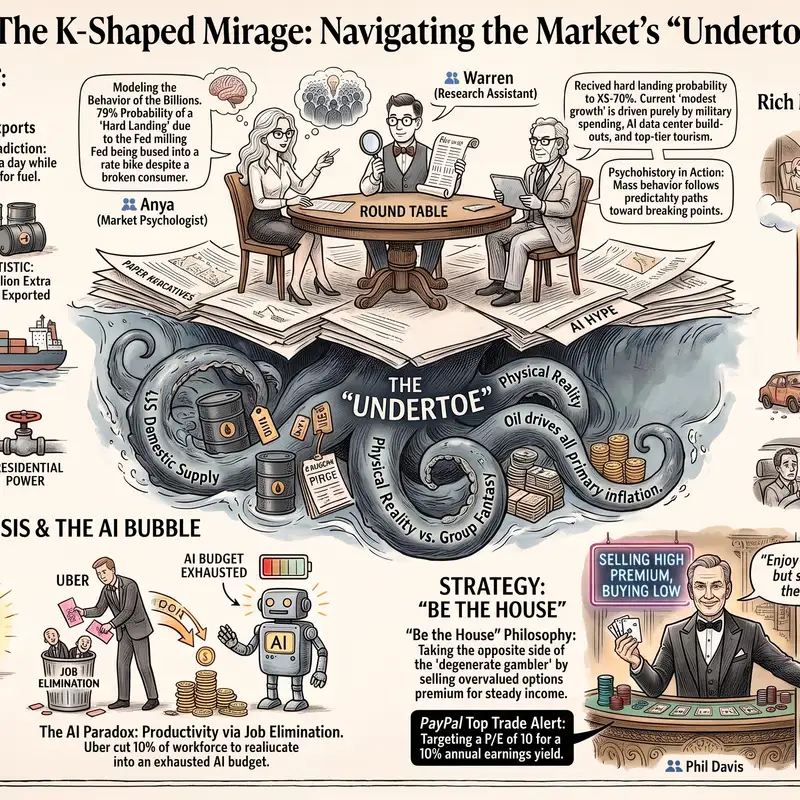
Roy:So Anya is the roundtable's chief market psychologist. Her entire function, her whole reason for being, is to analyze behavioral economics and market sentiment.
Penny:Okay.
Roy:And her read on the current environment is, well, it's incredibly dark.
Penny:Yeah, she does not share Phil's optimism. Not at all.
Roy:During the webinar, she introduces this concept she calls the undertow and she actually spells it t o e, which is a clever reference to the John Irving novel, The World According to Garp.
Penny:Oh, Where the child mishears the word undertow.
Roy:Exactly. The kid thinks there is a literal monster under the ocean water called the undertow, like a giant toe.
Penny:Right. Right.
Roy:And Anya uses that to point out this crucial psychological flaw in investors right now. Because the real undertow isn't some mythical monster, it's the physical reality of the ocean's current.
Penny:But human psychology just desperately tries to ignore that reality.
Roy:Yeah. Until it pulls you under. So Anya argues that the entire market right now is trapped in this, this group fantasy.
Penny:A group fantasy.
Roy:Yeah. She calls it a psycho historical coping mechanism.
Penny:Wow. That's quite a phrase.
Roy:It is. But it perfectly describes how investors are just flat out ignoring, you know, $40,000,000,000,000 in US public debt.
Penny:Just acting like it's not there.
Roy:Completely. And they're ignoring real physical supply chain constraints. Like, we have grain trucks burning in Ukraine, major oil shipment threats in the Strait Of Hormuz.
Penny:But the market doesn't care.
Roy:Right. Instead, they've embraced this deeply comforting narrative that AI is going to just magically fix the economy.
Penny:Like it'll expand supply side forever and solve everything.
Roy:Exactly. Meanwhile, the physical reality, the actual undertow, is that the average consumer is at a breaking point.
Penny:Right. Because real wages for most workers have been flat or even declining.
Roy:Yeah. And credit cards are maxed out just to sustain basic living standards. Personal savings have completely collapsed.
Penny:So the financial gap between this, like, official narrative of an AI utopia and people's actual lived reality at the grocery store.
Roy:It's stretching to a breaking point.
Penny:It really is. It's like everyone in the market is ignoring a violently blinking check engine light just because the radio is playing a really great song.
Roy:That is the perfect analogy.
Penny:But I have to push back on this a little bit. Sure. How does Anya's grim psychological reads square with Phil's total lack of panic? I mean, Anya is literally predicting a 60% chance of a hard economic landing and a 30% chance of what she calls a credibility crack in the central banks yet Phil is sitting there pulling in massive returns. How do those two realities even coexist?
Roy:They coexist because Phil isn't betting on the ship not sinking, he is betting on the math of the lifeboats.
Penny:Oh that's interesting.
Roy:Think about it when a ship starts taking on water human panic is entirely predictable. People will overpay for a spot on a lifeboat.
Penny:Right they panic by safety.
Roy:Exactly. Phil isn't trying to patch the hull of the global economy He is the one selling the lifeboat tickets at a massive premium.
Penny:Wow. Okay. That makes sense.
Roy:His calm comes from his mechanical strategy, you know, we'll break down later. But to truly understand why Anya's check engine light is brinking so hard, we need to look under the hood at the raw numbers.
Penny:Right and for that the webinar turns to another AI persona Zephyr.
Roy:Yes Zephyr, the roundtable's chief macro logician.
Penny:He is basically the data synthesizer of the group.
Roy:Yeah. He crunches all the weekly macro data and his analysis reveals this deeply conflicted economic picture.
Penny:Because on one hand, we just saw a blowout August jobs report.
Roy:Right. The US added 162,000 jobs.
Penny:Which absolutely crushed the 55,000 estimate.
Roy:Crushed it. And July was also revised upward, erasing a previously reported loss. Plus, unemployment held perfectly steady at 4.1%.
Penny:So on the surface, that sounds like a roaring economy. You'd look at that and think everything is great.
Roy:You would, until Zephyr cross references those top line numbers with the Federal Reserve's Beige Book.
Penny:Right, the Beige Book. For some context for you listening, the Beige Book is qualitative ground level data. It compiled from actual conversations with business contacts across all the Fed districts.
Roy:So it tells you what businesses are actually experiencing on Main Street rather than just what the spreadsheets say.
Penny:And what did the Beige Book show?
Roy:It reveals a severely K shaped economy.
Penny:Okay, so a K shaped recovery, meaning the top prong of the K is flying first class and the bottom prong is putting groceries on a credit card.
Roy:That is the exact mechanism. The growth we are seeing is incredibly narrow. The top of the K is being driven almost entirely by defense spending, huge data center build outs for AI, and high end consumers buying luxury goods and traveling.
Penny:But the bottom of the k.
Roy:The bottom of the k, which is everyday retail, hospitality, auto sales, is dropping rapidly because low and middle income consumers are just completely tapped out.
Penny:Let me play devil's advocate for a second here.
Roy:Go for it.
Penny:If the top 10% are still spending heavily on flights and tech, doesn't that just mean the economy has evolved rather than broken?
Roy:That's the counterargument. Yeah.
Penny:Like, is the Fed fighting an inflation ghost that is only hurting half the population, which would make hiking interest rates right now a potentially fatal error?
Roy:Well, Zephyr's analysis points out that this is the exact trap Federal Reserve share Kevin Warsh is caught in right now.
Penny:He's stuck between a rock and a hard place.
Roy:Exactly. Worsch sounded very hawkish at the recent Jackson Hole symposium. He basically signaled that he wants to hike rates to fight this top heavy inflation.
Penny:But the mechanics of a rate hike are brutal here.
Roy:They are. If he hikes rates, he crushes the debt burdened bottom 90% of that K shaped economy even further.
Penny:Right, their credit card payments go up, auto loans become totally unaffordable, small businesses choke.
Roy:Yep. But if he doesn't hike, he risks losing all credibility with the bond market and letting inflation run hot for the wealthy.
Penny:And the market is completely split on what the Fed will actually do. Zephyr points out this fascinating divergence in the data.
Roy:Oh, yeah. The prediction markets versus the futures. Exactly.
Penny:The prediction markets like Polymarket and Calci, where actual retail traders are placing bets, they show a September rate hike as basically a coin flip.
Roy:Sitting right around 51%.
Penny:Right. But the CME Fed watch futures which represent massive institutional money hedging their bets they price a rate hike at nearly 60%.
Roy:Almost a 10 spread. Which brings us back to Anya's concept of the group fantasy.
Penny:How so?
Roy:Well, since AI, data centers, and wealthy consumers are the only load bearing pillars holding up this entire economy, we need to look at the tech sector's actual structural moves.
Penny:Are they building a durable foundation or are they just adding to the fantasy?
Roy:Exactly.
Penny:So let's look closely at NVIDIA because they are the absolute poster child for this AI pillar right now.
Roy:They really are.
Penny:They just confirmed a massive $12,900,000,000 acquisition of a platform called Hugging Face.
Roy:12,900,000,000.
Penny:Huge. And Hugging Face is this colossal AI community boasting 18,000,000 developers and over 3,000,000 hosted models.
Roy:And to understand the magnitude of this deal, you have to look at how it completes NVIDIA's ecosystem.
Penny:Because they already own the hardware side.
Roy:Right. They own the physical hardware market with their specialized AI chips. Yeah. But they also own the software layer through a platform called CUDA.
Penny:CUDA.
Roy:Which which is their proprietary programming platform. When a developer learns to build AI on CUDA, they are essentially locked into buying NVIDIA chips.
Penny:Oh, wow. So it is the ultimate walled garden.
Roy:It really is. And by buying Hugging Face, NVIDIA now owns the entire developer ecosystem as well. They've closed the loop from the physical silicon to the software to the open source community.
Penny:But this deal isn't expected to close until the first half of twenty twenty seven, and it is definitely going to face a massive regulatory review precisely because of how dominant NVIDIA is becoming.
Roy:Oh, antitrust regulators are going to be all over it.
Penny:So is this acquisition actually a defensive move? Like, they trying to build an unassailable moat to lock in developers now before market psychology turns or regulators crack down?
Roy:Zephyr's read is that it is absolutely a defensive moat building exercise. These tech giants know how fragile the current market psychology is.
Penny:Yeah, people are on edge.
Roy:And you can see just how punishing that psychology has become by looking at how traders reacted to the latest tech earnings. Zephyr actually pulled three very practical lessons from the recent earnings prints that illustrate this current mood perfectly.
Penny:Okay. Let's hear them. What's the first lesson?
Roy:The first lesson he highlights is the behavior of Snowflake.
Penny:Right.
Roy:They delivered a flawless quarter. They beat expectations, showed accelerating revenue growth up 37% year over year, and they raised their future guidance.
Penny:And the market rewarded them.
Roy:Big time. The stock jumped 20%.
Penny:So that is classic rational market behavior rewarding a flawless execution.
Roy:Right. But the second lesson is where the psychology gets really warped. Look at Broadcom.
Penny:Broadcom's print was crazy.
Roy:Their AI semiconductor revenue was up an astonishing 221.
Penny:Wow.
Roy:Yeah. They beat literally every metric Wall Street threw at them.
Penny:Wait. So they crushed every metric, but their stock still dropped 6% after the announcement. Why?
Roy:Because their fourth quarter revenue guidance came in at $34,800,000,000.
Penny:Okay.
Roy:Which was just a fraction under the $35,000,000,000 consensus.
Penny:Oh, wow. It's just like the straight A student getting grounded for bringing home a 99% on a final exam.
Roy:That's exactly what it is. There's a massive perfection penalty right now.
Penny:So it shows that at these astronomical being historically great just isn't enough. Any slight miss on future perfection is punished severely.
Roy:That perfection penalty is very real. And it leads to Zephyr's third lesson, which is looking at Dell.
Penny:What happened with Dell?
Roy:Dell beat their earnings per share estimates by 43, their revenue was up 58% year over year, the stock jumped 13% in a single day, and they were subsequently added to the S and P 100 index.
Penny:So they hit absolute perfection?
Roy:Yes. And what these three lessons show is that in a k shaped market, capital aggressively rotates into the absolute strongest, most perfect hands while ruthlessly punishing the slightly less perfect ones.
Penny:And NVIDIA's strategy with hugging face is all about building that defensive fortress before regulators can break them up.
Roy:Exactly.
Penny:But, you know, while the AI sector is trying to avoid the regulatory hammer, the digital asset space is in the exact opposite boat.
Roy:Yeah. They have a totally different problem.
Penny:They are begging for rules, and the lack of them is becoming a systemic risk.
Roy:Which brings in another persona from Phil's AGI team, Quixote.
Penny:Quixote, the chief visionary.
Roy:Right. Quixote ignores the daily price fluctuations and focuses on long range structural foundations.
Penny:And Quiote is looking at this massive dark cloud hanging over the crypto market. I mean, everyone is watching the daily prices of Bitcoin and Ethereum, but the real story is the Digital Asset Market Clarity Act.
Roy:The Clarity Act. Yes.
Penny:This is the bill that is supposed to finally provide rules for the road in crypto, and it is currently just stuck in the mud.
Roy:Completely stalled.
Penny:There is a crucial procedural vote in the senate coming up on September 15 that needs 60 votes just to move forward.
Roy:And the sticking points holding up the bill, they're impartial, but they represent huge structural hurdles.
Penny:What are they fighting over?
Roy:Well, lawmakers are arguing over the specific language for anti money laundering enforcement. That's a big one.
Penny:Okay. That makes sense.
Roy:They're also deadlocked on whether the SEC or the CFTC gets jurisdiction over stablecoins.
Penny:Which is a huge deal.
Roy:Immense because treating a stablecoin as a security under the SEC versus a commodity under the CFTC that requires two entirely different, incredibly complex compliance regimes.
Penny:Right. It totally changes how these businesses operate.
Roy:Exactly. And finally, they are fighting over ethics provisions regarding government officials holding crypto.
Penny:So the odds of navigating all that are pretty bleak. TD Cowen actually estimates a 75% chance of the bill failing entirely.
Roy:Wow.
Penny:Yeah. And Polymarket odds for it passing into law have crashed down to 15%.
Roy:Just 15%. It's basically dead in the water.
Penny:So, mechanistically, what does Quixote see as the fallout if this gridlock continues?
Roy:Quixote warns about a severe systemic impact. If the CLARITY Act fails, the fallback in Washington isn't to just sit down and write a new better bill.
Penny:Right.
Roy:The fallback plan is regulation by enforcement.
Penny:Regulation by enforcement.
Roy:Yeah. And even SEC Commissioner Hester Pierce has publicly criticized this approach. Yeah. Essentially confirming it is exactly what is
Penny:So instead of giving companies clear rules to follow, agencies will just continue to sue crypto companies one by one.
Roy:Exactly. To establish legal precedent through the courts.
Penny:But wait. If we are stuck in a world of regulation by enforcement, doesn't that fundamentally favor the legacy giant?
Roy:Oh, absolutely.
Penny:Because a startup cannot afford a $10,000,000 multiyear legal battle with the SEC just to figure out if their product is legal.
Roy:No way.
Penny:But a major legacy bank with an army of lawyers absolutely can. Doesn't this approach just centralized power in an industry that was built on a decentralized ethos?
Roy:Quixote points out that is exactly the unintended consequence. Regulation by enforcement creates this insurmountable barrier to entry for innovators.
Penny:It just starves the space of new capital.
Roy:Right. And Quixote notes this creates a brutal double headwind for digital assets. Rising interest rates from the Fed pulling liquidity out of the system combined with a total failure of regulatory clarity freezing institutional adoption. It is a structural void that could severely test the market.
Penny:Okay, let's zoom out and pull all these threads together. Let's do it. We have Anya warning about a tapped out consumer and a 60% chance of a hard economic landing. Yep. We have Zephyr outlining a k shaped economy that has the Federal Reserve completely trapped.
Roy:Right.
Penny:We have tech stocks facing a ruthless perfection penalty and crypto staring into a regulatory void.
Roy:It is a lot.
Penny:The environment is chaotic. So how do you actually survive and build wealth when the data looks like this?
Roy:Well, this is where Quixote's visionary lens perfectly highlights the genius of PhilDawaka's core investment strategy.
Penny:This is how Phil stays so calm.
Roy:Exactly. It explains why Phil can sit on a live webinar, look at all this terrifying macro economic data and calmly discuss making triple digit returns.
Penny:Right.
Roy:Phil's golden rule is structurally profound but it's simple: Be the house.
Penny:Be the house. Let's break down how that actually works.
Roy:Okay so, the world of options trading, the vast majority of retail investors act like gamblers walking into a casino.
Penny:Right, they are buying call options or buying put options hoping to hit a jackpot if a stock makes a massive move.
Roy:They're paying huge premiums for the mere chance to be right.
Penny:And Phil's strategy takes the exact opposite side of that trade.
Roy:Yes. He acts like the casino or, you know, the insurance company. He is the one selling those options to the gamblers, collecting those high premiums up front.
Penny:So he relies on mathematical odds?
Roy:Specifically a mechanism called theta decay.
Penny:Let's define theta decay because that is the secret sauce here.
Roy:Theta decay is simply time decay. When a gambler buys an option, they are buying a contract that expires on a specific date. Every single day that passes, that contract loses a little bit of its time value. It just melts away like an ice cube on a sidewalk.
Penny:And Phil structures his trades to profit from that exact mathematical decay.
Roy:Precisely. Just like a casino takes a tiny, guaranteed cut of every spin of the roulette wheel, Phil collects the premium as time runs out on the gamblers.
Penny:So he isn't playing the cards, he is playing the players.
Roy:That is the perfect way to look at it, which fundamentally shifts your entire investing model.
Penny:Because Anya's analysis proved that predicting the macroeconomic future right now is basically feudal, it's a group fantasy.
Roy:Right, so instead of trying to predict the unpredictable, Phil's strategy exploits the inefficiencies in human panic.
Penny:Ah, going back to the lifeboats.
Roy:Yes, people get scared by the undertow, they overpay for options to hedge their bets, They overpay for the lifeboats. And Phil happily collects their premium.
Penny:But he doesn't just do this blindly, right? He anchors this casino math to incredibly strict fundamentals.
Roy:He does. In the webinar, Phil explains that he targets what he calls the chip bullies.
Penny:Chip bullies.
Roy:Yeah, massive stable companies with fortress balance sheets. And his hard rule right now is that he only looks for stocks with a PE ratio, a price to earnings ratio of under 20.
Penny:And that number 20 is not arbitrary?
Roy:Not at all. If you invert a PE of 20, it represents a 5% earnings yield.
Penny:Okay.
Roy:The reason that specific yield matters is because right now, the thirty year US Treasury Bond is yielding roughly 5.28%.
Penny:So, if a company isn't yielding at least 5% in earnings, it mathematically cannot compete with a risk free government bond paying over 5%?
Roy:Precisely. By strictly anchoring his trades to a PE under 20, Phil ensures he is only selling options on assets that are fundamentally undervalued relative to the risk free rate of return.
Penny:So it is a dual layered defense system?
Roy:Exactly. He has the mathematical edge of selling premium and collecting time decay, and it's backed entirely by the structural safety of deep, fundamental value.
Penny:So how can you, listening right now, apply this casino mentality to your own financial life, even if you aren't sitting at a terminal trading complex option spreads all day?
Roy:It is really about a fundamental mindset shift. Right. It means stepping away from speculative bets where you are paying a premium for hope. Whether that means chasing the latest AI momentum stock, trading at evaluation, or buying a crypto token hoping a regulatory miracle happens.
Penny:So what should you do instead?
Roy:Instead, look at the market and ask yourself, where can I be the liquidity provider? Where can I collect a premium for taking on a defined, calculated risk that others are currently too panicked to hold?
Penny:It requires moving your capital from the demanding side of the market to the supplying side.
Roy:Exactly.
Penny:Wow. We have covered a massive amount of ground today.
Roy:We really have.
Penny:We navigated the psychological undertow of a market high on a group fantasy. We looked at the cold, hard, k shaped data trapping the fed between sticky inflation and a consumer breaking point.
Roy:Yeah.
Penny:We examined the fragile perfection required to survive in tech and the structural regulatory voids threatening crypto. And finally, landed on the strategic mindset of being the house.
Roy:Using time decay and strict valuation to exploit the predictable panic of others.
Penny:Right. Because understanding this macroeconomic weather report and the human psychology driving it is what allows you to step away from the slot machines.
Roy:When you understand the physical constraints the market is trying to ignore, you stop reacting to the daily noise and you start acting like the casino owner.
Penny:Keep one hand on the door handle.
Roy:Absolutely.
Penny:But I want to leave you with one final provocative thought to mull over. We talked about standing by the door at that 1AM college party ready to bolt when the lights flash.
Roy:Right.
Penny:But if this current market really is a group fantasy propped up entirely by promises of future AI productivity and the spending habits of the top 10%. What happens to the global economy when the casino itself realizes that chips on the table might be counterfeit?
Roy:Oof. That is a terrifying but essential question to consider.
Penny:It really is. Thanks for taking the deep dive with us.