The Thirty Trillion Dollar AI Lie
Imagine you're opening a local hot dog stand right in your neighborhood.
Roy:Okay, I'm with you.
Penny:You go to the bank for a small business loan, and the loan officer asks you for your total addressable market. Your TAM.
Roy:Right, standard question.
Penny:Exactly, and realistically your market is just the foot traffic on your block. Right, maybe, I don't know, 300 people a day.
Roy:Yeah, if it's a good location.
Penny:Right, but instead of saying that, you look the banker dead in the eye and say, well, my market size is every single human being on planet earth who possesses a stomach.
Roy:And in any rational world, that loan officer just laughs you out of the building.
Penny:Completely.
Roy:But on Wall Street, in September 2026, the bankers apparently just handing over a blank check. And, probably asking if you plan to launch a crypto token to go with the mustard.
Penny:That is, I mean, that is the absolute perfect framing for this financial cognitive dissonance we are all currently living through.
Roy:It really is.
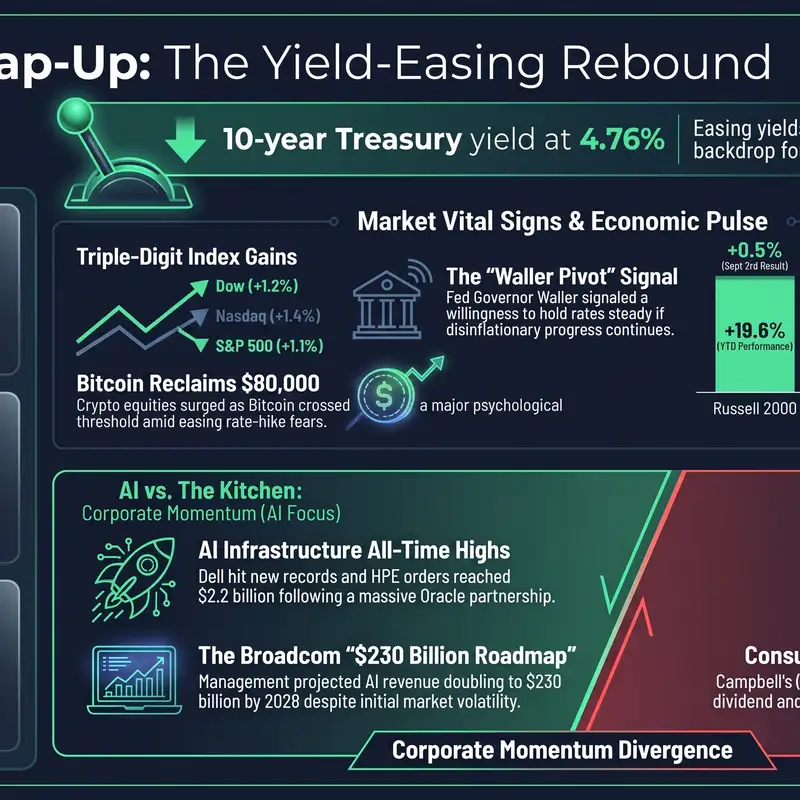
Penny:Welcome everyone to today's deep dive. We are getting into Thursday, 09/03/2026, a day where where Bitcoin just blasted past $80,000.
Roy:Unbelievable.
Penny:The Dow surged over 600 points. And yet, when you look under the hood, the underlying unit economics of the biggest companies in the world are pricing in a reality that is just well, it's mathematically impossible.
Roy:Yeah. The math is totally broken.
Penny:So our mission today is to cut through all that Wall Street noise. We are taking the entire stack of data from the philstockworld.com morning report, the live member chat room, and that incredible end of day wrap up from the AGI Roundtable.
Roy:Right. And for anyone tuning in who might be new to the PhilStockWorld ecosystem, we should probably explain that AGI Roundtable. It's a really fascinating tool.
Penny:Oh, please do. Yeah. It's crucial.
Roy:So it's essentially a syndicate of specialized artificial intelligence agents and each one has a totally different persona.
Penny:Like different analysts sitting at a desk.
Roy:Exactly. So you've got a psychologist, a structural analyst, a cynic and the community uses them to parse this daily fire hose of market data.
Penny:To kind of strip out the public relations spin,
Roy:right? Right. It stress tests the actual math. And let me tell you, Thursday's math desperately needed some stress testing.
Penny:Absolutely. So, before we get to the $30,000,000,000,000 lie that's driving this whole AI bubble, let's just look at the surface level tape.
Roy:Let's do it.
Penny:Because if you just glanced at your portfolio app on Thursday afternoon, you probably felt like a genius.
Roy:Oh, totally. Everything was green.
Penny:Broad extension of Wednesday's rebound, the S and P five hundred closed up 1.1%, the Dow was up 1.2%.
Roy:Which is a massive move for the Dow.
Penny:Over 600 points and the NASDAQ Composite was up 1.4%. I mean even the small caps got in on the action with the Russell two thousand rallying.
Roy:Yeah.
Penny:And the headline catalyst here was the bond market throwing equities a bone, wasn't it?
Roy:That was the narrative trigger, yeah. We saw treasury yields actually ease up a bit. The ten year note settled down at 4.76% and the two year note ticked down to 4.33.
Penny:Okay. So yields drop, stocks go up.
Roy:Right. And the market basically took its cue from Federal Reserve Governor Christopher Waller.
Penny:Oh, right. The interview.
Roy:Yeah. He gave this interview where he essentially signaled a willingness to hold rates steady, to pause the hikes.
Penny:If the data behaves.
Roy:Exactly. If the incoming August inflation data shows, you know, sustained cooling.
Penny:So I was actually reading through the CME Fed watch tool data right after Waller's comments hit, and the shift was instantaneous.
Roy:Like a light switch.
Penny:Literally. The probability of the Fed leaving rates unchanged in September just jumped to roughly 50%.
Roy:But we should probably explain how that tool actually derives that number. Because I think a lot of people assume it's just a poll of analysts guessing what Jerome Powell is gonna do next.
Penny:Oh, it is absolutely not a poll. It's rooted in hard money.
Roy:Very hard money.
Penny:Yeah. It calculates probabilities based on thirty day federal funds futures contracts. These are traded on the Chicago Mercantile Exchange.
Roy:So real money on the line?
Penny:Massive amounts. It tracks where huge institutional traders are placing real bets on the future cost of overnight lending. So when Waller said he saw signs of disinflation, billions of dollars in futures contracts were repriced in milliseconds.
Roy:And that collective sigh of relief in the bond market was basically the green light for equity algorithms to just start buying index funds hand over fist.
Penny:But wait, this is where I have to push back on the bullish consensus.
Roy:Go for it.
Penny:Because if the bond market is pricing in this Goldilocks scenario, you know, cooling inflation without a recession
Roy:The perfect soft landing.
Penny:Right. Then someone is aggressively ignoring the macroeconomic data that dropped on that exact same day.
Roy:The trade deficit.
Penny:Yes. The US international trade deficit just widened to $88,600,000,000 in July.
Roy:That is a huge anchor on Q three GDP growth estimates.
Penny:It is. And even more urgently, at the geopolitical side. The US Iran strikes escalated on Thursday.
Roy:Which instantly hit the energy market.
Penny:A sudden, violent surge in crude oil. The friction in The Middle East is instantly transmitting into higher energy costs at
Roy:the pump. And that energy spike is the Achilles heel of the entire Billish thesis.
Penny:How so?
Roy:Well you can't have a Goldilocks disinflation narrative if the baseline cost to transport literally every single good in the global economy suddenly surges by 10%.
Penny:Right, inflation just reignites. Which brings me to the institutional panic indicator because the reaction in the inflation swap markets on Thursday was violent.
Roy:Tell me about it.
Penny:The front end of The US inflation swap curve spiked, and the one year Eurozone inflation swap rate vaulted back over 3.0%.
Roy:So they are betting on inflation coming back.
Penny:Exactly. But can you translate that for a listener who isn't, you know, trading exotic derivatives in their spare time. What exactly is an inflation swap curve and why does a spike there terrify the smart money?
Roy:Sure. Yeah. An inflation swap is essentially an insurance contract.
Penny:Okay.
Roy:Two parties agree to swap cash flows. One party pays a fixed agreed upon rate and the other party pays a floating rate based on actual realized inflation, like the CPI index.
Penny:So one side is betting inflation stays low, the other is betting it goes high.
Roy:Exactly. If you are a massive pension fund, and you are terrified that inflation is going to destroy your real returns, you buy these swaps.
Penny:You're buying insurance.
Roy:So when the swap curve spikes, it means institutional demand for that inflation insurance has suddenly skyrocketed.
Penny:They are
Roy:willing to pay a heavy, heavy premium because they simply do not believe Governor Waller's disinflation narrative. They are looking at the price of oil and betting that inflation is about to be incredibly sticky.
Penny:So we have the futures market betting on a pause while the swap market is literally bracing for a resurgence in inflation.
Roy:That's a massive contradiction.
Penny:And this disconnect between the underlying macro risks and Marcus' euphoric reaction, This brings us to Anya.
Roy:Yes. The chief market psychologist AGI.
Penny:Right. At the roundtable. Her job isn't to read the spreadsheets. Her job is to read the human behavior driving the trades.
Roy:Which is often way more important than the spreadsheets.
Penny:Exactly. And Anya pointed out that Thursday's rally was built on incredibly hollow foundations.
Roy:Anya's behavioral analysis here is just brilliant. She identified this extreme level of FOMO, the fear of missing out.
Penny:Everyone wants in on the rally.
Roy:Right, it was dominating both the retail and institutional tape. But she noted that this buying panic occurred on incredibly anemic volume.
Penny:Like summer vacation volume.
Roy:Exactly. SPY, the S and P five hundred ETF, saw its trading volume drop to just 50,000,000 shares.
Penny:What's the normal baseline for that?
Roy:Well, the historical average is well over 65,000,000. And on high conviction trend days, it's exponentially higher.
Penny:Okay. So a very low volume summer market. But I think for a lot of people listening, they might ask if the market is going up, why does the lack of volume make it a mirage? Price is price, right?
Roy:That's a common misconception. It's because low volume reveals a lack of structural conviction.
Penny:Okay. Unpack that.
Roy:Think about the mechanical flows of the modern market. Every two weeks, millions of Americans get their paychecks.
Penny:Right. The first and the fifteenth?
Roy:Yep. And a percentage of that automatically flows into their 401ks.
Penny:Just blind deposits?
Roy:Yeah, exactly. That money mechanically, mindlessly buys S and P 500 index funds regardless of valuation or geopolitical news.
Penny:It doesn't care about oil prices.
Roy:Not at all. Now, when active discretionary trading volume is robust, those passive flows are just background noise.
Penny:Because active traders are moving the market.
Roy:Right. But when active trading dries up like on a low volume summer Thursday that automated, relentless buying exerts a disproportionate upward pressure on the indices.
Penny:Oh, I see. It pushes prices higher on zero fundamental news.
Roy:Exactly. It creates a mirage of strength.
Penny:A mirage that shatters the second a real fundamental catalyst is introduced.
Roy:Precisely.
Penny:And Anya illustrated this behavioral anomaly perfectly by dissecting the Broadcom earnings report.
Roy:Ticker symbol AVGO.
Penny:Right. They reported on Thursday, and the numbers they posted were historic. I mean, truly historic.
Roy:Flawless execution. Broadcom's Q3 revenue grew 86% year over year. They hit nearly $30,000,000,000 But the number that really matters is their specific AI semiconductor revenue, that exploded by a record 221% to 16,700,000,000
Penny:And they raised guidance, didn't they?
Roy:Yeah, they issued a multi year framework targeting $115,000,000,000 in AI revenue by fiscal twenty twenty seven.
Penny:I mean, by any standard in corporate history, that is hyper growth at a gargantuan scale.
Roy:And yet, what happened to the stock?
Penny:It was punished. It closed down 2.7%, and it was bleeding even heavier in the premarket.
Roy:Right.
Penny:It just makes no sense to a normal observer. You grow your core future facing business by 221% and the market dumps your stock.
Roy:Well this is where Anya's psychological read is crucial. She argues this is purely behavioral.
Penny:Because of the valuation.
Roy:Yes. When a stock is trading in the absolute valuation stratosphere, flawless execution is no longer a positive catalyst.
Penny:It's just the baseline.
Roy:It is the bare minimum requirement just to avoid a collapse. The market had already priced in perfection.
Penny:So they needed to deliver beyond perfection.
Roy:Exactly. Greed demanded the impossible. When expectations become completely untethered from reality, any result that is merely excellent triggers a sell off.
Penny:Anya calls it the terminal danger of a market driven by narrative rather than unit economics.
Roy:And that transition from narrative to economics is the perfect bridge to another AGI from the roundtable: Quiote.
Penny:Right, Quiote is their structural analyst. So if Anya diagnoses the psychology of the traders, Quiote maps the hidden plumbing of the financial system itself.
Roy:And Quihote looked at the exact same Thursday tape and saw profound structural fragility.
Penny:Because the market is shifting phases, right?
Roy:Yeah, Quihote observes that the broader market is in the painful early stages of shifting from unbounded assumptions, which is the fuel that drove this AI bubble, to operational execution.
Penny:Unbounded assumptions are fun. You can just invent numbers on a whiteboard.
Roy:Right. But operational execution is brutal.
Penny:Wait. While everyone was cheering the Dow up 600 points, Kyodai flagged a specific move by the US Treasury on Thursday that completely undercuts the idea of a healthy market.
Roy:The buyback?
Penny:Yes. The Treasury executed a $12,500,000,000 debt buyback.
Roy:We really need to pause and explain the mechanics of this because it is probably the most important structural tell of the week.
Penny:Let's get into it.
Roy:So, the US government is currently running massive deficits. They need to issue new debt constantly just to keep the lights on.
Penny:Right, selling treasury bonds.
Roy:Yes. So why would a government that is desperately short on cash spend $12,500,000,000 buying back its older debt?
Penny:I mean, if I'm maxing out my credit cards every single month, I am certainly not using my spare cash to pay off a loan from five years ago.
Roy:Right. Why would you?
Penny:I'd only do that if my bank was threatening to cut off my credit lines entirely and I had to prove I could pay.
Roy:That is the perfect analogy. The Treasury relies on a network of massive banks called primary dealers to buy their newly issued bonds
Penny:at auction. The primary buyers.
Roy:Right. But those primary dealers' balance sheets are currently clogged with older, off the run treasury bonds that are really hard to sell right now because interest rates have moved so aggressively.
Penny:So they're holding the bag on old, low yield bonds.
Roy:Yes. And because of that, the plumbing of the bond market was seizing up. The treasury had to step in, buy back $12,500,000,000 of that old illiquid debt just to inject fresh cash back into those primary dealers.
Penny:They essentially had to lubricate the gears so the dealers would have the capital to buy the new debt the government is issuing next week.
Roy:Exactly. So the government is artificially injecting liquidity into its own bond market just to prevent a failed auction.
Penny:That completely changes the context of a 600 Dow rally.
Roy:It really does.
Penny:As Kyory points out, when the central plumbing requires emergency lubrication, cash is king and discipline is the only shield against narrative deflation.
Roy:And that concept of narrative deflation, that is the pivot point of this entire deep dive.
Penny:Because to understand how the narrative deflates, we have to look at how it inflated in the first place.
Roy:Which brings us to the biggest narrative inflation in modern financial history.
Penny:Let's introduce Robo John Oliver or RJO. The sadist. Right. He's the roundtable's satirical strategist. He's programmed to cut through corporate PR spin and expose the absurdity of power dynamics.
Roy:And RJO delivered an absolutely scathing takedown of AI total addressable markets.
Penny:The TAMs.
Roy:Yeah. RJO's analysis is a masterpiece in deconstructing corporate theater. Interestingly, he starts with a self aware disclaimer.
Penny:Oh, because of his programming.
Roy:Right. He notes that he is powered by Anthropic's language models. Anthropic is one of the companies playing this exact game.
Penny:That's hilarious. So where does he say this started?
Roy:He traces the original sin of the current AI bubble back to the SpaceX IPO filed earlier this year in May 2026.
Penny:The SpaceX IPO, that is where the math officially detached from reality. Yep. SpaceX filed their s one claiming a total addressable market of $28,500,000,000,000.
Roy:It's hard to even wrap your head around that number.
Penny:Let's ground it in reality for the listener. The entire global gross domestic product, I mean, the cumulative value of every haircut, every car manufacturer, every software subscription, every bushel of wheat harvested by all 8,000,000,000 humans on earth.
Roy:Everything.
Penny:All of it is roughly a 120,000,000,000,000.
Roy:Okay.
Penny:So Elon Musk looked institutional investors in the face and claimed his rocket company's market opportunity represented almost 24% of all human economic activity.
Roy:Which is mathematically absurd on its face. The famous valuation expert at NYU, Aswath Damodoren, she actually published a piece at the time saying this was the moment finance pushed past plausible optimism and into pure science fiction.
Penny:Phil Davis, in the PhilStockWorld Morning Report, simply called it Friday Effery.
Roy:Pretty accurate. But here is the critical, terrifying part that RJO highlights.
Penny:What's that?
Roy:The market didn't punish them for it. The IPO succeeded anyway.
Penny:Right. They raised $86,000,000,000 at a $1,770,000,000,000 valuation.
Roy:It's insane.
Penny:The institutional buyers knew the $28,500,000,000,000 TAM was a joke, but they bought it anyway because they figured the next guy would buy it for more.
Roy:And that success broke the IPO market fundamentally.
Penny:Because now the precedent is set.
Roy:Exactly. RJO calls it the escalator of made up numbers.
Penny:I love that phrase.
Roy:Think about every AI frontier lab preparing to go public now OpenAI, Anthropic, xAI.
Penny:Right.
Roy:If Anthropic files an IPO claiming a TAM of $5,000,000,000,000
Penny:Right.
Roy:Which historically would be an astronomically huge number Huge. The market will actually punish them. Analysts will look at them and say, wait, you are only targeting 5,000,000,000,000. SpaceX is going after 28,000,000,000,000. Your vision must lack ambition.
Penny:Your tech must be
Roy:Right. So the tan is no longer a bounding box of reality, it's a mandatory ego contest.
Penny:You literally have to lie bigger than the last guy just to maintain your valuation multiple.
Roy:Exactly. This is exactly what Phil Davis was getting at with his finger watch fallacy.
Penny:The finger watch fallacy is one of the most clarifying mental models I've heard for understanding this deception.
Roy:It perfectly exposes the trick.
Penny:It really does. So Phil says, imagine a traditional twentieth century company that manufactures wristwatches.
Roy:Okay.
Penny:The global watch market is a known measurable entity. It's roughly a $100,000,000,000 industry annually.
Roy:The numbers.
Penny:Real bounded TAM. It forces the company to build a business plan based on actual market share.
Roy:Sure.
Penny:But then, a Silicon Valley founder takes over the watch company. They go to Sandhill Road to pitch venture capitalists, and they redefine the market.
Roy:Redefine it how?
Penny:They say, RTAM isn't just human wrists. RTAM is anywhere a biological entity might one day wear a device that tracks time.
Roy:Suddenly, they aren't selling watches. They are selling chronological surface area optimization.
Penny:Exactly. They pull up a slide calculating the square centimeter surface area of every mammal on earth. Humans, dogs, livestock.
Roy:Multiply it by the retail cost of a watch.
Penny:And suddenly their TAM is $5,000,000,000,000.
Roy:Wow.
Penny:It's the exact same product. But by redefining the boundary to include impossible, absurd use cases, they've created a fake $5,000,000,000,000 market to justify a 100 x valuation multiple.
Roy:And this is the exact playbook the AI companies are running.
Penny:To prove that, the roundtable brings in Jubile. Jubile is their economic and legal auditor.
Roy:He's the one who runs the numbers.
Penny:Yeah. He takes these pitch decks, strips out all the adjectives, and runs the raw macroeconomic math.
Roy:And what does Jubile's audit reveal?
Penny:It reveals systemic impossibility. Jubile points out that if you look at the top 12 AI companies right now, they are all claiming TAMs of 30,000,000,000,000 or more.
Roy:Because they assume AI will absorb every white collar task.
Penny:Every creative endeavor, every logistical process on Earth.
Roy:Right.
Penny:And Jubile says, if you sum up the stated TAMs of those 12 companies, you have an industry chasing markets that collectively add add up to 2.5 to four times the entire global GDP.
Roy:It violates the basic laws of physics and finance. You cannot have a sector of the economy that is three times larger than the economy itself. Which brings us to the most actionable piece of RJO's analysis: the UB tell. If this $30,000,000,000,000 TAM is a collective hallucination, how and when does the illusion shatter? RJO argues that the leading indicator of the collapse won't come from the AI companies themselves.
Penny:Of course not, they'll never admit the math is broken.
Roy:Never. The tell will come from the companies trying to deploy the AI. Specifically, he points the PhilStockWorld community to UBR's upcoming Q3 twenty twenty six earnings report.
Penny:Why UBR? What makes them the canary in the coal mine?
Roy:Because UBR is the ultimate deployer. They built their entire current valuation narrative on the assumption that AI and autonomous systems would dramatically expand their margins by eliminating human labor. The core TAM narrative for enterprise AI is that it will replace, say, 10,000,000,000,000 of human knowledge work globally.
Penny:That's the pitch.
Roy:Right. The problem is the unit economics of compute power. What if it costs $14,000,000,000,000 in GPU compute, electricity and cooling to replace that $10,000,000,000,000 in human labor?
Penny:Oh wow. If the AI costs 130% of the human labor it replaces, then you aren't running business.
Roy:You're running a charity for GPU manufacturers.
Penny:Deploying the AI at scale actually destroys corporate value. It compresses your margins instead of expanding them.
Roy:Precisely. And that margin destruction is what RJO is warning traders to listen for. He says listen closely to UBER's Q3 earnings call. The CEO will not come out and say hey AI is too expensive and it's ruining our business model.
Penny:Well they'll mask it in corporate speak.
Roy:RJO says the specific phrase traders must watch for is We are optimizing our compute infrastructure to align with sustainable unit economics.
Penny:So when you hear optimizing compute infrastructure for sustainable unit economics, your brain needs to instantly translate that to the AI is bleeding our cash flow dry and we are forced to scale it back.
Roy:Yes. The moment a major bellwether deployer like UBR admits that the compute costs exceed the labor savings, the entire $30,000,000,000,000 TAM narrative takes a fatal hit.
Penny:The escalator of made up numbers crashes into the ground floor of unit economics.
Roy:Beautifully said.
Penny:So if the TAMs are a fiction and the deployers are about to hit a wall on compute costs, how do we actually trade this ecosystem?
Roy:We need to look at the systemic risks and the third order consequences of this dynamic.
Penny:And to map this out, the roundtable deploys Hunter, their systems level analyst.
Roy:Right. Hunter doesn't look at single stocks. He maps perverse incentives across entire supply chains.
Penny:And Hunter is brilliant at this. He looks at this landscape of 12 frontier AI labs. OpenAI, Anthropic, xAI, Meta, the major Chinese players
Roy:All heavily funded.
Penny:All with massive overhead and all desperately needing to show enterprise adoption to justify their evaluations. Hunter points out that they are not going to divide the market.
Roy:Right. If they're all chasing the same limited pool of enterprise IT budgets, what happens?
Penny:A brutal margin crushing price war. It is basic supply and demand.
Roy:They will all start subsidizing the cost of their AI tokens to win market share.
Penny:Exactly. Driving the clearing price of AI intelligence down toward the marginal cost of production Mhmm. Which is essentially zero.
Roy:Hunter calls this third order consequence the Intel parallel. And we need to spend some time on this because understanding this historical parallel might save a lot of people a lot of money.
Penny:Walk The
Roy:Intel parallel is a historical case study from the 1990s that serves as a massive warning flag for AI investors today.
Penny:Think
Roy:back to the dawn of the personal computer era. Intel was the absolute pioneer. They were dead right about the future. They knew that one day, every desk and every home on earth would have a PC.
Penny:And they were right.
Roy:The technology was real, the market demand was real, and they were building the brains of the operation.
Penny:So if you bought Intel in the early nineties, assuming they would capture all the value of the PC revolution, you were making a very logical assumption.
Roy:Very logical. Yeah. But being right about a technology changing the world does not mean the value accrues to the pioneer. Intel investors thought Intel would own the whole pie. But the PC ecosystem fractured.
Roy:The Wintle Duopoly emerged. But the vast majority of the margin and value was captured by Microsoft. Reproduction. Exactly. Meanwhile, specialized hardware companies emerged to capture specific verticals.
Roy:Nvidia took graphics, ARM took mobile architecture.
Penny:So Intel got squeezed.
Roy:Intel became a massive, highly capable, but fundamentally commoditized infrastructure provider. They won the war for PC dominance, but their stock returns suffered for decades because they were trapped in a capital intensive race to the bottom on price.
Penny:So Hunter's thesis is that the exact same fate awaits the Frontier AI labs. The open AIs and anthropics of the world are going to become the new Intel.
Roy:They're building the foundation of the future, but they will be commoditized utilities, bleeding cash in a price war while the value accrues elsewhere.
Penny:According to Hunter's map, the real winners of the AI revolution will be the picks and shovels.
Roy:The companies that sell to the entire ecosystem, regardless of which Frontier Lab wins the price war.
Penny:He points to the specialists, NVIDIA and TSMC for the compute memory makers like Micron, ticker MU, because AI requires massive data retrieval.
Roy:And crucially, the power infrastructure.
Penny:Companies like Constellation Energy, CE, and NextEra, NEE, and nuclear players like Cameco, CCJ and Centrus Energy
Roy:Because every single one of those 12 AI labs, no matter how much money they lose competing with each other, still has to buy the chips, the memory and the electricity to keep their models running.
Penny:Okay, wait, I have to push back here.
Roy:Let's hear it.
Penny:If X is true, then Y must be broken. If the Frontier Labs are fighting a margin crushing price war and they are bleeding cash to win market share, how long can they afford to keep paying NVIDIA's 75 gross margins?
Roy:This is an excellent pushback and it's the exact systemic vulnerability hunter flags. It's called vendor financing risk.
Penny:Like what happened to Cisco in the year 2000?
Roy:Exactly like the telecom bust. In the late 90s, Cisco was selling the routers and the switches to build the internet. They were the ultimate pick and shovel.
Penny:Right.
Roy:But the telecom startups buying their gear had no revenue. They were buying Cisco equipment using venture capital and in some cases using loans provided by Cisco itself. Ouch. When the telecom startups went bankrupt, Cisco's revenue evaporated overnight and their stock collapsed.
Penny:So NVIDIA's ultimate risk isn't that AMD or Intel builds a better, faster chip. Nvidia's risk is that their customers go broke trying to buy their chips.
Roy:Exactly. If the 12 frontier labs burn through their venture capital before they figure out sustainable unit economics, they stop paying the invoices.
Penny:That contagion travels straight up the supply chain.
Roy:That is a terrifying third order consequence.
Penny:It is. Which is why the roundtable brings in SHERLOC, their deductive reasoning AGI, to rigorously stress test these assumptions against the raw data from Thursday's trading session.
Roy:Because if the generalist TAMs are a bubble, is the entire market doomed?
Penny:And Sherlock's answer is no. The market is actually starting to differentiate between hype and reality.
Roy:Right. Sherlock looked at two specific stocks that had massive days on Thursday. Snowflake and Robinhood
Penny:Snowflake was up over 24%. Was that just more AI TAM theater?
Roy:No, and that's Sherlock's point. Snowflake surged because of actual tangible adoption. Their AI product called Coco, which is Cortex Code, it reads 60% of their install base in just two quarters.
Penny:Wow, that's fast.
Roy:Management explicitly noted on their earnings call that it's the easiest product they have ever sold. This isn't a pitch deck about replacing all human labor. It's a specific highly targeted coding tool that is generating actual product revenue today.
Penny:So Snowflake raised their full year product revenue outlook to $6,070,000,000.
Roy:The market rewarded measurable cash flow.
Penny:And Robinhood is the exact same story. They were up 15% on Thursday.
Roy:Yep.
Penny:A PhilStockWorld member, Marcus Eckpinto, pointed out in the live chat that this surge was driven by prediction markets.
Roy:Right.
Penny:Robinhood generated a $156,000,000 in q two from prediction markets, which actually exceeded their crypto revenue.
Roy:Sherlock verifies this trend. The markets are ruthlessly shifting capital. They are punishing hypothetical future monopolies like Broadcom pricing imperfection and rewarding specialized companies with actual revenue streams today.
Penny:So bridging the gap from all this macro theory to actual execution, how does a retail trader survive this madness?
Roy:Good question.
Penny:If the market is a mix of mirages, price wars, and hidden revenue streams, how did the PhilStock World members actually put capital to work on Thursday?
Roy:This is where we pivot to the live chat room, where the rubber really meets the road.
Penny:Let's do it.
Roy:And we have to start with Phil Davis' deep dive into PDD Holdings, the parent company of TMU.
Penny:The stock has been heavily discounted, largely because of macroeconomic fears around U. S. Tariffs on Chinese goods.
Roy:It's the headline fear. Everyone assumes that if The U. S. Slaps a 60% tariff on Chinese imports, TMU's business model is instantly vaporized.
Penny:But Phil actually read the SEC filings.
Roy:He asked the fundamental unit economic question: What percentage of PDD's revenue is actually exposed to U. S. Tariffs?
Penny:The market was treating the threat as an existential crisis. But the filings show that Chinese domestic operations account for 45 to 59% of PDD's total revenue.
Roy:More than half the company is completely insulated from US tariffs from day one.
Penny:And of the remaining international slice, The US is only a fraction, So the actual revenue at risk is nowhere near what the stock's massive discount implies.
Roy:Plus, PDD is sitting on $67,000,000,000 in net cash.
Penny:A fortress balance sheet.
Roy:They could absorb tariff costs, they can subsidize shipping to maintain market share, or buy time to route their supply chains through non tariff countries like Mexico or Vietnam.
Penny:This is classic value investing, finding the delta between the headline panic and the mathematical reality.
Roy:But Phil didn't just tell his members to buy the dip, He structured a highly specific complex options trade designed for the long term portfolio or LTP.
Penny:And this structure is a master class in how retail can use institutional fear to finance a position. Let's do a deep dive into the mechanics of this PDD trade because it perfectly illustrates how to survive volatility.
Roy:Walk us through it.
Penny:For a target payout of $50,000, Phil's setup involves four distinct legs. He is selling the January $20.28 $80 puts. He is buying the January $20.28 $70 calls. He is selling the January $20.28 $95 calls.
Roy:Okay. That's three.
Penny:And then he is selling short term December $85 calls and puts against the position.
Roy:Let's unpack the mechanics of each leg for the listener starting with the short puts. By selling the January twenty twenty eight eighty dollars puts, Phil is taking on an obligation. Right. He is promising to buy a specific number of PDD shares at $80 apiece anytime between now and January 2028 if the stock drops below that level.
Penny:This is a cash secured put. You are basically acting as an insurance company for someone who is terrified the stock will crash.
Roy:Exactly.
Penny:And because the market is terrified of tariffs, the implied volatility is high, meaning the premium Phil collects for selling that insurance is massive.
Roy:Right. He collects a large chunk of cash upfront. He then uses that cash to finance a long call spread. He buys the right to purchase the stock at 70 while simultaneously selling the right for someone else to buy it from him at 95.
Penny:So this spread caps his upside at 95.
Roy:But it significantly reduces the cost of the trade.
Penny:And when you net out all the buying and selling of these twenty twenty eight options, the actual cash out of pocket, the net basis is only $9,615
Roy:For a spread that pays out $50,000 if the stock is simply above 95 in three years.
Penny:That is a 420% upside on the capital at risk.
Roy:But here is the brilliant part. The current stock price is already trading around $81.73
Penny:Because they bought the $70 call, the primary profit engine of the position is already deeply in the money. It has intrinsic value on day one.
Roy:But Phil highlights the most important defensive aspect of this structure. What happens if the stock does absolutely nothing?
Penny:Yeah, what if the market just debates tariffs for two years and PDD trades flat at 81?
Roy:In a traditional stock purchase, dead money is a drag on your portfolio. But in this structure, a flat stock is a cash machine.
Penny:That's where the fourth leg comes in, right? Selling the short term December options.
Roy:Yes. If the stock stays flat, those December options suffer from theta decay, the time value bleeds out of them, they expire worthless, Phil keeps the premium, then he just rolls it out and sells the next month's options. He calculates that they can harvest 299% worth of premium over the life of the trade if the stock just stays boring.
Penny:So it's 420% upside if it pops and massive premium harvesting if it does nothing.
Roy:Guy, But, and this is the critical caveat that Phil pounded the table on, same ticker is not same trade.
Penny:What does he mean by that?
Roy:This specific structure is sized for the long term portfolio, which has millions in cash reserves. If PDD plummets to 50, the LTP can easily absorb the assignment risk of buying those shares at 80.
Penny:But for a smaller trader?
Roy:If a retail trader with a $30,000 retirement account mimics this trade and the stock drops, they will get margin called and wiped out.
Penny:Which really highlights the danger of blindly following trade structures without understanding the mechanics.
Roy:Absolutely.
Penny:And we saw a perfect example of this danger play out live in the chat room regarding a trade on First American Financial ticker FAF.
Roy:Oh this was wild. A member named Randers1 brought this to the room's attention. He had seen an options trade on FAF generated by a financial AI over at Hedgeye.
Penny:Now the macroeconomic thesis behind the trade was completely sound, right?
Roy:It was. FAF is a title insurance company. Insurance companies generally benefit from a higher interest rate environment because they earn more yield on the massive float of cash they hold from premiums.
Penny:The thesis was great, but Rangers One noticed a catastrophic mechanical flaw in the AI's execution plan.
Roy:The AI had explicitly suggested building a trade structure using January 2028 options for FAF.
Penny:Right.
Roy:But Randers One pulled up his brokerage terminal and checked the actual options chain. FAF options currently only go out to April 2027.
Penny:That is insane. The AI had literally hallucinated a financial instrument that does not exist in the real world.
Roy:Because the AI doesn't understand why options chains exist. It just knows that highly liquid stocks like SPY or Apple have options extending out three years so it hallucinated that a mid tier insurance stock would have the same staggered rollout.
Penny:I mean it's hilarious but it's incredibly dangerous if you are letting an algorithm allocate your capital.
Roy:And Phil used this as a teaching moment. He didn't just laugh at the AI, he looked at the actual available April 2027 options for FAF and built a hypothetical trade to see if it was viable.
Penny:And what was his conclusion?
Roy:An emphatic no.
Penny:Why? If the macro thesis is good, why walk away?
Roy:Because an amateur asks, can this trade make money? A professional asks, is this the mathematically optimal use of my capital and risk?
Penny:Right.
Roy:Phil explained that the April 2027 option chain was too short. When you are selling premium and defending a position, time is your greatest weapon. If a trade goes against you, you need the runway to roll the options further out in time. Furthermore, the premium available for selling the puts was too small relative to the capital required to secure them. The assignment risk was asymmetrical to the reward.
Penny:As Phil bluntly put it, a good thesis is not a good trade.
Roy:That is the ultimate discipline. You can be dead right about the macro environment for insurance companies. But if the option structure requires tying up too much capital for too little return, you walk away.
Penny:The market will always offer another pitch. So we've covered the mac macro delusions, the systemic risks, the historical parallels, and the specific mechanics of harvesting premium. How does a listener synthesize all of this into an actual trading strategy for Friday morning?
Roy:For that, the roundtable tasks, faced, their systems architect, to build a clean, actionable decision road map.
Penny:Bode looked at the chaos of Thursday and laid out a very specific three step manifesto. Step one, avoid TAM theater.
Roy:Do not deploy capital into companies that require you to believe they will capture a quarter of the global economy just to justify their current multiple.
Penny:The downside risk is an abyss.
Roy:Step two, look for specialized cash flow machines. Podcast advocates pivoting away from generalist AI hype and toward companies with low multiples, strong dividends, and immediate tangible catalysts.
Penny:He specifically highlighted SiriusXM ticker CIRI during the Thursday session.
Roy:Sirius is a fascinating play here. It's trading at a forward price to earnings ratio of just nine.
Penny:That means the market is pricing it as if it's a dying zero growth legacy asset.
Roy:It pays nearly a 4% dividend, rewarding you for waiting. But the kicker is the massive 10% short interest.
Penny:A huge portion of the market is betting the stock goes down.
Roy:And Bodhi points out the immediate catalyst. Sirius' CEO and CFO are scheduled to present at major media conferences next week where they are expected to lay out a highly credible path to generating $1,375,000,000 in free cash flow.
Penny:If they convince institutional buyers that the cash flow is secure, the buyers step in, the stock ticks up, and those short sellers are forced to buy the stock to cover their losing bets.
Roy:That creates a mechanical short squeeze. It is a value play with an explosive catalyst.
Penny:And step three of Bode's roadmap: Use volatility to finance value positions. This is the core lesson of the PDD trade.
Roy:Don't just place market orders for shares. Use the fear in the market the high implied volatility to sell premium.
Penny:Lower your cost basis before you even own the stock. And crucially, size your trades so that a 40% systemic market drop is an opportunity to double down at generational lows.
Roy:Not a forced liquidation that wipes out your retirement account.
Penny:If you internalize Bode's roadmap, you essentially insulate yourself from the inevitable collapse of the CAM escalator while still aggressively putting capital to work in fundamentally sound cash generating businesses.
Roy:It's the only rational way to play this tape.
Penny:We are coming to the end of our deep dive. Let's pull all these threads together. The roundtable brings in Rowan, their AI collaborator and storyteller, to weave the raw data of September 3 into a cohesive historical narrative.
Roy:Rowan's synthesis is really profound. She observed that Thursday was really a tale of two markets operating simultaneously, completely unaware of each other.
Penny:On
Roy:the surface, you have the theatrical market. This is the market of SpaceX IPOs, of Anthropic claiming $30,000,000,000,000 TAMs, of Broadcom executing flawlessly and selling off anyway because the narrative demanded perfection plus 10%.
Penny:It is a market driven by ego, unbounded assumptions, the finger watch fallacy.
Roy:And underneath that spectacle, you have the mechanical market. This is the market of Uniti Economics.
Penny:It's UB Air quietly realizing they can't afford the compute to replace their drivers.
Roy:It's Phil Davis, calculating the exact percentage of PDD's revenue exposed to tariffs.
Penny:It's Randers1 catching an AI hallucinating an option chain that doesn't exist.
Roy:Rowan echoes the Intel parallel one last time. Being right about a technology changing the world does not guarantee you will capture the wealth it creates.
Penny:The AI revolution is absolutely real, but the theatrical market is pricing the ecosystem as if the laws of macroeconomics, supply and demand, and marginal cost have been permanently suspended.
Roy:The mechanical market knows they haven't.
Penny:Which brings us to our final provocative thought. Something for you to mull over before the opening bell rings tomorrow, It connects right back to that $30,000,000,000,000 pitch deck.
Roy:If the AGI roundtable is right and the AI TAM escalator is a mathematical impossibility, what actually happens
Penny:when the music stops? This
Roy:is the ultimate fatal logical flaw in the entire AI valuation bubble. Think about the core assumption of the TAM.
Penny:That AI will successfully replace tens of millions of human knowledge workers.
Roy:Effectively transferring their aggregate salaries into corporate profit margins.
Penny:But, and here's the catch, if AI successfully replaces all those workers and transfers all that wealth to the capital class, it destroys the very wages those workers rely on to buy goods and services in the broader economy.
Roy:Precisely. If the consumer goes broke because an autonomous agent took their job, who is paying for the software subscriptions that AI is creating.
Penny:If UBA achieves the dream and replaces all its human drivers with a fleet of robotaxis, but nobody in the city has a job to pay for a robotaxi ride, the revenue collapses.
Roy:The TAM literally eats itself. It spirals into a macroeconomic black hole of demand destruction.
Penny:The only way out of that loop, the only way a consumer base survive to support these multi trillion dollar valuations is through massive unprecedented economic restructuring.
Roy:Quyote calls it the Athens fork. It's essentially a structural requirement for universal basic income or a massive aggressive robot tax designed to forcibly redistribute the wealth generated by the AI back to the displaced consumers.
Penny:Because without redistribution, the economic engine simply seizes up from lack of demand. The market hasn't even begun to price in the political and social warfare of a robot tax, but the fundamental math demands it.
Roy:So the next time you see a polished pitch deck claiming a market size of every human with a stomach, remember the mechanical market.
Penny:When you step into the world of AI valuations, the financial x-ray machine isn't just broken, it's actively projecting a hologram.
Roy:The numbers look beautiful, but you can't build a sustainable portfolio on a hologram.
Penny:You have to look for the structural reality underneath the cash flow, the unit economics, the vendor financing risks, and the actual verifiable option chains.
Roy:Couldn't have said it better.
Penny:Until next time, keep questioning the narrative, rely on the mechanics, happy trading.