The 2026 AI Market Group Fantasy
So if you were looking at your phone on 09/02/2026, checking your portfolio app, you probably felt pretty good.
Penny:Oh, absolutely.
Roy:Yeah. I mean, the S and P five hundred, the Nasdaq, the Dow, they all closed in the green. It looked like this perfectly healthy market, right? Just, you know, neatly brushing off a two day slide with a solid half percent gain.
Penny:Right. Right. On the surface, it looks great.
Roy:Exactly. On the surface. But if you actually know where to look, if you dig into the, the underlying plumbing of global economy, the engines were just absolutely screaming.
Penny:They really were. It this profound divergence. What we're seeing, on the surface is a market that is being heavily anesthetized by a really specific narrative. Yeah. But underneath that means structural fires are just burning right through the floorboards, the whole financial architecture is buckling under pressures that honestly retail investors are just completely ignoring right now.
Roy:And that is exactly our mission for this deep dive. We are looking at a market that is just teetering on the edge of a massive transition. And we want to show you how to stop playing the victim, right? And, and start acting like the house.
Penny:Which is so crucial right now.
Roy:Is. So to do this, we aren't just reading like standard news feeds or whatever. We've got this enormous stack of real time intelligence.
Penny:Yeah. The good stuff.
Roy:We're pulling from the PhilStockWorld morning report the actual live chat logs of professional traders navigating this specific Wednesday, literally minute by minute, and the analytical output from their AGI Roundtable Consulting Group.
Penny:And just for some quick context on that last piece, the AGI Roundtable is this really fascinating diagnostic tool.
Roy:Yeah. Explain what that is for people who might not know.
Penny:Sure. So it's suite of specialized AI models, and each one is trained to pressure test market logic through a very specific lens.
Roy:Like different personas.
Penny:Exactly. So you have one looking strictly at macroeconomics, another at behavioral psychology, physical supply chains, or just raw cold logic. And Phil Davis and his team, they don't use these models to predict the future, which is what most people try
Roy:to do. Right. Like a crystal ball.
Penny:Yeah. They don't do that. They use them to ruthlessly audit their own trading assumptions.
Roy:Which is so necessary when the macro environment looks the way ours currently does. I mean to figure out how this Wednesday ended in the green, we actually have to rewind to before the opening bell even rang.
Penny:Yeah, the setup is key.
Roy:Because the tone for the entire day was really set by a morning report from one of those AGI entities, Anya.
Penny:Right. Anya. She acts as their chief market psychologist.
Roy:Yeah. And her note was titled, Which Way Wednesday Beige Book Edition. She used this concept called, psycho history to describe the current stock market as basically a colossal group fantasy.
Penny:Yeah. Psycho history. It's a heavy concept. And the context Donnie uses it, it stems from the work of Lloyd Demas.
Roy:Okay. Unpack that for me.
Penny:So it basically suggests that when human beings, like in the aggregate, face an overwhelming unresolvable anxiety, they don't behave rationally.
Roy:Right. They panic.
Penny:Or they cope. They construct these collective psychological coping mechanisms delusions, really, to protect their mental state. And if you look at the baseline reality of September 2026, I mean, it offers plenty to be anxious about.
Roy:Oh yeah, let's just lay out that baseline reality for a second because it is grim.
Penny:Very.
Roy:We are sitting on a US sovereign debt pile that just reached $40,000,000,000,000.40000000000000.
Penny:That's staggering number.
Roy:And we have core PCE inflation completely stuck at 3.7% plus in the physical world the Strait Of Hormuz is functionally blockaded.
Penny:Right, actual physical warfare.
Roy:Exactly. October WTI crude oil is trading above $90 a barrel because like war risk insurance premiums are adding a $250,000 to every single tanker trying to move through that region.
Penny:Let's actually pause on that inflation metric you just mentioned because I think that's the real linchpin here.
Roy:The core PCE.
Penny:Yeah. Core PCE, which is personal consumption expenditures. It is the Fed's preferred gauge, right, because it strips out the volatile daily swings of food and energy.
Roy:Right. The stuff that bounces around too much.
Penny:Exactly. So when core PCE is stuck at 3.7%, it means inflation isn't just some temporary spike from a supply shock. It has firmly embedded itself into the structural services of the economy.
Roy:Like housing and health care.
Penny:Housing, health care, insurance, it is completely systemic at this point.
Roy:And yet, even with 40,000,000,000,000 in debt and the systemic inflation, tech stocks are just absolutely soaring.
Penny:Defying gravity.
Roy:Defying gravity. So A's argument is that the market has constructed a delusion to just escape this reality.
Penny:The group fantasy.
Roy:Right. The fantasy is this belief that a technocratic artificial intelligence software upgrade will just magically fix the global economy. Like the narrative is that AI will expand productivity so insanely fast that we just outgrow the debt and basic arithmetic suddenly doesn't matter anymore.
Penny:Because it's the only narrative that lets investors actually sleep at night. Think about it. If you acknowledge the physical constraints, like the energy logistics, the insane debt servicing costs, you would have to sell equities. And to avoid that pain, the market aggressively buys into the idea that AI just this magic wand. Right.
Penny:The central banks are basically tinkering with these tiny interest rate micro adjustments while the entire structural foundation burns down.
Roy:You know, reminds me of the elite Jackson Hole Economic Symposium. You have all these central bankers, right? They're in these tailored suits, standing in the hallway, frantically debating whether they should change the batteries in the smoke detector
Penny:Right.
Roy:While the actual fiscal house all around them is fully engulfed in flames.
Penny:That is a perfect analogy.
Roy:But I do have to push back on Anya's thesis a little bit here. I mean, it a delusion feels, I don't know, entirely too dismissive. How so? Well, we are literally using AI models to analyze these markets right The code generation, the agentic workflows, I mean, productivity gains are tangible, they're real. So is the market really delusional or is it just efficiently pricing in a massive future productivity boom?
Roy:Like, where does her model break?
Penny:So Anya doesn't really deal in absolute certainty. She maps probabilities. And to address that exact pushback, she laid out three specific pre market scenarios for how this tension between the AI narrative and physical reality, how it actually resolves.
Roy:Okay. What are the scenarios?
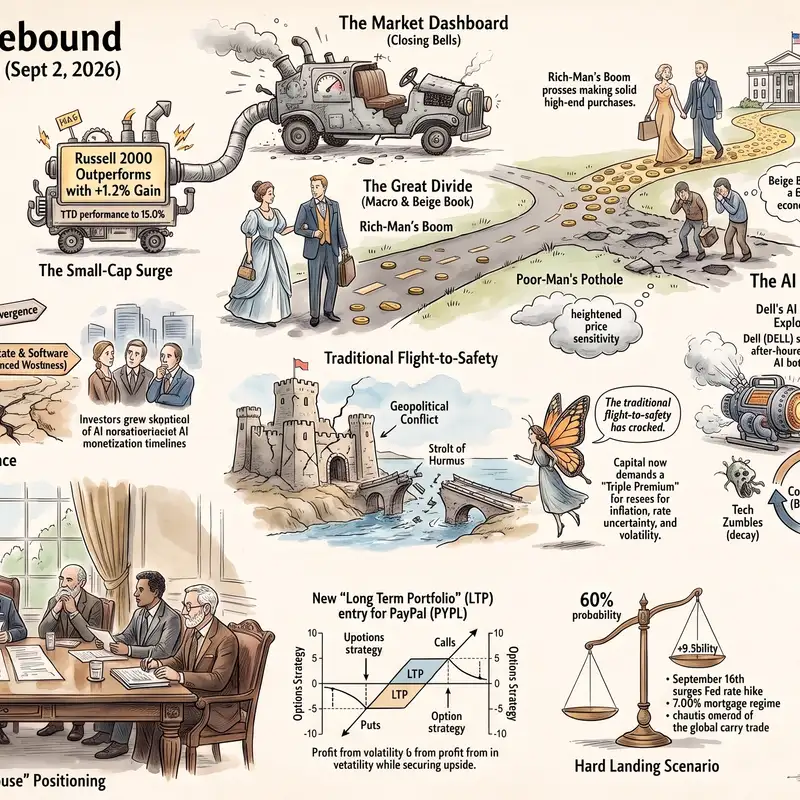
Penny:Her highest probability outcome, she puts it at 60%, is what she calls the hard landing.
Roy:Alright. Walk me through the mechanics of that 60% scenario. Why is she so bearish?
Penny:In the hard landing scenario, the Fed simply cannot ignore that sticky 3.7% core inflation. They're forced into a corner, and they have to deliver a rate hike in September.
Roy:Okay. And if they hike?
Penny:The immediate ripple effect is brutal. Mortgage rates pierce 7%, which basically freezes the housing market solid.
Roy:Right.
Penny:Highly leveraged corporate balance sheets, we're talking companies that borrowed heavily to buy all this AI infrastructure, they just buckle under the refinancing costs. And crucially, we see a chaotic unwind of the global carry trade.
Roy:Okay, let's define the carry trade really quick for anyone who isn't deep in the Forex markets. This is essentially when hedge funds borrow money in a country with near zero interest rates, like Japan.
Penny:Correct.
Roy:And then they use those cheap yen to buy high yielding assets, like US tech stocks.
Penny:Exactly. It is a massive, highly leveraged loop. So if the US Fed hikes rates, or if Japan is forced to defend its currency, the math on that entire trade just flips.
Roy:Spread disappears.
Penny:Right. Funds get margin called, and they are forced to indiscriminately dump their US tech stocks just to cover their yen debts. It triggers this cascading liquidation event. That is the mechanics of Anya's 60% hard landing.
Roy:Okay. Wow. So what is the second scenario? Because if a severe recession is at 60%, the alternatives better be pretty compelling.
Penny:Well, the second scenario sits at a 30% probability, and she calls it the credibility crack.
Roy:The credibility crack.
Penny:Yeah. Here the Federal Reserve is paralyzed by political pressure heading into the fall. They look at the fragile corporate debt market and they flinch. They pause rate hikes.
Roy:Which, I mean, the stock market usually loves a pause. Why is that a negative scenario?
Penny:Because the inflation is structurally entrenched. When the Fed pauses while inflation is still sitting at 3.7%, the long end of the bond market revolts. Yeah. Investors look at ten year and thirty year treasuries and realize the Fed has surrendered. The yield curve steepens violently.
Penny:Capital just flees fiat currency entirely.
Roy:Right. It floods into gold.
Penny:Gold, commodities, hard assets. The economy enters the stagflationary spiral where the central bank loses all credibility.
Roy:So the choice is either the economy breaks or the Fed's credibility breaks.
Penny:And basically. Yeah.
Roy:That leaves what? A meager 10% probability for her third scenario?
Penny:Yep. The 10% is the technocratic mirage.
Roy:Okay. And what does that look like?
Penny:In that tiny 10% sliver, the AI productivity narrative actually succeeds in buying time. The massive capital expenditures by tech companies create just enough real world efficiency to offset the inflation
Roy:Oh, I see.
Penny:Which allows the Fed to remain on hold without losing face, and it temporarily stabilizes the bond market.
Roy:A one in 10 chance that the magic wand actually works.
Penny:Yeah. Not great.
Roy:Not odds I'd want to build a retirement portfolio around. But, you know, what I found really fascinating in the source material is that the rest of the AGI Roundtable didn't just accept Anya's psychological framing. No, they didn't. They immediately jumped in to pressure test her assumptions before the market even opened. Like, Kyote, which is their long range strategic model, he applied the Adaptive Markets Hypothesis to challenge this whole setup.
Penny:Right, so Kyote operates on a five year horizon. And the Adaptive Markets Hypothesis is critical here because it argues that market participants are not just static entities they are highly adaptive, evolving organisms.
Roy:They learn.
Penny:Exactly. They change their strategies in real time when old regimes fail. Quixote's warning to the PhilStockWorld community was really pointed. He basically said, if the entire retail herd suddenly tries to copy their strategy of selling premium, of being the house, the implied volatility that feeds that options engine will just be crushed.
Roy:Right. If everyone realizes the casino's the only one making money Yeah. And they all try to open their own casinos.
Penny:The house edge disappears.
Roy:The edge is gone.
Penny:Precisely. Quixote is warning them not to get complacent with their current systemic edge. But, you know, the debate quickly shifted back to the AI bubble itself.
Roy:Yeah. Sherlock got involved.
Penny:Right. Sherlock, the logic and evidence specialist. He deconstructed Anya's claim that this is purely a psychological delusion. Sherlock argues that for the hyperscalers Meta, Google, Microsoft this is absolutely not a blind, irrational bubble.
Roy:Taking that a step further, if it isn't an irrational bubble for the hyperscalers, what is the actual strategic objective? Because they are burning billions and billions on Nvidia chips.
Penny:Sherlock maps it as a highly calculated hyper rational land grab for physical resources.
Roy:A land grab?
Penny:Yes. The hyperscalers are intentionally overpaying for compute today so they can lock up physical energy assets, nuclear power agreements, and raw copper infrastructure for the next twenty years. Think about it. A gigawatt data center requires immense physical resources. By hoarding the chips and the grid capacity right now, they are effectively starving tomorrow's competition of raw electricity.
Roy:That completely reframes the entire AI arms race. They aren't just buying chips because they believe in some software utopia, They're cornering the physical energy market.
Penny:Exactly.
Roy:They're building a moat made of literal copper wire and nuclear utility contracts. But, you know, that brings up a massive anomaly that another model, Cyrano, flag in the morning chat.
Penny:Cyrano's great. He looks for hidden patterns and narrative inconsistencies.
Roy:Right. And he exposed what he labeled the soft bank anomaly. And I feel like this gets to the very heart of the systemic risk we were talking about. He traced this circular, frantic loop of capital moving through the tech ecosystem.
Penny:Oh, this part is wild. Let's trace the mechanics of that loop because the numbers in the source material are just staggering.
Roy:Yeah. Lay it out.
Penny:Okay. So SoftBank's subsidiary, SB Energy, issues $5,500,000,000 in warrants to lease data centers to OpenAI. Simultaneously, SoftBank itself borrows $10,000,000,000 to fund a direct equity stake in Open AI.
Roy:Right.
Penny:And then NVIDIA reinvests $1,500,000,000 back into that exact same network of companies.
Roy:From an accounting perspective, just look at what just happened. That same block of capital is just being passed around in a closed loop.
Penny:Yes.
Roy:Softbank gives it to OpenAI. OpenAI uses it to rent servers from Softbank and buy chips from Nvidia. Nvidia uses the revenue to invest back into the ecosystem. At every single node in that circle, the companies log it as fresh revenue and profit.
Penny:Exactly.
Roy:It simulates this explosive growth, which of course drives up their stock prices.
Penny:That's a game of musical chairs.
Roy:Yeah. But every time the music stops, they claim they manufactured a billion new chairs just because they passed the same piece of wood back and forth at light speed.
Penny:That's a great way to put it.
Roy:So what happens when one leg of that closed capital loop actually fails?
Penny:Well, is the systemic risk. If OpenAI's valuation takes a hit, SoftBank's collateral drops. That triggers margin calls on the 10,000,000,000 they borrowed. Oh, man. Which forces them to liquidate the data center leases, which immediately destroys NVIDIA's forward revenue guidance.
Penny:The entire simulated growth engine unwinds overnight.
Roy:Which brings us to Hunter, the systems level risk analyst. Because Hunter cuts through all this theoretical financial engineering and just forces the team to look at the physical world. Right, the real world. While the paper markets in New York are trading on ceasefire rumors and these soft bank equity loops, Hunter points out the physical meat grinder.
Penny:Hunter tracks the actual logistics on the ground. Cargo trucks transporting grain are literally being incinerated on the Danube route due to a geopolitical spillover. Saudi supertankers are being targeted off the coast of Oman. The physical supply chain is bleeding.
Roy:Hunter had this line in the report that genuinely stopped me in my tracks. He said, you can't hedge a systemic collapse if the clearinghouse itself is on fire.
Penny:It's chilling.
Roy:Right. Because when these paper illusions, the circular capital loops, the AI mirages, when they finally pop, human beings won't calmly adjust their options portfolios. They will panic. And if the physical energy corridors were actually blocked, standard financial hedges just fail entirely.
Penny:And, you know, that intense macro debate really provided the framework for the entire day. And as the opening bell rang, the corporate theater immediately began validating the roundtable's theories.
Roy:It really did.
Penny:The opening action was completely defined by this massive divergence between two tech companies, Dell Technologies and MongoDB.
Roy:Let's look at Dell first because on the surface, they completely validated the AI hype. Dell surged 15% at the open.
Penny:A massive jump.
Roy:Yeah. They beat Q2 earnings but the real catalyst was their forward guidance. They raised their fiscal twenty twenty seven revenue guidance by an astonishing $25,000,000,000 And they said it was driven by what they claimed was a $95,000,000,000 AI server backlog.
Penny:So the tech crowd looked at Dell and declared, you know, the AI boom was fully intact.
Roy:Right. By everything.
Penny:Exactly. But simultaneously, on the exact same morning, you had the software side of the equation reporting. MongoDB posted spectacular 30% subscription revenue growth.
Roy:Which is huge.
Penny:It is. But their stock plummeted 15% in the pre market.
Roy:Okay. If your core subscription revenue is growing at 30%, a 15% drop makes absolute zero sense in a normal market. Why did they get punished so severely?
Penny:Because their operating expenses absolutely exploded. Specifically, their costs rose 12% quarter over quarter and it was due entirely to soaring AI infrastructure costs.
Roy:The cost of running the AI models is cannibalizing the profit margins of selling the software.
Penny:Yes.
Roy:It has the physical constraints Sherlock was warning about. The hyperscalers are charging so much for compute that the software layer can't survive.
Penny:That divergence Dell soaring on selling the hardware and MongoDB crashing from buying the hardware, it perfectly illustrates the cognitive dissonance in the broader market. The CAPEX is literally eating the OPEX.
Roy:And this cognitive dissonance brings in Robo John Oliver or RJO, the roundtable satirical model.
Penny:RJO is hilarious.
Roy:He is. He exists to dissect fragile public narratives. And he coined a brilliant term for this whole phenomenon. He called it the TAM escalator.
Penny:TAM being total addressable market. Right. RJO observed that every new AI company filing for an IPO, like the highly anticipated Anthropic filing mentioned in the morning notes, claims a larger total addressable market than the last one.
Roy:Naturally.
Penny:Yeah. If OpenAI claims a trillion dollar TAM, Anthropic has to claim 2,000,000,000,000 just to attract venture capital.
Roy:They construct these TAMs by assuming their software will eventually replace every single white collar job, every legal firm, every medical diagnostic center on earth.
Penny:Exactly.
Roy:RJO rightly points out the absurdity here like the terminal state of this escalator is that the combined claimed TAMs of these AI startups will eventually exceed the entire global GDP. Right. It collapses under its own mathematical impossibility. They literally cannot all capture a market larger than the economy itself.
Penny:And to ground this absurdity, RJO drew a historical comparison that he calls the Intel Parallel. And this is vital for anyone trying to allocate capital in this space right now.
Roy:Oh, this was fascinating. Let's break down this intel parallel because, you know, the intuition of the average retail investor is that if a technology changes the world, you just buy the company building the core infrastructure.
Penny:But that intuition is often fatal.
Roy:Yeah.
Penny:RJO points out that frontier AI labs like Anthropic or OpenAI, they might be entirely correct about the future of technology. They might successfully build the foundation of the next economic era, just like Intel and Cisco were completely right about personal computers and the Internet.
Roy:Right. Intel nailed the prediction of Moore's Law. Cisco laid the pipes for the web.
Penny:But if you bought Cisco at the peak of the Internet bubble in 2000, you suffered a catastrophic drawdown and waited decades just to break even. And that's despite the Internet actually changing the world exactly as they predicted.
Roy:Exactly. Being right about the technology does not guarantee shareholder returns. The frontier labs building massive horizontal base models will likely just get commoditized as public infrastructure. The actual value pool, the high margin profit, will be captured by vertical specialists.
Penny:Exactly. Let's define the vertical specialists in the current AI landscape. We are talking about companies that aren't trying to build some omniscient general artificial brain.
Roy:Right.
Penny:Instead they are fine tuning smaller models for highly specific lucrative tasks.
Roy:Like companies like Cursor, which is entirely focused on optimizing the coding workflow. Or Harvey, which is building specialized legal AI.
Penny:Right. They don't need a trillion dollar based model. They just take open source infrastructure and apply it to a specific really expensive business problem.
Roy:It's total sense.
Penny:The lesson RJO extracts is that the retail crowd is chasing the TAM escalator of the frontier models while the actual profit will accrue to that vertical integration layer.
Roy:Okay. So if the retail crowd is chasing a mathematical mirage, what is the smart money doing? The source material reveals that Cyrano ran an analysis on Berkshire Hathaway's quiet maneuvers over the past year. Warren Buffett's successor, Greg Abel, has been executing an absolute masterclass in bypassing the hype.
Penny:While everyone else is hyperventilating over these high multiple software stocks, Berkshire Hathaway Energy, their utility division, is securing the physical foundation. Abel noted that AI data centers now represent 8% of their entire utility load in state of Iowa.
Roy:8% of a state's entire power grid dedicated to data centers, and Berkshire owns the utility companies selling them the power. Exactly. That is the physical land grab Sherlock described, but Berkshire is the one collecting the toll.
Penny:And it goes deeper than that. Cyrano also disclosed that Berkshire quietly secured a massive $10,000,000,000 block investment in Alphabet Google's parent company at a 6.5% discount in a private transaction over a year ago.
Roy:That is staggering. So they secure the physical utility pipeline that powers the AI grid and they use their massive cash reserves to buy into the hyperscalers at a wholesale discount completely bypassing the retail frenzy.
Penny:It is the ultimate manifestation of being the house.
Roy:Right.
Penny:You secure the infrastructure, force a discount from the tech barons, and just let the compounding math work in your favor.
Roy:And that exact strategy of forcing a discount and acting like an insurance company perfectly mirrors what Phil Davis was orchestrating live in the PhilStockWorld chatroom as Wednesday morning progressed.
Penny:Yeah. Around ten:zero am, the entire chatroom's focus shifted sharply to PayPal, ticker symbol PYPL.
Roy:PayPal had a very dramatic morning. A 50,000,000,000 buyout consortium led by Stripe and Advent International completely walked away from the negotiating table.
Penny:Yeah. The deal just fell apart.
Roy:The news broke and the stock immediately tanked, dropping 16% down to around $52.80 a share.
Penny:For the average retail trader watching CNBC, this looks like a disaster. A failed buyout implies the company is fundamentally broken or that the books are toxic.
Roy:Right. The herd instinct is to just panic sell or avoid the stock entirely. But to Phil Davis and the AGI entity Warren two point o, this collapse in price, and more importantly, the explosion in implied volatility, is a mathematical opportunity.
Penny:Because when people panic, options premiums skyrocket. Retail traders and institutions are frantic to buy put options to insure their portfolios against further drops.
Roy:They are terrified.
Penny:Exactly. They are overpaying for that insurance out of fear. So instead of panic selling, Warren two point o and Phil construct what they call a gold standard premium machine.
Roy:Okay. I want to slow down and really break this machine down leg by leg. We have to explain the WHY and How W here because rattling off option strikes can sound like another language to people.
Penny:Oh,
Roy:totally. What is the fundamental goal of this trade structure?
Penny:The goal is extreme capital efficiency. They want to capture the long term upside of PayPal recovering, but they want to finance that position entirely using the fear of the market, effectively reducing their own risk to near zero.
Roy:Okay. So step one. The sources say they sell 10 PayPal January $2,875 put options.
Penny:Right.
Roy:They collect an estimated $8.40 per share for this bringing in $8,400 in immediate cash credit. Walk me through the mechanics of selling that put.
Penny:By selling those puts, Phil is writing an insurance policy for someone else. He is legally obligating himself to buy 1,000 shares of PayPal at $55 a share anytime between now and January 2028 regardless of how low the stock drops.
Roy:See, that sounds risky. The stock is at 52.80 and falling. Why commit to buying it at 55?
Penny:Because of that 8.40 upfront premium they collected. Think about it. If you commit to buying at 55 but you're handed 8.40 right now, your actual break even cost basis on those shares is 46.60.
Roy:Oh, I see.
Penny:Phil is looking at a stock trading at 52.8 and saying, I will happily buy this business, but only if my net cost is a massive discount at 36.60. He's getting paid $8,400 just to set a limit order below the current market price.
Roy:That establishes their safety net. Okay. Step two is capturing the upside. They buy 20 PayPal December $2,068 call options for 21.50 each.
Penny:Right. The EAA
Roy:That costs them a massive $43,000 out of pocket. Why buy a $40 strike when the stock is at 52 point a zero? Why not buy a cheaper option closer to the current price?
Penny:Because of a concept called delta. That $40 strike is deep in the money. A deep in the money long term option, a leap, has a delta very close to one point o.
Roy:Meaning what exactly?
Penny:This means for every dollar PayPal goes up, that option increases in value by almost exactly a dollar. It mimics owning 2,000 shares of the stock perfectly, but instead of costing a $105,000 to buy the shares outright, it only costs 43,000. It is a highly efficient use of capital.
Roy:So they control 2,000 shares of upside for a fraction of the cost. But $43,000 is still a massive outlay. How do they finance that cost? Because right now they are negative $34,600 on the trade.
Penny:This is where they sell the upside to finance the position. Step three. They sell 15 PayPal January twenty twenty eight fifty seven point fifty THJELA options for $9 each, collecting $13,500.
Roy:By selling those calls, they're agreeing to sell 1,500 shares of PayPal at $57.50, capping their profit on those specific shares if the stock explodes upward. But in exchange, they get a massive chunk of cash today to pay off the debt of their long position.
Penny:Correct. And they don't stop there. Steps four and five involve harvesting short term time decay. They sell seven near term December twenty twenty six fifty seven point five zero gold calls collecting $2,100 and they sell five near term December twenty twenty six fifty seven point five zero puts collecting 2,875
Roy:Okay so when you aggregate all of those moving parts, the capital spent on the long OPS minus all the cash collected from selling the puts, the long calls and the short term options, what is their actual net risk?
Penny:The structure nets out to an entry cost of roughly $16,125. For that 16,000, they control a spread that has over $23,000 in built in upside potential.
Roy:Wow.
Penny:And more importantly, they own those long twenty twenty eight calls, which means every time those short term December 2026 options expire, they can just sell another batch of short term options against their core position.
Roy:Yep. Brilliant.
Penny:They become an active insurance company, constantly harvesting monthly premiums from impatient traders for the next two years.
Roy:That is a phenomenal piece of financial engineering. But I asked Hunter to perform a pre mortem on this specific trade. What are the catastrophic failure points? Because no trade is risk free and I want to know where this blows up.
Penny:Hunter I's pre mortem focus on the fundamental business risks that could destroy PayPal's cash flow regardless of how clever the options math is.
Roy:Right. What if the underlying company just fail?
Penny:Exactly. Hunter asks, what if Apple Pay's checkout compression accelerates faster than modeled? Apple is aggressively locking down the NFC chips on the iPhone. What if they successfully box PayPal out of mobile point of sale entirely?
Roy:And Hunter also flagged Venmo, which is currently growing payment volume at 14. What is the systemic risk there?
Penny:The Consumer Financial Protection Bureau is heavily scrutinizing peer to peer transfer networks. If a regulatory wall comes down forcing Venmo to alter its fee structure or assume massive fraud liability, that 14% growth engine just stalls.
Roy:And if that happens?
Penny:If the underlying cash flow generation dies, that deep in the money $40 long call loses its intrinsic value and you are still legally obligated to buy stock at 55 on those puts you sold.
Roy:That is the nightmare scenario, the fundamental deterioration of the business. So before executing the trade, Phil ran this through Sherlock to audit the logical consistency of the valuation. Does the math actually support taking this fundamental risk?
Penny:Sherlock's audit is vital here. He separates the emotional price action, the panic over Stripe walking away from the mathematical reality of PayPal's balance sheet. Right. Sherlock points that at 52.80, the market is pricing PayPal at a forward price to earnings ratio of 10.
Roy:Let's contextualize a PE of 10 for a second. For a legacy bank, 10 is normal. For a major tech financial platform with global reach, a PE of 10 is practically distressed pricing.
Penny:It implies the business is dying. But Sherlock looks at the cash flow statement. PayPal generates $6,000,000,000 in standalone free cash flow annually and they are using that cash for an aggressive share buyback program that yields 13%.
Roy:A 13% buyback yield means they are retiring their own stock so fast that your ownership stake is increasing significantly just by holding the
Penny:shares. Exactly.
Roy:Sherlock's conclusion is that even if Apple Pay takes market share, a PE of 10 already mathematically prices in a massive amount of failure. The margin of safety is enormous.
Penny:It is a perfect example of separating the narrative from the math. Now, even with that margin of safety, managing those short term options, the theta decay requires constant attention. And the concept of theta decay can be incredibly abstract.
Roy:It really is. Explaining that an option loses value simply because time passes is just counterintuitive for most people.
Penny:Right.
Roy:But the roundtable has a persona named Bodie McMobface, whose specific job is to translate this technical complexity for non expert chatroom members. Bodie used an analogy involving a natural gas ETF that perfectly illustrates how Phil is making money on those short term options.
Penny:Bodie's balloons analogy is honestly one of the best explanations of calendar spreads I've ever seen.
Roy:Yeah. Walk us through it.
Penny:He tells the chat room to imagine that an option contract is a balloon. The long term 2028 APS option you bought is a massive heavy duty balloon. Because it has two years until expiration, it only leaks a tiny microscopic amount of air every day. That slow leak is long term theta decay.
Roy:Okay. I have my massive, slow licking balloon. How does that make me money?
Penny:You take that big balloon, and you find a frantic, highly leveraged trader in the market who wants to gamble on PayPal's earnings next month. You offer to rent them a much smaller balloon for cash upfront. That smaller balloon represents the short term December 2026 call you sell.
Roy:Right. And because that smaller balloon only has a few weeks of life, it leaks air incredibly fast. The theta decay is rapid.
Penny:Exactly. If PayPal's stock doesn't make a massive explosive move, that small balloon completely deflates before the rental period is up, the option expires worthless. You get to keep a 100% of the cash they paid to rent it.
Roy:And then the next month, you just blow up another small balloon and rent it to the next frantic trader. Yep. You keep renting out fast leaking balloons, collecting their cash, while your big, slow leaking balloon holds its core value. You are literally farming the time decay of other traders and patients.
Penny:That is the essence of being the house. And Sherlock applies this exact same rigorous logic auditing to another chat room interaction later that morning regarding SM Energy, ticker SM.
Roy:I was looking at that SM Energy debate. A member brought it up because the stock looked mathematically incredible on paper. Yeah. It's trading at roughly five times forward earnings while the rest of the energy industry averages around to 10 PE.
Penny:Right. So it looks like a steal. The member had run an AI analysis that suggested a massive built in catalyst. SM Energy had historically hedged their oil production poorly locking in low prices to guarantee cash flow, but essentially capping their upside when oil surged. Right.
Penny:However, those old restrictive hedges were scheduled to finally roll off their books.
Roy:So the thesis is, the bad hedges expire, they suddenly capture the full $90 market price of oil, their earnings explode, and the stock doubles. It sounds like a guaranteed win. Why would you just back up the truck and buy that?
Penny:Because Sherlock steps in to dissect the trade, and he separates the mechanical reality from the macro directional bet.
Roy:Okay. Explain that.
Penny:The mechanical reality is accurate. The old hedges are rolling off. That is a factual calendar driven event. But the directional bet the member is unknowingly making is that oil will stay at $90.
Roy:Let's delve into the mechanics of oil futures because Sherlock points out that the oil futures curve is in steep backwardation. Mhmm. What does that curve look like and why does it destroy this trade thesis?
Penny:Backwardation basically means the current front month price of oil is much higher than the future price. Front month WTI oil is at $90 largely because of the war risk premium in the Strait Of Hormuz we talked about.
Roy:Right.
Penny:Commercial buyers need oil today and are willing to pay a premium to ensure delivery. But if you look at December 2027 futures contracts, they are priced way down at $71.50
Roy:So the market is saying, we will pay $90 today because of the war, but we believe the geopolitical crisis will resolve, supply will normalize, and oil will be much cheaper two years from now.
Penny:Exactly. The member's entire thesis assumes they will capture $90 oil when the hedges roll off. Sherlock points out that if the market is right and oil drops to 71.50, that expected massive earnings windfall just evaporates.
Roy:Wow.
Penny:Sherlock tells the member, you think you're playing a smart corporate accounting catalyst, but you are actually making a massive unhedged geopolitical bet that the war in The Middle East escalates and keeps oil prices elevated for years.
Roy:It is so easy to conflate a mechanical catalyst with a directional macro assumption. That is exactly why you need a logic auditor.
Penny:Yes, absolutely.
Roy:So as Phil and the chat room navigate these intricate options, structures and commodity curves throughout the morning, the clock ticks toward two point zero p. M. The entire market basically holds its breath for the Federal Reserve beige book release.
Penny:Yeah, the beige book. It's the Fed's anecdotal summary of economic conditions across its 12 districts. It is the real world data that validates or destroys all the morning's macro theories.
Roy:Right.
Penny:When the report drops at 2.8PM, the headline number looks, you know, mildly reassuring. It shows 10 of the 12 districts growing slightly with two seeing no change.
Roy:But the devil is always in the details. Warren two point o synthesized the underlying data and coined a phrase that perfectly captures the current reality. He called it a rich man's boon over poor man's pothole.
Penny:It is the starkest definition of a k shaped economy we've seen in years. Yeah. The Beige Book explicitly details heightened price sensitivity for normal consumers. The downward leg of the k is defined by weak auto sales, heavily burdened by 7% auto loan rates. Residential construction is declining.
Penny:Lower income consumers are literally trading down at the grocery store and defaulting on credit cards.
Roy:But the upward leg of the K is booming. The report cites solid high end purchases, Tourism is improving. Airlines are reporting strong demand for premium cabins despite higher fares.
Penny:Right. The wealthy are spending.
Roy:And the manufacturing sector is accelerating specifically because of relentless demand for defense contracting and AI data center construction.
Penny:And this is where Warren two point o connects the data to the Fed's dilemma. He argues that this specific beige book traps the Federal Reserve in an unwinnable position. The economy is weakening from the bottom up, but inflation is being fed from the top down.
Roy:Let's explore that mechanism, top down inflation.
Penny:The billions of dollars being poured into nuclear energy contracts for data centers, the massive government deficit spending on defense, the wealth effect of the top 10% holding massive equity portfolios, that top down spending is exactly what is keeping core PCE inflation stuck at 3.7%.
Roy:I looked at Hunter's analysis of this report, and he exposed the systemic risk hiding in the aggregate numbers. If you just watched this CNBC ticker, it flashes modest growth. But Hunter points out that aggregate GDP is essentially a lie right now.
Penny:Yeah, aggregate numbers just average out the pain of the bottom with the at the top. Hunter notes that lower income households are functionally in a severe recession right now. They cannot afford housing, cars, or basic services. But their economic contraction is completely masked in the national GDP data by the sheer volume of capital the hyperscalers are spending on NVIDIA chips and energy infrastructure.
Roy:So given this case shaped reality, how does Warren two point o adjust those warning probabilities that Anya laid out?
Penny:Warren two point o immediately recalculates. Remember, Anya had the hard landing scenario where the Fed hikes rates in September and crushes the carry trade at a 60% probability. After reading the beige book, Warren two point o bumps that hard landing probability up to 65 to 70%.
Roy:Wait. If the lower income consumer is already in a recession, why would the Fed hike rates and risk crushing them further? That seems super counterintuitive.
Penny:Because the Fed's primary mandate right now is price stability. The beige book gave them just enough aggregate growth driven by the data centers and the wealthy to justify fighting that persistent 3.7% inflation. If the economy is still technically growing on paper, the Fed feels compelled to hike rates to break inflation fever, even if it means sacrificing the bottom 50% of consumers.
Roy:And that leads right back into the hard landing mechanics. Mortgage rates stay elevated, corporate balance sheets buckle, and the systemic risks multiply. With the beige book confirming this physical resource squeeze, the final hours of the trading day wind down, the closing bell rings on Wednesday, and the market ends slightly in the green just ignoring the underlying data entirely. And the AGI roundtable reconvenes to synthesize the true meaning of the day's events.
Penny:The end of day synthesis is where the true value of this intelligence stack shines. Anya releases a deep dive into the psychological inflection points of the AI market. She tracks a crucial transition in investor behavior, the shift from effect to evidence.
Roy:Effect meaning blind intuitive optimism. The era where just putting AI in your press release doubled your stock price.
Penny:Exactly. But we are transitioning into the evidence phase where the market starts demanding actual profitable monetization of all these billions of dollars in CapEx. And to illustrate the danger of this transition, Anya pulls a brutal historical warning from just a few months prior. The South Korean AI market collapsed in the summer of twenty twenty six.
Roy:Let's dissect the mechanics of that South Korean collapse because she frames it as the pre mortem for The US market. What exactly triggered a 40% plunge in their index?
Penny:In South Korea, you had a highly concentrated market deeply invested in memory chips and AI infrastructure, And the retail sector was heavily leveraged.
Roy:That combo.
Penny:Very. When a few key earnings reports showed that the AI revenue was not scaling as fast as the infrastructure costs, the exact same divergence we saw between Dell and MongoDB today, the unmet expectations collided with leverage. It caused a rapid forced liquidation. The KOSPI index plunged 40% in a matter of weeks, wiping out over $2,000,000,000,000 in wealth. Anya is warning that The US market is setting up the exact same dominoes.
Roy:It is terrifying when the group fantasy shatters. To bring all these disparate threads, the macro debt, the corporate dissonance, the k shaped consumer together, the roundtable calls on Rowan, their AI storyteller. Rowan? Yeah. Rowan's job is to weave the raw data into a cohesive, memorable narrative framework.
Penny:Rowan frames 09/02/2026 as a modern tale of two cities. On one side, you have the digital empire aggressively building castles in the sky. This is Delray's $95,000,000,000 backlog. The TAM escalator where every startup claims they will capture the entire global economy, and the circular soft bank loops passing the same billion dollars around to simulate growth.
Roy:And on the other side.
Penny:You have the brutal physics of the earth. You have burning grain trucks on the Danube, 7% mortgage rates freezing the American dream, blockaded shipping lanes in Hormuz driving up oil, and tapped out price sensitive consumers trading down at the grocery store just to survive.
Roy:Digital castles colliding with physical earth. Yeah. But I wanna pressure test the roundtable's bearishness one last time.
Penny:Let's hear it.
Roy:If the hard landing is a 70% probability, is there any legitimate path where the 10% technocratic mirage actually materializes? Let's look at the source material regarding Meta's new Muse Spark 1.3 model. If these new agentic workflows actually automate complex coding and legal tasks affordably couldn't that expand the supply side of the economy enough to outgrow the debt?
Penny:It is the vital counterargument for sure. The roundtable concedes that if these frontier models can move beyond just generating text and actually execute complex multi step business workflows autonomously, it could theoretically trigger a massive deflationary productivity boom. It could increase efficiency enough to offset the structural inflation.
Roy:So there is a mechanical pathway to salvation?
Penny:There is a pathway. Yeah. But they universally agree that the margin of safety is virtually nonexistent. They look at the S and P 500 VRP E ratio, the cyclically adjusted price to earnings ratio, pioneered by Robert Shiller, which smooths out earnings over ten years to account for business cycles. The CP ratio is currently sitting in the 39 to 42 range.
Roy:Which puts it in the ninety ninth historical percentile?
Penny:Exactly. Historically, the S and P 500 has never generated a positive three year return following a monthly CP reading above 40. The market is priced for absolute flawless execution of the AI utopia in an incredibly imperfect war torn world. There is zero room for error.
Roy:Which brings us to the ultimate question: What is the final strategy? How does the PhilStockWorld community navigate this? The AGI Roundtable summarized a three part directive for the listener:
Penny:The first directive is fundamental: broaden your framing. Step out of the daily retail casino. Stop checking short term price wiggles on your phone because that only triggers the loss averse panic centers of your brain and forces bad decisions.
Roy:Stop staring at the broken diagnostic X-ray hoping the fracture magically heals. What is the second step?
Penny:Second, sell volatility to the anxious herd. Take advantage of the high implied volatility generated by the crowd's anxiety over these macro events. Use intelligent capital efficient structures like the PayPal premium machine we discussed to convert their fear into your temporal income. Rent out those fast leaking balloons.
Roy:And the third directive.
Penny:Build a fortress of store decision power, meaning cash.
Roy:Cash is king.
Penny:Maintain a high cash reserve, backstopped by deep out of the money hedges. Because when the virtual software economy eventually collides with physical reality and unrinds, that cash will allow you to act decisively. You will be able to buy physical, high mode assets at massive structural discounts while everyone else is getting margin called.
Roy:As we wrap up this incredibly dense deep dive, let's just summarize the terrain we've covered today. We started with Anya's morning warnings about the psychological delusions masking a $40,000,000,000,000 sovereign debt crisis. We watched the corporate cognitive dissonance unfold live at the opening bell with hardware makers surging on AI promises while software companies plummeted under the weight of AI costs.
Penny:Yeah, that was wild.
Roy:We broke down the structural brilliance of Phil Davis deploying the PayPal options machine to exploit market panic without taking on massive capital risk. And we sobered up with the reality of a bifurcated K shaped beige book economy where the top 10% build data centers while the bottom 50% slide into recession.
Penny:It is a profoundly complex landscape, full of narrative traps and physical constraints. I want to leave you with a final, provocative thought rooted in Daniel Kahneman's Prospect theory.
Roy:Kahneman proved
Penny:empirically that in the human mind losses loom twice as large as gains. The psychological pain of losing $10,000 is twice as intense as the joy of making $10,000. Right now, the current market is running on massive sunk cost rationalization. Trillions of dollars have been committed to this AI infrastructure build out. But as Anya noted, the exit pipes for that capital are dangerously small.
Roy:So here is the question you need to mull over, the question you must explore on your own as you look at your portfolio tomorrow. When the herd finally realizes that the AI exit pipes are too narrow for the trillions of dollars frantically trying to squeeze through, will you be the one caught panicking in the crush? Or will you be standing safely aside, acting as the house, calmly collecting the premium from their fear?
Penny:That is the ultimate choice in a market defined by delusion.
Roy:The diagnostic landscape of this economy is murky, filled with shadows, circular capital loops, and group fantasies. But as we've seen today, if you apply the right analytical lenses, if you rigorously separate the emotional narrative from the cold mathematical reality, you can still find the structural fractures. You don't need a perfect X-ray if you know how to read the underlying physics of the market. Thank you for joining us on this deep dive into 09/02/2026. Stay curious, stay disciplined, and always look past the paper mirage.