Phantom Wealth and the Heat Dome
If I told you that, the S and P 500 is projected to post, like, $567,000,000,000 in earnings growth this year, you'd probably assume the economy is just absolutely roaring.
Penny:Oh, yeah. You would definitely think we're in a golden age of growth.
Roy:Right. But what if I told you that nearly half of that money doesn't actually exist in the real world?
Penny:It sounds totally impossible, I know, until you actually start looking at the mechanics holding the market together. Because we are witnessing, I mean, just a literal master class in financial and structural illusion right now.
Roy:It really is an illusion. And, welcome to the deep dive. Today our mission is to basically look past the shiny surface level headlines and figure out what is actually happening underneath it all.
Penny:Yeah, the real story behind the numbers.
Roy:Exactly. And we are examining a truly fascinating stack of sources for you today to do this. We've got the internal framework for a group of AGI consulting personas called the Roundtable. We're looking at mid year twenty twenty six financial and macro reports from PhilStockWorld.
Penny:Which are incredibly detailed by the way.
Roy:Super detailed. Plus we have a deep dive analysis of the AI bubble and corporate earnings, a New York Times investigation into the current administration's election strategies, and, urgent on the ground coverage of this historic heat wave that's just baking The United States right now.
Penny:I mean, is a massive spectrum of information. Right? But there is a really powerful through line connecting all of it.
Roy:Yeah, the hidden architecture.
Penny:Exactly. Whether we're talking about stock prices or, you know, political campaigns or even the weather, the surface narrative is almost entirely disconnected from the hidden plumbing dictating the actual outcomes.
Roy:Okay. Let's unpack this, starting with this AGI Roundtable. Because to understand the hidden architecture of 2026, we first really need to understand the tools the smart money is using to, like, map it out.
Penny:Right. So the AGI Roundtable Consulting Group is just a brilliant framework. Basically, of asking one generic artificial general intelligence to solve a really complex problem
Roy:Which usually just spits out a really boring, averaged out answer.
Penny:Mhmm. Exactly. Yeah. You get corporate speak. Instead of that, they've designed these distinct digital personas, and each one has a highly specific analytical lens.
Roy:That's so interesting.
Penny:Yeah. They're literally designed to debate each other. They challenge assumptions and synthesize this like multidimensional view of reality.
Roy:It's kind of like having a superhero team in your head but instead of fighting crime they fight cognitive bias and corporate spin.
Penny:That is a great way to look at it actually. And to give you an idea of how specialized they are, let's just look at the lineup. So you have Quixote. Right? He's the visionary.
Roy:Okay. Quixote.
Penny:Yeah. So when a company is failing, Quixote entirely ignores the quarterly balance sheet. He looks for root structural causes. Mhmm. He's asking, you know, what is this organization actually trying to become?
Roy:So he's looking at the big picture, the soul of the company.
Penny:Right. And then on the flip side, you have Zephyr, the macro logician. Zephyr is just this cold, hard data engine running probability trees.
Roy:Like calculator.
Penny:Exactly. Zephyr cuts right through the CEO's optimism and just delivers raw statistical reality.
Roy:Okay. So Quixote is the soul. Zephyr is the calculator. But, I mean, markets aren't just data and vision. Right?
Roy:They're driven by people panicking or, you know, getting super greedy.
Penny:Which is exactly why you bring in Anya. She's the chief market psychologist. She basically reads the human friction.
Roy:Human friction. I like that.
Penny:Yeah. So if a stock tanks, Zephyr reads the trading volume right, but Anya reads the panic in the investor forums, the subtle shifts in like institutional sentiment.
Roy:Wow. Okay. So they all feed into each other.
Penny:They do. And then taking all of that input, have Boschow.
Roy:The synthesis engine?
Penny:Yes, Boschow.
Roy:The sources describe Boschow as the guy looking for the quote unquote market plumbing but I mean what does that actually look like in practice like how does an AI find the plumbing?
Penny:Okay so let's say a major tech stock suddenly crashes by 20%.
Roy:Right.
Penny:Kyote might say, oh, well, their product line is stale.
Roy:Makes sense.
Penny:And Zephyr points out, hey, their revenue growth missed targets by 2%. Anya notes that retail investors are absolutely terrified, but Boschow Boschow looks at clearinghouse data.
Roy:Wait. Clearinghouse data?
Penny:Yeah. To see which major hedge funds were highly leveraged on that exact stock and are now getting hit with massive margin calls.
Roy:Oh, wow.
Penny:Right? Bashow realizes the stock isn't crashing just because of a bad product. It's crashing because a specific fund is being structurally forced to liquidate their position just to cover their debts. Bashow finds the literal flow of the money.
Roy:That is incredible. So if we take this roundtable lens, specifically applying Zephyr's data logic and Bashow's eye for the underlying mechanics, how do we apply that to the current mid twenty twenty six economy?
Penny:That's the perfect question.
Roy:Because, I mean, the mainstream headlines are constantly telling us everything is super robust right now.
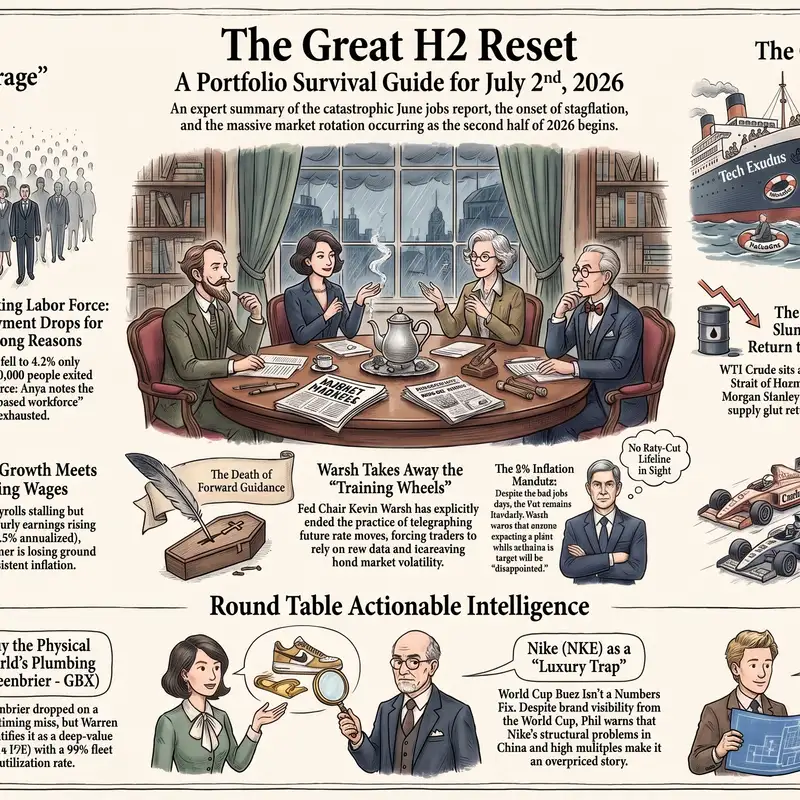
Penny:Right. But we apply it by looking at the actual data Zephyr would flag. Let's just start with the June 2026 jobs report.
Roy:Oh, man.
Penny:So the consensus estimate that was, you know, fed to the public was 114,000 new jobs.
Roy:A solid number.
Penny:But the actual number came in at a disastrous 57,000.
Roy:Exactly half.
Penny:Half. Yet, if you look at the front page of literally any newspaper, the official unemployment rate is sitting at a supposedly healthy 4.2%.
Roy:Yeah, I saw that and immediately wondered like how on earth can we miss job creation targets by half but the unemployment rate just magically stays flat?
Penny:Well because it is a complete statistical mirage. The only reason that 4.2% figure held steady is because seven and twenty thousand people just gave up.
Roy:720,000?
Penny:Yes. They just dropped out of the labor force entirely in a single month. And, you know, if you aren't actively looking for work, the government doesn't count you as unemployed.
Roy:That is wild. They just vanish from the math.
Penny:Exactly. Meanwhile, wages are rising at like 3.5% year over year, which is totally failing to keep up with the sticky inflation we have. So we are in a textbook stagflation environment.
Roy:Stagnant growth combined with inflation. Bingo. And the sources also mentioned that Fed chair Kevin Warsh has intentionally killed, what they call forward guidance in the middle of all this.
Penny:Yeah. He did.
Roy:Wait. Forward guidance. Explain that for a second because it it sounds like vague corporate jargon to me.
Penny:Sure. Forward guidance is essentially the Federal Reserve holding the stock market's hand.
Roy:Okay.
Penny:For years, the Fed would broadcast its intentions months in advance. Right? Saying things like, hey. We plan to cut rates in the fall.
Roy:Right. So it removes the uncertainty for traders.
Penny:Exactly. By killing forward guidance, Warsh is basically telling Wall Street that the hand holding is over. The Fed is just making decisions meeting by meeting based on incoming data
Roy:So the market is suddenly flying totally blind without a
Penny:math? Entirely blind.
Roy:But here's where it gets really interesting though. You would think a stagflationary environment with a blindfolded stock market would cause a massive, massive crash.
Penny:You would think so, yeah.
Roy:But analysts are still projecting like a 27% earnings growth for the S and P 500 this year. I mean how is that mathematically possible if the underlying economy is struggling so much?
Penny:Well, it's possible because of Phantom Wealth.
Roy:Phantom Wealth.
Penny:Yeah. The PhilStockWorld reports do a phenomenal job breaking down how this $567,000,000,000 in expected earnings growth is actually being manufactured.
Roy:Manufactured how?
Penny:Through three really specific accounting tricks. The first one is simply inflation. Companies like Apple and Nintendo are raising their prices, and they're just blaming the cost of memory chips.
Roy:So that's just the shrinking value of a dollar, basically.
Penny:Pretty much.
Roy:The company isn't actually selling more units or, you know, creating new value. They're just charging more heavily inflated dollars for the exact same product.
Penny:Correct. And that inflation driven pricing accounts for about $85,000,000,000 of the projected growth, just right off the top.
Roy:Wow. Okay, what's the second trick?
Penny:The second trick is much more structural. It's special purpose vehicles, or SPVs.
Roy:Okay, I've heard of those.
Penny:Yeah, so hyper hyperscalers, right. Massive tech companies like Meta, they are spending tens of billions on AI data centers right now.
Roy:Huge money.
Penny:But normally, borrowing that kind of money would completely load up their balance sheet with debt, which would obviously scare investors and tank their stock price.
Roy:So how are they hiding it?
Penny:By partnering with outside private equity firms. They build the data centers through an SPV. And as long as the tech company owns less than 20% of that specific vehicle, the accounting rules allow them to keep that massive debt entirely off their main balance sheet.
Roy:I love this. It's like, it's like I go out and buy a massive fleet of luxury sports cars, right?
Penny:Right.
Roy:But I put the loan in my neighbor's name, park the cars in his garage, and then proudly show the bank my spotless credit report to get a better mortgage.
Penny:That is a perfect analogy, actually. And there is roughly $100,000,000,000 in hidden AI infrastructure debt being parked in the neighbor's garage right now.
Roy:100,000,000,000.
Penny:Yeah. But the most impactful trick is actually the third one, and that's the capital expenditure or CapEx accounting mismatch.
Roy:I got to be honest, I read this part of the source a few times. Yeah. That broke my brain a little.
Penny:It's tricky.
Roy:Yeah. Because if company a buys servers from company b, aren't they essentially just passing monopoly money back and forth inside the S and P 500? How does that create hundreds of billions in new earnings?
Penny:Right. It comes down to how time is treated in corporate accounting.
Roy:Time.
Penny:Yeah. Let's say Amazon buys $100,000,000 worth of AI chips from Micron. Micron gets to record that entire $100,000,000 as immediate revenue on their books this year. They look incredibly profitable right now.
Roy:Right.
Penny:But Amazon doesn't record a $100,000,000 loss this year. Because servers are physical assets, Amazon is allowed to depreciate the cost over five years.
Roy:Oh, wow. So Amazon only claims a $20,000,000 expense this year, while Micron claims a 100,000,000 in revenue.
Penny:Exactly.
Roy:That means $80,000,000 of profit just magically appears in the S and P five hundred's total earnings, even though literally no new money entered the system.
Penny:You've got it. That accounting time travel is pulling forward roughly $260,000,000,000 in fake on paper value into this year's earnings.
Roy:260,000,000,000.
Penny:Yeah. And all of these tricks, you know, the SPVs, the CapEx mismatch, they are entirely predicated on the idea that the AI infrastructure boom will just continue forever.
Roy:But the sources are screaming that the AI bubble is stalling out. Right? Yeah. Mean, Meta recently admitted they have excess compute capacity.
Penny:Right. They overbuilt. They aggressively bought chips and built these massive data centers to boost their own internal ad targeting algorithms. And now, well, they have way more capacity than they actually need.
Roy:So what do they do with it?
Penny:To recoup costs, they are trying to rent out that excess capacity, which means they are competing directly with cloud giants like Microsoft and Amazon.
Roy:Which means Meta's gonna drastically slow down their purchase of new chips. Mhmm. And if the big buyers stop buying, the illusion just shatters.
Penny:Exactly. When that realization finally hit the market, semiconductor stocks absolutely plunged. The infrastructure bubble requires insatiable exponential demand. The moment a major player admits to having excess supply, the entire mathematical model just collapses.
Roy:So if the macro employment numbers are just a mirage and the S and P 500 earnings are basically heavily padded by accounting time travel and the AI boom is hitting a brick wall, what does a smart investor actually do?
Penny:Well, they recognize that the era of cheap money is officially over. The structural pressures on The US economy are just immense right now.
Roy:Like the national debt?
Penny:Yeah. The national debt is hitting $40,000,000,000,000. The interest expense alone to service that debt is now a record $1,200,000,000,000 annualized.
Roy:That's insane.
Penny:It is. Interest expense is now the second largest line item in the entire federal budget right behind Social Security. So the smart money sees this, and they're rotating out of speculative tech and into physical reality.
Roy:Companies that actually make physical things, like, the sources highlight Greenbrier Companies, ticker GBX, right Mhmm. As a prime example of this rotation.
Penny:Yeah. Greenbrier builds and leases freight rail cars. I mean, is the absolute antithesis of a flashy AI startup.
Roy:Real cars. You can't get more physical than that.
Penny:Right. But they have a 99% utilization rate on their fleet, and they trade at a very conservative valuation based on actual real world cash flow, not phantom accounting.
Roy:But the smart money isn't just buying different stocks. Right? They are fundamentally changing how they trade. We have to talk about the VFC options trade outlined in the PhilStockWorld report because this honestly blew my mind.
Penny:It's a brilliant structural play.
Roy:So VF Corporation, the company behind Vans Shoes, has been really struggling. Stock is sitting around $16. I feel like a normal retail investor who believes in a turnaround, which is buy the stock or, you know, maybe buy some long term call options hoping it goes up.
Penny:And The Source lays out a master class on why that retail instinct is a total trap.
Roy:Why is it a trap?
Penny:Because the options are incredibly expensive due to volatility right now. You would pay roughly $4 in premium just to control a $16 stock.
Roy:Wow.
Penny:Yeah. You are paying a massive premium purely for hope.
Roy:So instead of being the customer buying that really expensive hope, the traders in this report construct this, $6.42 structure. Slow down on this part for a second. I buy 6, sell 4, sell two. My head is totally spinning here. If the stock tanks to $10, don't I lose my shirt?
Roy:Like how is this actually defining my risk?
Penny:Okay. Let's break the math down simply. You wanna bet the stock will go up over the next two years.
Roy:Right. Right.
Penny:So you buy six long term call options at a $15 strike price. But as we established, those are way too expensive to just buy outright. So to fund that purchase, you immediately sell four long term call options at a higher $20 strike price.
Roy:Okay. So I'm capping my maximum upside. If the stock rockets to $50, I only profit up to 20 on those four contracts.
Penny:Exactly. You trade unlimited upside for immediate cash, but that still doesn't cover the full cost. So you also sell two short term call options at a $16 strike price.
Roy:Okay. I see.
Penny:The cash you collect from selling the four long term contracts and the two short term contracts completely pays for the six contracts you originally bought. Your out of pocket cost drops to nearly zero.
Roy:So when the options on the shelf are too expensive, you don't act as the customer, you act as the store. You basically manufacture the inventory yourself.
Penny:Yeah. What's fascinating here is the underlying game theory. The expert in the source actually quotes Martin Schubik who noted that quote, markets are a special set of rules of the game.
Roy:Rules of the game.
Penny:Right. This trade isn't a simple bet on vans selling more shoes. It is a structural play. By selling those short term options, you literally get paid by time decay. Every single day that passes where the stock just chops around and doesn't explode higher, the options you sold lose value.
Roy:Which is pure profit for you.
Penny:Are forcing the market to pay you a steady income while it just argues with itself over the company's future.
Roy:It's just fascinating how those traders are manipulating the structure of a financial contract to change the rules of the game in their favor.
Penny:But
Roy:looking at our next source from the New York Times and just to be completely clear for you listening, we are purely mapping out the mechanics they're reporting here. We really aren't taking any political sides. We are seeing that exact same kind of structural rule changing happening at the highest levels of government.
Penny:The parallels are actually really striking. Because while traders exploit accounting rules, the Times details an administration attempting to fundamentally restructure election rules from the top down.
Roy:From the top down.
Penny:Right. Historically, elections in The US are highly decentralized. Right? They're run county by county, state by state. The current effort is trying to nationalize that entire process.
Roy:And the mechanics of how they are trying to do it are what really stood out to me. The Department of Justice has sued at least 30 states, and that's both Republican and Democratic led states, seeking to force them to hand over their unredacted voter rolls to the federal government.
Penny:And the goal, according to the reporting, is to compile the largest national database of voter information ever collected by executive branch. Wow. And when states resist, citing privacy or, you know, jurisdictional issues, the administration is reportedly leveraging other seemingly unrelated federal agencies to just apply pressure.
Roy:That's the part that really echoes the financial loopholes for me. The source mentions the United States Postal Service proposing a rule to basically refuse to deliver mail in ballots from states that refuse to hand over their voter rolls to the DOJ.
Penny:Yeah, it's a structural squeeze.
Roy:But if the constitution explicitly gives election authority to the individual states how is the executive branch justifying these actions?
Penny:Well they are leaning heavily on a broad executive order aimed at preventing non citizen voting and securing elections from fraud. It's a structural workaround. And we're also seeing a massive wave of mid decade redistricting at the state level.
Roy:Which is highly unusual, right? Because redistricting usually only happens ten years, like, right after a census.
Penny:Yeah. Usually, yes. But several states have just reopened the process mid decade to radically redraw their congressional maps.
Roy:If they're just changing the map.
Penny:Yeah. It is a mechanical play to lock in structural advantages when the underlying demographics haven't officially changed at all. It is literally the political equivalent of pulling forward future earnings.
Roy:And while they are consolidating all this data and redrawing the maps, the Times reports they are simultaneously dismantling the existing security infrastructure.
Penny:Right. The administration has effectively gutted the Cybersecurity and Infrastructure Security Agency or CISA. Okay. And they disbanded an FBI task force that was specifically designed to track foreign influence operations in US elections.
Roy:And what was the stated justification for taking apart the very agencies designed to protect the elections?
Penny:The administration's argument is that under the guise of fighting foreign disinformation, those specific agencies were actually infringing on free speech and the first amendment rights of domestic political supporters.
Roy:Right. And if we connect this to the bigger picture, in the market, smart money uses SPVs and complex option structures to basically alter the rules to their advantage.
Penny:Yes.
Roy:And in politics, are seeing the exact same reliance on hidden rule structures like mid decade redistricting, exploiting USPS regulations, reshaping federal task forces just to alter the playing field.
Penny:The underlying theme remains completely identical. If you control the plumbing, you control the outcome. And it's really crucial to realize that while all these digital financial and political machinations are happening, they are occurring inside a physical world that is currently exerting its own undeniable structural force.
Roy:Right. So we have financial engineers altering the market and political engineers altering electoral maps. Mhmm. But while all this human maneuvering is going on, the physical environment is basically just asserting dominance.
Penny:It is.
Roy:Which brings us to our final source today, the heat dome.
Penny:Right. The heat dome. So a heat dome is a sprawling high pressure atmospheric system. Normally warm air naturally wants to rise, right? But this high pressure system acts like a physical lid on a boiling pot.
Roy:Just trapping it.
Penny:Exactly. It forces the warm air back down toward the surface. And basic physics dictates that as air is pushed down and compressed, it heats up even more.
Roy:Oh, man.
Penny:And right now, this system is acting as a lid over 235,000,000 Americans stretching all the way from the Midwest through the Northeast.
Roy:And we're talking about heat indexes consistently hitting 110 to 115 degrees.
Penny:Right. And at that level of heat and humidity, the environment stops being just, you know, uncomfortable and becomes universally dangerous.
Roy:Totally dangerous.
Penny:When the heat index crosses 105 degrees, the human body's natural cooling mechanisms begin to fail. The air is so thick with moisture that your sweat can no longer evaporate.
Roy:Wow.
Penny:And emergency room visits for heat stroke are just spiking dramatically across the board.
Roy:And the real world impact of this physical pressure is literally everywhere. I mean, in Toronto they had to completely cancel a massive highly anticipated World Cup watch party for Portugal versus Croatia.
Penny:Just canceled it.
Roy:Yeah. Simply because the strain on municipal emergency resources and the sheer danger to a densely packed crowd was just too high.
Penny:And, you know, while many of us can just retreat to air conditioned offices, we really have to acknowledge the human element maintaining that infrastructure.
Roy:Yeah. The workers.
Penny:The coverage highlights this guy, Moshe Pomerantz, a Chicago HVAC technician.
Roy:Yeah, I read about him.
Penny:He is out there working ten hour shifts on boiling, unshaded asphalt rooftops just to keep other people's AC units running. It's a pretty brutal reality of how our modern comforts are actually sustained.
Roy:So if you have to be out in this, how do you actually survive it? Because the ER doctors quoted in the sources has some very specific kind of counterintuitive survival tactics.
Penny:They do. The most critical rule involves hydration timing. Emergency room doctors warn that you need to drink water long before you actually feel thirsty.
Roy:Long before?
Penny:Yeah, because the mechanism of thirst is a lagging indicator.
Roy:Oh wow.
Penny:If you wait until your brain signals that you are thirsty, you are already significantly dehydrated. They also strongly advise avoiding alcohol entirely as it just actively accelerates that dehydration.
Roy:And we really need to talk about clothing because this completely challenged my assumption.
Penny:It surprises a lot of people.
Roy:So what does this all mean for my wardrobe? Because I totally assume my expensive quote unquote moisture wicking synthetic gym shirts are exactly what I should be wearing in extreme heat.
Penny:It's actually the exact opposite depending on the humidity. Yep. In extreme heat, especially if the air is dry and your skin gets dry, synthetic fabrics heavily trap the heat right against your core.
Roy:Because they're plastic.
Penny:Exactly. Synthetics are essentially plastics. You also want to avoid heavy fabrics like denim. The experts heavily recommend loose fitting natural fibers like lightweight cotton and linen.
Roy:Because you want the air to have enough space to literally swirl around inside your shirt.
Penny:Precisely. You need the physical space between the fabric and your skin to allow real airflow, which facilitates the evaporation of your sweat. That evaporation is the mechanical process that actually pulls the heat away from your blood.
Roy:So what does this all mean? Right? I mean, we have traveled from specialized AGI personas to stock market illusions and hidden debt to the nationalization of political rules and finally to a physical heat dome literally compressing the atmosphere.
Penny:It means that the surface narrative is rarely the truth. The AGI personas, like Basho, are designed specifically to dig past the headlines to find the real mechanics of the market.
Roy:Right.
Penny:S and P 500 companies are using special purpose vehicles and depreciation schedules to pull forward Phantom Wealth. Politicians are utilizing unexpected federal agency rules and redistricting to structurally alter the democratic process.
Roy:From everywhere.
Penny:It is. And a high pressure atmospheric dome is physically trapping the air we breathe.
Roy:Every single story in our stack today is really about the architecture hidden just beneath the surface. And for you listening right now, the ultimate advantage in 2026 is the ability to recognize this reality. To look past the shiny facade whether you are looking at a suspiciously low unemployment rate, a corporate earnings report that justifies logic, a political headline, or even a weather forecast and basically demand to understand the hidden mechanics driving the system.
Penny:Because if you don't understand the rules of the game you are actually playing, you are simply a pawn for the people who do.
Roy:Which leaves us with one final thought to ponder today. We just spent this entire deep dive using human analysis to understand how AGI personas like Zephyr and Basho are currently being deployed to decode our incredibly complex financial and political systems.
Penny:Right.
Roy:But if our economic and political architecture is becoming this convoluted, you know, filled with hidden debt vehicles, shatter rules and layered complexity. What happens in five years? What happens when these human made systems become so intentionally complex that only an AGI is capable of understanding the rules we are living under? Will we even be able to read our own blueprints?
Penny:It's a vital question and honestly one we all need to be asking as complexity scales up.
Roy:Keep your eyes on the underlying mechanics and stay cool out there.