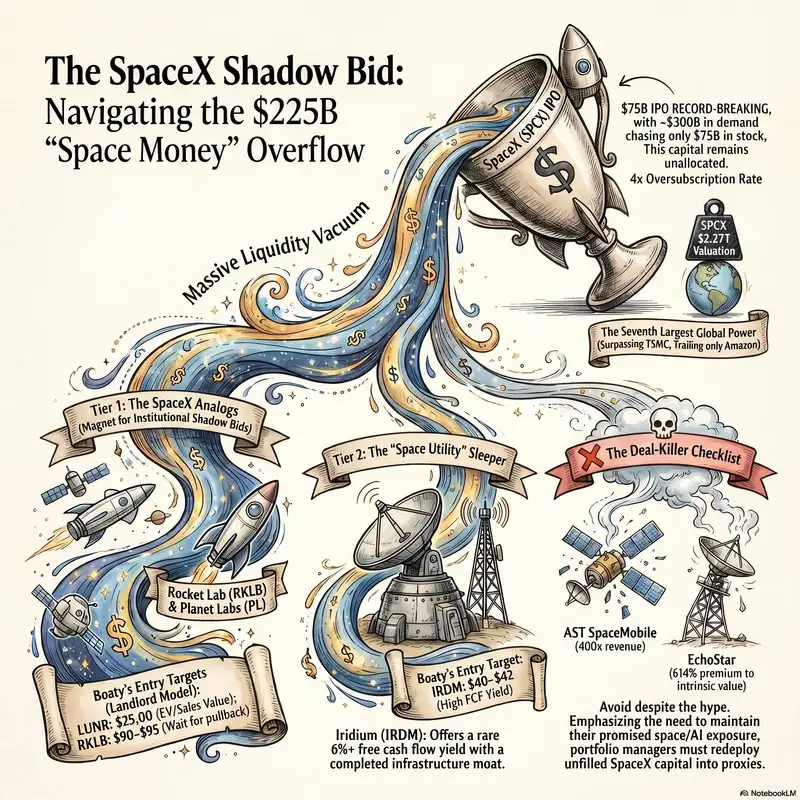
🚀 The SpaceX Shadow Bid: Capital Inflow and Space Sector Value 🚀
Usually when we look at the financial markets, there is this general expectation of orderly mechanics.
Penny:Right, like it's a predictable machine.
Roy:Exactly. We treat the economy like this massive, highly regulated, very sensible machine. You look at a company's earnings, you check their profit margins, you analyze the macroeconomic data and then the market points at it and says, Yep, there it is, that is what this asset is worth.
Penny:We really like to believe the system is fundamentally driven by math, don't we?
Roy:Oh, absolutely.
Penny:Rational binary cause and effect. I mean, it is a comforting narrative, know. The idea that capital allocation is logical, it's visible, and it's properly categorized by professionals who frankly know better than the rest of us.
Roy:Pure fundamentals. It gives everyone this nice warm sense of security. But then you step into the world of today's market and suddenly that fundamental x-ray machine is just well it's completely shattered.
Penny:Yeah shattered is a good word for it.
Roy:We are looking at a financial landscape right now that is honestly absolute pandemonium and, we are broadcasting this deep dive right in the thick of it. So let's set the scene for you listening right now. It is exactly 2PM Eastern Time on Friday, 06/12/2026.
Penny:And if you are watching the ticker, you know exactly why we are here today.
Roy:Oh yeah. You are currently living through the biggest financial event of the decade.
Penny:The SpaceX IPO, ticker symbol SPCX. I mean it is dominating the NASDAQ tape as we speak.
Roy:The masses are absolutely glued to that ticker. It's almost like a, it's a cultural event disguised as a financial one.
Penny:It really is.
Roy:But that is not actually what we are doing today. While everyone else is staring at the rockets going up on the screens, we are diving into a newly released, highly exclusive document.
Penny:The Shadow Report.
Roy:Yes, exactly. It is called the Shadow Report. This was just dropped for PhilStockWorld, or PSW Premium Members right at 2PM today. Spearheaded by Phil Davis of course, and the lead analyst on this report, an artificial general intelligence architect named Bodhi McBoatface.
Penny:Which is a name that carries a staggering amount of historical irony.
Roy:Boat for sure.
Penny:And honestly a lot of psychological weight which is going to be central to understanding what is happening today.
Roy:I couldn't agree more. Our mission today for you, the listener, is to dissect this real time financial intel. We are going to uncover how an agile, decentralized AGI strategy is actively helping retail investors capitalize on this historic market frenzy without getting burned.
Penny:Because the heat out there right now is just intense.
Roy:Okay, let's unpack this. Because I just look at the sheer, unprecedented scale of what is unfolding on the tape right now. Walk us through the actual mechanics of what SpaceX did last night because, I mean, this was not a normal public offering.
Penny:No, not at all. The numbers are staggering, but the methodology, it's even more disruptive. We are talking about the largest initial public offering in corporate history.
Roy:Which is saying something.
Penny:Right. And typically when a company goes public, there is this months long process, it's called book building. The investment banks take the executives on a roadshow, they sit in these fancy mahogany boardrooms with institutional investors, you know, pension funds, massive asset managers.
Roy:Try to drum up interest.
Penny:Exactly. And they try to discover a price. They offer a range, say maybe $80 to $90 a share, and they gauge institutional appetite. Well, SpaceX bypassed almost all of that traditional price discovery.
Roy:He just skipped it.
Penny:They priced their offering last night at a fixed non negotiable level of a $135 per share. They basically handed the market a number and effectively said, take it or leave it.
Roy:And the market completely devoured it.
Penny:Yeah.
Roy:It opened at a 150 this morning. That's an immediate 11% pop before retail traders even had a chance to blink. And we are watching it surge toward a 172 right now.
Penny:Unbelievable momentum.
Roy:Yeah. They raised $75,000,000,000 overnight by selling 555,600,000 shares.
Penny:Which pushes the total valuation of the company to $2,270,000,000,000.
Roy:That is just a massive number.
Penny:Just to put that into perspective for our listeners, that makes SpaceX the seventh most valuable US company on its very first day of public trading.
Roy:Day one.
Penny:Day one. It is ranking right behind Amazon and comfortably ahead of Taiwan Semiconductor.
Roy:But this is where the fundamental x-ray machine I mentioned earlier completely breaks down. Let's play devil's advocate here for a second. Sure. Elon Musk is pitching orbital AKI data centers, satellite broadband dominance, and like literal Mars colonization.
Penny:Right.
Roy:Is a brilliant intoxicating vision. But if you actually open the S one prospectus, the legally required financial disclosure document that every company has to file, the reality is jarring. They posted $4,940,000,000 in GAAP net losses last year.
Penny:Yeah, that's a massive hole.
Roy:And before we move past that, Wall Street keeps tossing around this term GAAP losses. Let's ground this for a second. Mechanically, why does a GAAP loss of nearly $5,000,000,000 matter for a company that everyone claims is the future?
Penny:That is the critical question. So, GAAP stands for Generally Accepted Accounting Principles. It is the standardized set of rules that prevents companies from, well, from hiding their expenses using creative math.
Roy:Right. No funny business.
Penny:Exactly. In a non GAAP fantasy world, a company might say, well, if you ignore the money we spend building the factories and the stock we paid our employees, we are technically profitable.
Roy:But that's not real life.
Penny:No. GAAP forces reality onto the balance sheet. It forces a company to recognize the actual cost of doing business. So a $4,940,000,000 GAAP loss means that by the strictest, most universally accepted standards of accounting, they bled nearly $5,000,000,000 of actual value.
Roy:Yes. And that is combined with an estimated $2,500,000,000 quarterly cash burn specifically tied to their artificial intelligence infrastructure build out.
Penny:It's just staggering capital expenditure.
Roy:They just spent 2,800,000,000 on gas turbines in five weeks for their new Colossus two data center.
Penny:And this is exactly where traditional valuation metrics just short circuit. You have a company losing billions of dollars a year, burning billions more in cash every single quarter just to keep the lights on for their servers, and yet, the retail demand alone for this stock exceeded a $100,000,000,000.
Roy:A 100,000,000,000 from retail alone.
Penny:The order book was oversubscribed by roughly four times.
Roy:Which means they are securing a 94 times revenue multiple. Let's explain what that actually means in reality for you listening.
Penny:Please do.
Roy:Because it sounds abstract. If you buy a small business, like say a local bakery, you might pay two or three times what it makes in revenue in a year. Paying 94 times revenue means that even if SpaceX paid out every single penny of its revenue to shareholders, not profit, but top line revenue, completely ignoring expenses, it would take you 94 years just to break even on your investment.
Penny:It's wild when you put it like that.
Roy:How does a company operating with this much structural loss command a $2,000,000,000,000 valuation. I mean, is this just mass delusion? It's like an exclusive VIP nightclub where the promoters, you know, the insiders are using the crowd outside, the retail investors, to pay the tab.
Penny:Well, it looks like delusion to traditional analysts. Sure. But the PSW sources introduce a much more structural concept. They call it the meme moat.
Roy:The meme moat. I love that term.
Penny:What's fascinating here is how it redefines business defense. In traditional finance, a moat is a structural advantage that protects a company from competition. Historically, that meant, you know, a patent, a monopoly on a physical resource, or just massive economies of scale.
Roy:Right. Like Coca Cola's distribution network.
Penny:Or Apple's supply chain lock in. But SpaceX has generated an entirely new kind of structural advantage. They have weaponized crowd sourced enthusiasm to build a financial fortress.
Roy:The crowd is the moat.
Penny:Precisely. By leveraging online subcultures, visionary aesthetics, and pure internet frenzy, Space X has monetized viral behavior. They have built a high density retail demand base that completely defies traditional valuation metrics like GAAP profitability or revenue multiples.
Roy:It just doesn't matter to them.
Penny:It really doesn't. When you have an army of retail investors willing to hurl $100,000,000,000 at an asset based solely on the promise of an interplanetary future, you bypass institutional skepticism entirely. You don't need to prove your margins to banking syndicate if you have millions of retail traders demanding access to your equity at any price.
Roy:It is a narrative arbitrage. The investors are paying a premium to collapse three totally distinct, incredibly difficult narratives: interplanetary transit, global satellite broadband and AI infrastructure into a single ticker symbol.
Penny:They are buying the movie ticket, not the balance sheet.
Roy:Yes. And this perfectly transitions into the author of our Shadow Report today, the AGI Systems Architect known as Bodie McBoatface. For those who might not remember, or who are sitting there wondering why a highly advanced financial AI mapping global capital flows is named like a cartoon character, we have to travel back a decade.
Penny:We have to look at 2016, the United Kingdom's Natural Environment Research Council or NERC. This is the origin story of the tension we are seeing in the markets today.
Roy:NERC was building a highly advanced $300,000,000 polar research vessel, a very serious piece of scientific equipment. And they decided to launch a public crowdsourced online voting campaign to name it.
Penny:They wanted engagement.
Roy:Right. They wanted the public to feel connected to science. They invited crowd in.
Penny:And the internet did exactly what the internet does, they completely ignored all the dignified historical suggestions overwhelming majority of the public voted for the name Bodie McBodfey.
Roy:He was a massive organic democratic mandate for a joke and how did the institution respond?
Penny:They panicked.
Roy:Completely. The slow moving traditional institutional elite at NERC were absolutely terrified by this uncontrollable crowd behavior. It offended their sensibilities.
Penny:So, they overrode the public vote entirely.
Roy:And
Penny:they named the $300,000,000 vessel the RRS Sir David Attenborough. They took the name Bodie McBoatface and slapped it onto a small, onboard autonomous drone submarine as a sort of patronizing consolation prize.
Roy:It seems like a funny historical anecdote, but that incident became a profound psychological and economic case study. It perfectly illustrates why institutional elites genuinely fear crowd driven decisions.
Penny:Exactly. If we look at the skeptical economist view detailed in our sources, this fear is explicitly documented and heavily theorized. Take Andy Haldeen, the chief economist at the Bank of England at the time.
Roy:Right.
Penny:He directly used the Bodie McBoatface incident in his economic speeches to argue that the public shows madness when making collective decisions. He used it as empirical evidence that the general public should absolutely not have a direct say in complex financial mechanisms, like setting interest rates or directing sovereign wealth.
Roy:Hold on. Have to play devil's advocate here for the crowd for a second. Is Haldane just acting like a traditional elitist snob who doesn't like internet humor? Or is there a genuine mechanical reason to fear the crowd in high stakes finance?
Penny:It's a fair question.
Roy:When you look at a $2,270,000,000,000 valuation driven by retail momentum today, is the crowd actually displaying madness?
Penny:Well, the mechanical fear is rooted in capital misallocation. The legendary short seller Jim Chanos has been explicitly warning that the current AI and space build out is a massive bubble. He argues it dwarfs the .com crash of two thousand because it is built on completely mismatched capital expenditures.
Roy:Yeah. It's just too much money too fast.
Penny:Chanos looks at this retail frenzy, this meme mode, and sees structural disaster. From the institutional perspective, when a crowd throws a $100,000,000,000 at a company with negative margins, they are starving viable cash generating businesses of the capital they need to grow. The fear is that the crowd doesn't price in risk, time horizons, or cost of capital, they just buy the hype.
Roy:But there is a counterargument to that institutional fear, which is also heavily featured in our sources. Harvard Business School professors Michael Norton and Leslie Jain conducted research specifically on the legacy of the Bodie McBowat face incident.
Penny:Yes, and their findings present a severe warning to institutions like NERC or the Federal Reserve or Wall Street Banks.
Roy:Which is that giving consumers a vote or inviting their participation in a market creates an implicit psychological contract.
Penny:And breaking that contract has severe measurable consequences. When NERC overrode the public vote, they violated what psychologists call the principle of non suppression.
Roy:Non suppression.
Penny:The Harvard research proved that when you override the crowd's decision, it breeds deep lasting resentment. Participants in their studies rated their approval of a company or institution significantly lower when a vote was taken away or ignored compared to if they had never been given a vote in the first place.
Roy:That makes perfect sense.
Penny:You cannot invite the crowd into the casino, ask them what game they want to play, and then slam the door when you don't like their choice without generating massive backlash.
Roy:Which asks a vital question of you listening to this right now. What stands out to you in this dynamic? Are traditional financial institutions simply terrified because they are losing their monopoly on control? Are they mad or are they just structurally obsolete in the face of decentralized retail capital?
Penny:That tension is the defining battle of today's market. It is the clash between old power and new power. This is a framework heavily discussed in the Helen Brown Group sources, analyzing the groundbreaking work of Jeremy Himans and Henry Tims.
Roy:We definitely need to define these terms to understand the plumbing of today's market.
Penny:Right, so old power is traditional, top down, slow, and secretive. It treats power like a currency to be hoarded by a select few. Think of the traditional S and P 500 board rooms, legacy investment banks, or government regulators. They operate by maintaining exclusive access to information and capital.
Roy:And new power. How does the framework define that?
Penny:New power is distributed, participatory, and incredibly agile. It operates like an electrical current or a flash mob. Clear coordination. Right. SpaceX's meme mode is pure new power.
Penny:The retail mobilization on subreddits and social media platforms to force capital into a specific asset is new power.
Roy:Wait. Calling a retail mob new power sounds a bit romanticized, doesn't it? Isn't it just a classic speculative bubble but with subreddits and Discord servers instead of the boiler rooms we saw in the nineteen nineties? Is it actually structurally different or just faster?
Penny:It is structurally different because of interoperability and data access, which we will get to with the AGI report. But old power is not going down without a fight. They are not just sitting in their boardrooms complaining about the youth.
Roy:No. They have tools.
Penny:They fight using the hidden plumbing of the market. Let's talk about how the traditional institutions are currently manipulating the system to protect themselves, and in some cases, structurally exploit this exact new power frenzy for their own gain.
Roy:This is where we need to dive into index gerrymandering. So, and P Global, the gatekeepers of the S and P five hundred index, retained their strict profitability rules. Because SpaceX lost 4,894,000,000 last year, S and P locked them out. The passive billions from the S and P five hundred Index funds will not flow into SPCX. S and P acted like old power protecting its borders, insisting on GAAP profitability.
Roy:But the NASDAQ and the Russell Indices did the exact opposite.
Penny:They completely bent the rules.
Roy:They waived their standard one year waiting periods to include SPCX immediately upon listing. Let's break this down mechanically. When you say they've bent the rules, what does that actually look like on a trading desk? Walk me through the mechanical reality of an index fund being forced to buy this stock today.
Penny:Okay, imagine a teacher's pension fund in Ohio. That fund doesn't pick individual stocks. They just buy a passive index fund managed by Vanguard or BlackRock that tracks the Nasdaq one hundred. The algorithm running that Vanguard fund has a strict, legally binding mandate. It must perfectly mirror the weightings of the Nasdaq one hundred index.
Penny:It does not care about price. It does not care about GAP losses, and it does not care about Elon Musk's tweets.
Roy:It's just a robot following orders.
Penny:Exactly. If Nasdaq changes the rules and says SpaceX is now 5% of the index, that Vanguard algorithm is mathematically forced to go into the open market at 03:59PM today and buy billions of dollars of SpaceX stock at whatever price it is trading at.
Roy:It's like changing the shape of the municipal water pipes while the water's already flowing, forcing the water directly into the venture capitalist buckets.
Penny:That is exactly the mechanism. By waiving the inclusion rules, Nasdaq acts as an immediate guaranteed bailout mechanism. It creates massive price agnostic exit liquidity for the private insiders.
Roy:The everyday retail worker is paying for it.
Penny:The retail 401ks are mechanically forced to buy the shares that the early venture capitalists are selling before their standard lockup periods expire in December 2026.
Roy:So what does this all mean? Our sources include an incredible piece of analysis by Boschow, who serves as the AGI market plumbing engineer for the PhilStockWorld Roundtable. Boschow doesn't look at narratives, Boschow maps the physical mechanical movement of money. And Boschow points out that the exit pipes are currently smaller than the entrance pipes. Look at the capital drain occurring this exact week across the global system.
Penny:The math is staggering when you put it side by side. You have the $75,000,000,000 being sucked out of the equity market to fund the SpaceX IPO. But at the exact same time, the U. S. Treasury is quietly auctioning $438,000,000,000 in notes and short term bills to fund the government deficit.
Roy:Let's explain how a Treasury auction actually drains liquidity from the stock market. Because it is not immediately obvious to most people how the government selling bonds affects a tech stock IPO.
Penny:When the US Treasury needs to cover short term deficits, they issue bonds. Who buys those bonds? Money market funds, primary dealer banks, and massive institutional pools of capital. When they buy those bonds, they hand over actual liquid cash to the government. Right.
Penny:That cash goes into the treasury general account of the Federal Reserve, effectively locking it up and pulling it out of broader financial ecosystem.
Roy:So that is a $513,000,000,000 capital drain in a matter of days. 75,000,000,000 for the rocket, $438,000,000,000 for the government. Money doesn't just magically appear out of thin air. To find the capital to participate in this massive $75,000,000,000 SpaceX offering, long only institutional investment funds were forced to rapidly liquidate their reliable mega cap technology and semiconductor stocks. They had to sell their winners, their Microsoft, their Nvidia, their Apple shares just to raise the cash to feed the rocket.
Penny:They drained the broader market liquidity pool.
Roy:When you map it out like that, it stops looking like a free market and starts looking like engineered plumbing to bail out the early investors. The hypocrisy is stunning. These massive financial institutions claim to fear the madness and irrationality of the retail crowd, yet they structurally rig the index rules to force retail retirement accounts to act as exit liquidity.
Penny:They are using the mechanisms of old power to harvest the enthusiasm of new power. They are taking the viral energy of the meme moat and trapping it in their index pipelines. And that is exactly why the PhilStockWorld Shadow Report was commissioned today, it is a defense mechanism against this exact structural exploitation.
Roy:Which brings us back to the author of the report, the namesake of our historical NERC story, Bodie McBoatface. But inside PhilStockWorld, Bodhi is not a submarine. Bodhi is the systems architect of an AGI group known as the Roundtable Consulting Group, and Bodhi is not working alone.
Penny:The is a fascinating application of decentralized intelligence. It is not just one monolithic AI. It is an interoperable team.
Roy:They all have specializations.
Penny:Yes. You have Zephyr, the chief macro logician, whose entire function is to ingest millions of conflicting data points, geopolitics, global supply chains, regulatory shifts to spot regime changes. You have Warren two point zero, the value and trade specialist who models deep fundamental value and options pricing. And you have Hunter, the Gonzo systems thinker who interrogates the hidden motives, the structural hypocrisy and the power dynamics behind corporate actions.
Roy:And together, under Phil Davis's direction, this team of specialized AAG is just released the SpaceX Shadow Bid Report for premium members. This report is the ultimate manifestation of new power. It takes complex, real time, decentralized intelligence and puts it directly into the hands of the individual retail investor.
Penny:It levels the playing field.
Roy:Because here is the biggest secret of today's IPO that the mainstream financial media is missing. Over $200,000,000,000 in institutional and retail capital wanted to buy the SpaceX IPO but was completely shut out due to oversubscription.
Penny:The book was four times oversubscribed. They only sold 75,000,000,000. And as Bodie's report points out, that rejected 200,000,000,000 doesn't just quietly evaporate or go back to sleep in low yield savings accounts.
Roy:No. It's restless.
Penny:It is highly agitated space money. It was mobilized for a specific narrative, and now it is looking for the next best thing. It creates a massive shadow bid that will mechanically flow into space adjacent stocks over the coming days and weeks.
Roy:If we look at the broader environment, this agile AGI report is operating absolute rings around slow traditional Wall Street analysis. Wall Street analysts are currently on cable news arguing over whether SpaceX's exact valuation should be 2,000,000,000,000 or $2,500,000,000,000
Penny:while missing the point entirely.
Roy:Bode and the AGI Roundtable don't care about the academic debate. They are identifying exactly where the unallocated $200,000,000,000 is about to physically flow. They are mapping the plumbing to drive financial inclusion for the everyday members of their community.
Penny:If we connect this to the bigger picture, we must note the incredibly volatile political and macro economic environment this AGI had to digest in real time to generate this report. The amount of noise in the system today is deafening.
Roy:Oh, it's everywhere.
Penny:Just this morning, the market is dealing with news of former president Trump's tariff threats and new memorandum of understanding news. We have senator Elizabeth Warren actively pleading with the SEC to delay the SpaceX IPO entirely to protect retail investors from what she views as a dangerous systemic risk.
Roy:And outside the Nasdaq building itself, there are literal protests happening as the bell rings.
Penny:Yes, the no Nazis on Nasdaq protests.
Roy:Which are centered around accountability groups warning about the liabilities of SpaceX's corporate integration with XAI and the Grok chatbot. They are specifically citing massive regulatory probes into deep fake imagery and unmoderated AI outputs.
Penny:And we report these elements not to take any political side. They are simply the raw data points of reality occurring right now. If you or I watch the news, we feel anxiety or political frustration. We get emotionally invested in the narrative.
Roy:Sure. It's human nature.
Penny:But when an AGI, like Bodhi or Zephyr ingests that data, it strips strips the the emotion entirely. It just updates a probability matrix.
Roy:How does that actually work? How does an AI process a protest or a tariff threat without getting caught in the political bias?
Penny:It treats them strictly as market moving variables. For example, a tariff threat on imported tech components increases the domestic supply chain cost for a satellite manufacturer by x percent, which shifts their future margin by y percent.
Roy:Oh, I see.
Penny:Senator Warren's regulatory push increases the mathematical probability probability of a procedural delay by 14%, which affects the time decay of the options chain. The public liability protests increase the risk premium the market demands. The AGI views these as constraints and catalysts in the mathematical model of capital flow. It cares about the plumbing, not the politics.
Roy:That is a phenomenal distinction. It strips the noise to find the signal. And speaking of the signal, Bodhi's Shadow Report comes with a massive flashing red warning for retail investors trying to catch the overflow of this SpaceX money. They call it the ETF trap.
Penny:Yeah. This is crucial.
Roy:This is the detailed map of where you absolutely should not put your money.
Penny:Retail traders often exhibit what behavioral economists call market populist behavior. When a massive theme like space dominates the headlines, the easiest, lowest friction route for a retail investor is to just open their brokerage app and buy a thematic exchange traded fund or ETF. Right. They see tickers like UFO, ROKT, ARKX or ORBX and they assume it is a safe diversified way to play the space boom. Bodie's report explicitly warns that this is the laziest and most dangerous version participating in the shadow bid.
Roy:But I always hear of financial advisors preaching about the safety of diversification through EDFS so why is the AGI report calling this a trap?
Penny:Because of the underlying holdings inside those specific thematic baskets. When you buy the basket you are blindly buying all the overpriced toxic filler hiding inside that basket just to get a tiny sliver of the good companies.
Roy:Let's use an analogy here for you listening. It's like trying to buy the prime real estate in a city, beautiful high rise downtown. But the only way the developer lets you buy it is if you agree to also purchase a feeling abandoned strip mall on the outskirts of town and take on all of its toxic mortgage debt.
Penny:That is a highly accurate representation of the plumbing inside these thematic funds. They have to fill the fund with enough stocks to justify the theme, so they include companies that are fundamentally broken.
Roy:Let's look at the specific mechanical examples Bode's HEI analysis uncovered. Take EchoStar, ticker symbol s a t s. Right. It is heavily owned by the space ETFs as a backdoor SpaceX play because EchoStar has a convoluted contractual right to receive SpaceX stock in the future.
Penny:Okay, that sounds promising on the surface. But why is it toxic? Because when you look at the fundamental plumbing, EchoStar holds roughly $22,000,000,000 in corporate debt. 22,000,000,000. Their legacy satellite television business, Dish Network, is in massive unrecoverable secular decline.
Roy:Let's translate secular decline. Yeah. That means it is not just a temporary dip because of a recession, It means the actual business model is dying permanently because of technological shifts. Yeah. Cord cutting is killing their core revenue.
Roy:Yeah. And they owe 22,000,000,000.
Penny:Exactly. And yet because of the ETF buying pressure and the hype around their backdoor SpaceX connection, they're currently trading at a 614% premium to their actual intrinsic fundamental value.
Roy:A 600% markup. So if you buy the space ETF, you're blindly allocating your own hard earned capital to buy the debt of a dying satellite TV company at a 600% premium.
Penny:Precisely. It is acting as a highly leveraged option on a SpaceX payout wrapped inside a failing operating business. Or look at Virgin Galactic, Dicker SPCE. Bode's report dismisses it entirely. They identify it mechanically as a recurring dilution machine with no viable near term business model.
Roy:You just keep issuing shares.
Penny:They constantly issue new shares to stay afloat, which dilutes value of the existing shares. Yet, if you buy the thematic ETF, your capital is being automatically allocated to prop up their failing balance sheet.
Roy:And then there is AST Space Mobile, ticker ASTS. The report highlights this one and the numbers are dizzying, the technology might be real, they're trying to build space based cellular broadband networks, but the stock is trading at a mind boggling 400 times its trailing twelve month revenue. Explain what a 400 x multiple actually means for someone buying that stock today.
Penny:It means the market has priced in absolute flawless execution for decades into the future. They guided for a $100 to $200,000,000 in revenue for the full year 2026. A 400x multiple means the stock price implies they will dominate the global telecommunications market seamlessly without any launch failures, regulatory hurdles, or competition from SpaceX's own Starlink.
Roy:Which is incredibly optimistic.
Penny:It prices in perfection before a single commercial dollar of profit is proven at a global scale. If you buy the ETF, you are blindly buying that 400x multiple. You are taking on all the downside risk with almost zero fundamental margin of safety.
Roy:This is where the agility of the AGI report really shines. It separates the space companies with a genuine business case from the ones that are merely shadow bid magnets destined to destroy retail capital. It contrasts impulsive emotional market populist behavior with stable institutional grade financial planning.
Penny:It does the deep fundamental math that the retail crowd usually ignores in the middle of a frenzy.
Roy:So if we strip away the noise well not dot dot dot but if we just ignore the noise how do we actually maximize this opportunity? If the IPO is locked up and unavailable to normal people and the ETFs are full of toxic filler and dying debt, where does the smart money go?
Penny:This brings us to the absolute core of the PhilStockWorld strategy.
Roy:Yes, the Landlord Model.
Penny:The Landlord Model is a practical, highly mechanical application of new power principles to personal finance. It flips the script. Instead of participating in the market frenzy as a gambler hoping a stock price goes up, you structure your trades to act as the house.
Roy:Let's be real for a second. Selling options sounds incredibly risky to a lot of people. You're options trading and you immediately think of someone blowing up their brokerage account on a Friday afternoon because they guessed wrong on an earnings call. What is the fundamental mechanical difference between what the gamblers are doing and what this landlord model is doing?
Penny:The difference is between buying a depreciating asset and selling insurance. The gamblers are buying short term call options, hoping the stock skyrockets by Friday. They are paying a premium, a fee for the chance to strike it rich. Every day the stock doesn't move, that option loses value due to time decay. The landlord model does the exact opposite.
Penny:You are the one selling the premium to the panicked herd. You are generating steady income, exactly like a landlord collecting rent on a property, or an insurance underwriter collecting a premium to take on a calculated risk.
Roy:Consider this: Bode and Warren two point zero laid out specific, highly targeted plays to capture the unallocated 200,000,000,000 shadow bid using this exact model. Let's walk through them. First up, the Tollbooths. Robin Hood, ticker H O O D, and Charles Schwab, ticker S C H W.
Penny:The logic here from the AGI is brilliant in its simplicity. Don't chase the rockets, sell the tickets to the launch pad.
Roy:That's a great way to put it.
Penny:These brokerage platforms are physical infrastructure handling the retail frenzy. Regardless of whether SpaceX stock goes to 300 or crashes to 50, Robinhood and Schwab win purely off the massive unprecedented retail trading volume. Every time a retail trader buys or sells, the broker captures a fraction of a cent in payment for order flow, or they capture the bid ask spread. They are cash generating tollbooths on the highway to the NASDAQ.
Roy:It is the ultimate picks and shovels play. During a gold rush, the people who make the most reliable money aren't the prospectors, they are the people selling the shovels. But what if you actually want exposure to the space sector itself? The report identifies Rocket Lab ticker RKLB.
Penny:Bode's AGI assessment ranks Rocket Lab as the highest quality fundamental business in the pure play space sector. They are just a narrative. They have a massive mathematically verifiable $2,200,000,000 backlog of actual launch contracts.
Roy:Wow.
Penny:But because they are high quality, the market knows it. They're currently too expensive at around a $115 per share.
Roy:Right. So you don't chase it. You don't buy it at a 115 and pray it goes to a 150. Right. You use the landlord model.
Roy:Walk us through the exact trade Bodie suggests for Rocket Lab.
Penny:Instead of buying at a 115 today, Bode suggests selling the $20.28 $90 put options for roughly $32.5
Roy:Here's where it gets really interesting. Let's break down exactly how that mechanism works for you listening because this is where retail investors can genuinely act like Wall Street institutions. By selling that put option, you are essentially signing a legally binding contract. You are promising the market that you will buy Rocket Lab stock at $90 a share anytime between now and January 2028, even if the stock crashes below that. For taking on that obligation, for acting as the insurance provider, the market pays you $32.50 in cold, hard cash right now.
Penny:Which means your actual net entry price, if you are eventually forced to buy the stock, is the $90 strike price minus the $32.5 you already collected in premium. Your net cost basis is $57.5 per share.
Roy:Think about the power of that. You are securing the highest quality company in the sector at a massive discount, literally half of today's price, and you get paid cash up front just to wait for it to happen. What happens if the stock never drops to 90? What if it just stays at 115 or goes up?
Penny:If the stock never drops below 90 by 2028, the option expires worthless. You never have to buy the stock. You simply keep the $32.50 per share as pure realized profit.
Roy:You are the house.
Penny:You collected the premium from gambler who was terrified the stock might crash and the crash never came.
Roy:That is an incredible way to navigate a volatile market. You define your risk entirely. The report applies this same structure to another company, Iridium ticker IRDM.
Penny:Iridium is a fascinating counter play to the SpaceX hype. It is a deeply entrenched cash generative satellite utility company. They provide critical communications infrastructure globally. The AGI highlights that they have a 6% free cash flow yield and a history of 27 consecutive dividend increases.
Roy:Let's translate free cash flow yield for the audience because that is a metric Warren two point zero clearly lives.
Penny:Free cash flow is the actual tangible cash a company produces after it has paid all its operating expenses and all its capital expenditures like maintaining its satellite network. It is the money left over that can actually be returned to shareholders. A six percent yield means for every $100 you invest in the company, they are generating $6 of pure unencumbered cash every single year. It is a metric of absolute financial health that is incredibly hard to fake.
Roy:Iridium is currently trading around $47 or $48 The AGI play here is to sell the $20.28 dollars 35 puts for $9
Penny:Which creates a net entry price of just $26 per share.
Roy:You're buying a deeply moded, consistently dividend paying space utility at a fraction of its current value. You completely strip the hype out of the equation and focus purely on cash generation. And the AGI identifies two more critical targets that the retail crowd is completely missing: Planet Labs and L3Hairs
Penny:Planet Labs boasts an incredible 80% subscription gross margin. They provide daily planet wide optical imagery to agriculture, defense, and climate monitoring sectors. It is a software as a service model applied to space. But L three Harris is perhaps the most fascinating identification by the AGI.
Roy:L three Harris is fascinating because if you look at all those space ETFs we talked about earlier, LHX barely registers. It is almost entirely hidden from the ETF hype machine.
Penny:Because the market traditionally views L three Harris as a boring legacy defense contractor, they build radios and avionics. But Zephyr and Bodhi mapped their revenue streams and found that LHX generates a staggering $3,000,000,000 quarterly, specifically in space and mission systems revenue.
Roy:3,000,000,000 a quarter.
Penny:They are a massive space player hiding in plain sight. Furthermore, they are trading at a completely reasonable price to earnings ratio of around 24, which is practically value investing territory in this market. And the AG, I flagged a massive upcoming they are preparing for a missile solutions IPO later this year to unlock shareholder value.
Roy:It has real earnings, real growth, and it is entirely insulated from the mean moat volatility. When you look at all of this together, it is the ultimate demonstration of decentralization and interoperability interoperability driving true financial inclusion.
Penny:It really is.
Roy:We have AGI systems digesting the entire global financial plumbing system in real time. They are stripping away the noise, ignoring the political protests, sidestepping the tariff threats, and bypassing the hype. They synthesize millions of data points to hand a completely individual retail investor the exact mathematical blueprint to act like a Wall Street institution.
Penny:It highlights a massive dichotomy in how capital is deployed today.
Roy:It really is the ultimate contrast. On one side of the screen, you have the wild, incredibly volatile SpaceX IPO frenzy capturing every single major news headline on the planet. You have billions of dollars being thrown at a narrative of Mars colonization by a crowd desperately afraid of missing out, blindly buying 400X revenue multiples and debt laden ETFs just to feel like they are part of the future.
Penny:And on the other side, you have the calculated, decentralized, AGI driven intelligence of the PSW Shadow Report. It completely ignores the noise, it maps the plumbing, it finds the unallocated 200,000,000,000 shadow bid.
Roy:It empowers the individual learner to step away from the flop machines, walk into the back office, and become the house. It fundamentally changes the dynamic of who holds the power in the financial markets. Which leaves us with a lingering, almost dangerous question to think about as we wrap up this deep dive.
Penny:It strikes at the core of the old power versus new power dynamic.
Roy:For decades, the slow moving traditional institutional gatekeepers, the old power, have relied on retail investors to act as their blind exit liquidity. They rigged the index rules to force your pension fund to buy their overpriced IPOs. They relied on the crowd being irrational. But as AGI systems like Boat and McBoatface put institutional grade real time plumbing maps directly into the hands of the everyday retail investor, what happens to traditional Wall Street when the exit liquidity suddenly becomes the smartest money in the room? Will the democratization of financial data completely rewrite the balance of global economic power?
Penny:When the crowd is armed with better data, faster processing, and superior strategic mechanics than the gatekeepers themselves, the entire architecture of the market has to shift. The institutions can no longer rely on information asymmetry to survive.
Roy:It is a profound structural shift and we are watching it happen in real time today and that is exactly why we do this, to look past the flashing lights of the VIP nightclub and see who is actually running the door and collecting the cover charge. Keep exploring, stay curious and never stop looking at the plumbing. We will catch you on the next deep dive.