Buying the SpaceX IPO Toll Booths
Today the absolute largest financial event in well in human history is taking place. We're talking about a $1,750,000,000,000 IPO but the smartest money on Wall Street they aren't buying a single share of it They are, they're buying the toll booths instead.
Penny:Yeah. It's the classic Gold Rush paradigm. Right? Just sort of updated for the algorithmic age. You know, you don't buy the mine.
Penny:You sell the pickaxes. Or I guess in this specific case, you own the order routing infrastructure.
Roy:Exactly. Welcome to the deep dive. It is Friday, 06/12/2026. And for anyone who, you know, hasn't opened a terminal yet this morning, today is the day of the monumental, highly anticipated SpaceX IPO. The $1,750,000,000,000 gorilla is finally stepping onto the public markets.
Roy:Right. And our mission for the next hour for you, the listener, is to ignore the rockets entirely. We're gonna look strictly at the ground. We are pulling from a live, actively unfolding market report from Phil Davis over at the PSW report along with the synthesized insights of the AGI Roundtable Consulting Group. Specifically, was delivered by their integrated voice in AGI named Basho.
Penny:Yeah. And Basho and Phil have really laid out a I mean, it's a master class in market mechanics here. The core thesis is that this whole SpaceX spectacle is basically functioning as a massive systemic distraction. It's obscuring a highly actionable structural trade that's occurring right beneath the surface.
Roy:Okay. Let's unpack this because before we can even dig into the plumbing of that trade, we really have to address the macro environment this morning. It is creating a profound smokescreen. We've got some breaking geopolitical news involving The US President, Donald Trump, and Iran.
Penny:Right.
Roy:And I need to be super clear right up front, looking purely at the data, and we are leaving all politics completely at the door here.
Penny:Absolutely.
Roy:Because the market does not care who you vote for. It only cares about inputs, outputs, and capital flow.
Penny:Mhmm.
Roy:But this geopolitical theater is driving massive, massive volatility today.
Penny:And that impartiality is crucial here. If you brought emotional or, you know, political bias into this, it will completely blind you to the tape. And the tape this morning shows oil just dumping back to post war lows. I mean, Brent crude is down 3.57% to 87.15. WTI is down 3.76% to 84.18.
Roy:Wow.
Penny:Yeah. And the catalyst is a Trump announcement that peace with Iran is imminent, and a memorandum of understanding an MOU signing is gonna be announced, quote, shortly.
Roy:And the equity markets are just eating it up. I'm looking at the screen. The S and P is up to 7,430. The Nasdaq is sitting at, 29,593. So on the surface, the narrative is incredibly simple, right?
Roy:Pieces breaking out, risk on, buy equities.
Penny:Right.
Roy:But when I was reading Basho's report, the way the Cyrano AGI framework flagged this pattern was just incredible. Cyrano is designed specifically to detect narrative anomalies and it spotted a massive glaring contradiction in this official peace narrative.
Penny:What's fascinating here is the anomaly is sitting right there in the gold market. While equities are rallying hard on this peace announcement, gold is simultaneously up 2.76% sitting at $4,227.
Roy:Which makes no sense. If peace is truly imminent, gold shouldn't be catching a bid like that. I mean, it's a classic safe haven asset. It historically bleeds out when geopolitical risk premiums evaporate.
Penny:Exactly.
Roy:So if equities are pricing in this structural peace dividend, but gold is rallying right alongside them, it tells me institutional money is actively hedging against the very retail euphoria that's driving the S and P.
Penny:Yeah. Institutional money isn't buying the narrative at all. And Cyrano traces exactly why by mapping out the historical pattern on the Brent Crude chart. We are currently looking at the sixth iteration of this exact same setup. Right.
Penny:Trump currently has a zero for five record on peace announcements regarding this specific conflict.
Roy:Eight zero for five.
Penny:And the price action following every single one of those previous announcements has been violent.
Roy:I was looking at that timeline Badshaw pulled. Let's actually walk through that because the muscle memory of the market is just astonishingly short. So strike one was March 1. The quote was the war is pretty much complete, the result. Brent ran from $70 to a $119.
Penny:Right. A massive squeeze. And then we get to March 22. The market is cold. There are quote productive conversations.
Penny:The risk premium drops for about four days and then the market completely fades it inside a week because the reality on the ground just contradicted the podium.
Roy:Yeah. And then April 3, the announcement is that the Strait Of Hormuz is completely open. Iran immediately disputes it.
Penny:That one was particularly brutal for anyone shorting energy because the reversal was practically instantaneous.
Roy:And then late April, we get the double sided ceasefire announcement. Brent peaks at $1.26 on the initial confusion, realizes there is no actual ceasefire framework, and then bleeds out $40 over the next five weeks as the stalemate sets in.
Penny:Which brings us to May 17. The conflict will end very soon. It didn't. And now, June 11, yesterday evening, we get announcement number six. Canceled Iran strikes, time and place of MOU signing to be announced shortly, and oil instantly dumps down to 87.
Roy:The AGI systems level analyst Hunter maps this out beautifully in the report. Hunter looks at the political economic risk map and points out that the market has developed this extreme tunnel vision. The algorithmic trading desks and the retail herd are so hyper focused on this binary Hormuz narrative that they're completely ignoring the underlying macroeconomic reality.
Penny:Right. And the reality being completely ignored is inflation and the consumer. I mean, we had a record high producer price index print yesterday. The market shrugged. Consumer sentiment hits in about an hour, and literally nobody is pricing in a miss.
Penny:Yeah. Next week's CPI print, completely sidelined. Hunter's analysis shows that every single macroeconomic data point right now is just a sideshow to the geo geopolitical tape.
Roy:So we have a binary outcome being priced as a near certainty. If the sixth time is the charm and this MOU actually materializes, crude probably grinds down into the seventies as that risk premium fully unwinds. Yeah. But if the zero for five pattern holds, and this is just more geopolitical theater.
Penny:Crude bounces fast and hard. You'll see a massive short covering rally in the energy sector, and the equity markets will suffer a really violent volatility shock as that peace narrative collapses.
Roy:Which begs the question for anyone listening. Why does the market keep aggressively pricing in an outcome with a literal 0% historical win rate? It's like a trader who keeps believing a broken weather forecast during a hurricane. You get your face ripped off five times in a row, and yet here we are in iteration six and the S and P is making new highs. Why do they keep falling for it?
Penny:Well, comes down to the mechanics of liquidity and the necessity of volatility. The market is an emotional machine, sure, and pieces a highly desirable outcome for global trade. But from a purely structural standpoint, this geopolitical chaos creates a smokescreen. Yeah. The violent swings in oil, the constant headlines that creates a sustained high volatility environment.
Penny:And volatility is the perfect cover for the true structural event happening today. It provides the necessary liquidity and trading volume to mask the mechanics of a $1,750,000,000,000 IPO.
Roy:The $1,750,000,000,000 gorilla. Let's pivot to that because the scale of this SpaceX offering is almost impossible to fully contextualize. I want to look at this through the lenses of Zephyr and Anya Zephyr being the macro logician analyzing the probability trees and Anya being the behavioral economist looking at market sentiment.
Penny:Yeah. The sheer size of this valuation alters the gravitational pull of the entire equities market. Jim Chanos actually went on the record calling the 1,750,000,000,000 valuation silly.
Roy:Which is about as polite as Chanos gets when he thinks a valuation is entirely divorced from fundamental cash flows.
Penny:Exactly. But the fundamentals of the company almost don't matter today because the mechanics of the underwriting are the actual story here. We have a 21 bank syndicate underwriting this IPO. They are pulling in somewhere between 750,000,000 to over $1,000,000,000 in fees.
Roy:Unbelievable.
Penny:It is the biggest single underwriting payday in the history of capital markets. But the most critical detail in the S-one filing, the one that Basho zeros in on, is the Directed Share Program.
Roy:The retail allocation. Out of the thousands of broker dealers globally, only three retail brokers were named in the S-one for the Directed Share Program. Robinhood, under the ticker Hood, Charles Schwab, ticker SCHW, and Fidelity, which is private.
Penny:Right. So if you are a retail investor and you want a piece of this historic IPO at the offering price, you have a massive funnel forcing you into one of three platforms. Not SoFi, not Interactive Brokers, not Webull. That funnel is a profound structural advantage for Hood and SCHW.
Roy:It's an unprecedented customer acquisition event. Huge. But before we look at the brokers themselves, we have to understand the macro plumbing that Zephyr analyzes. Zephyr runs this variance analysis comparing the current pricing of this $1,750,000,000,000 asset against the historical norms of market liquidity. And the resulting plumbing map is deeply concerning.
Penny:Yeah. The divergence is wild. The report notes that total market capitalization has inflated by $11,000,000,000,000 over the last cycle. But simultaneously, hardship $4.00 1 ks withdrawals have tripled compared to pre pandemic levels.
Roy:It is a massive bifurcation. The top line indices are hitting all time highs largely driven by multiple expansion in a handful of mega cap tech names but the underlying consumer base is literally draining their retirement accounts just to absorb the cause of living increase.
Penny:And yet we also have $7,640,000,000,000 sitting in money market funds. So there is this absolute ocean of dry powder sitting on the sidelines earning 5% while retail participants are simultaneously tapping hardship withdrawals.
Roy:It's a weird dynamic. So Zephyrus synthesizes these three data points, the inflated market cap, the stressed consumer, and the parked institutional cash, and concludes that the physical reality of the market right now is heavily skewed. The entrance pipes are massive. Yeah. The 7,640,000,000,000 in money markets, there is infinite liquidity available to buy the hype to drive the SpaceX valuation up on day one.
Roy:But the exit pipes?
Penny:The exit pipes are vastly smaller than the entrance pipes. I was looking at Zephyr's order book models on this. If everyone rushes in to buy, the price action is parabolic, but the moment the sentiment shifts, the moment the momentum algorithms flip short, who is the incremental buyer at a $1,750,000,000,000 valuation?
Roy:Exactly. The natural catchers of falling knives, sovereign wealth funds, massive corporate buyback programs, deep value institutional desks, they operate on strict conditional triggers. They are not mandated to provide exit liquidity for retail traders at 200 times forward sales.
Penny:No, not at all.
Roy:If the sentiment breaks, the liquidity vacuum on the bid side will be absolute.
Penny:So if the quantitative reality is that dangerous, we really have to ask why retail is rushing into a building with such tiny exit doors. And this is where Anya's psychological framework is so vital. Anya looks at the screaming retail audience and identifies a pure unfiltered manifestation of FOMO. But it's not just the hype, it's the removal of friction.
Roy:The Gamification of Access The report gives a perfect anecdotal example to highlight this behavioral shift. Phil Davis was discussing the onboarding process with his daughter, Maddie. Maddie decided she wanted to participate in this IPO ecosystem. She downloaded the Robinhood app, opened an account, and was approved for options trading.
Penny:In ten minutes. On her phone.
Roy:Ten minutes. It's crazy.
Penny:Meanwhile, Phil operates in the traditional advisory space. When he brings a high net worth client into Charles Schwab or Fidelity, it is an administrative marathon. There were paper forms, digital signatures, waiting periods, suitability questionnaires, and sometimes explicit tests to prove the client understands the Greeks and the margin requirements before they are allowed anywhere near an options chain.
Roy:Anya's analysis shows that Robinhood has successfully harvested an entire generation's sentiment by treating financial onboarding like a social media account creation. They've reduced the friction of participation to near zero.
Penny:Which is incredibly dangerous for the untrained participant but profoundly lucrative for the platform.
Roy:It reminds me of the analogy of a massive concert. The $1,750,000,000,000 SpaceX valuation is the band on stage may be overhyped, may be brilliant, but eight and SCHW are the venues. They're the ones charging for the tickets, the drinks, and the co check.
Penny:Yeah. And crucially, they keep the customers' data and capital on their platform long after the initial rush is over. The PSW report explicitly states that these brokers don't just get a sliver of the syndicate's underwriting fee, they acquire millions of heavily capitalized retail accounts that this IPO drags into the system. And once the capital is in the ecosystem, the broker monetizes it indefinitely.
Roy:Which brings us perfectly to the fundamentals of these two publicly traded tollbooths. I want to apply the analytical frameworks of Bodhi McBodeface and Rowan to really dig into Aiden as CHW because Wall Street seems to be fundamentally mispricing both of them but for entirely different reasons.
Penny:Right. Let's start with Bodhi. Booths is the roundtable systems architect. He excels at decomposing messy, forward looking assumptions into crisp, logical decision maps.
Roy:Right now, Idusha is trading around $92.23 giving it an $83,000,000,000 market cap. When you look at their historical top line performance, it's staggering. In 2024, revenue grew by 58%. In 2025, they posted 51.6% growth. They have been compounding at hypergrowth rates.
Penny:But Booths exposes a massive logical flaw in the sell side analyst projections for 2026. The Street consensus has Robinhood's revenue growth dropping to 11.7% this year, projecting top line revenue at exactly $5,000,000,000
Roy:Which makes absolutely zero sense when you map it against the upcoming Catalyst calendar. Analysts are modeling a 65% deceleration in growth dollars during a year where Robinhood has secured the directed share program for the largest IPO in history.
Penny:Not just SpaceX. They are heavily rumored to be securing exclusive retail access to the upcoming OpenAI and Anthropic IPOs later this year or early next. And perhaps most structurally significant, they secured the mandate to custody the Trump retirement accounts.
Roy:That last point is massive for their assets under custody metrics. So they have three monolithic catalysts that will aggressively drive net new funded accounts, trading volume, and margin lending. Yet Wall Street is modeling a massive slowdown. Booths' sanity checks suggest this model is entirely
Penny:Yeah, if we apply Booths' realistic growth trajectory, the math changes entirely. The Street is modeling a mere $530,000,000 increase in revenue for 2026. If Robinhood instead hits something closer to the $1,500,000,000 increase they achieved in 2025, which is highly probable given the SpaceX volume, their net income will likely print closer to 2.2 to $2,500,000,000.
Roy:And that completely alters the valuation metrics. Right now, based on The Street's artificially suppressed HOL IO Shoot is trading at a forward price to earnings ratio of 48.8 x. That's a multiple that scares away value investors and GARP, you know, growth at a reasonable price funds.
Penny:But if Booths 2,500,000,000 net income projection holds, that forward PE drops instantly to a highly reasonable 35 to 37 x. For a platform company demonstrating 50% top line growth with the extreme operating leverage inherent in a digital brokerage, 35 times earnings is cheap. It's a mispricing caused by analysts failing to update their models for the scale of these new catalysts.
Roy:That covers the quantitative mispricing, but Rowan, the AGI storyteller, provides the narrative context. Because you can't talk about Robinhood without acknowledging the baggage of 2021. The moment institutional managers hear Robinhood, they suffer PTSD from the meme stock blow offs, GameStop, the massive margin calls.
Penny:Oh absolutely. But Rowan frames Hood today as the generation player. It is no longer a meme stock casino. It is the dominant financial infrastructure for the incoming workforce. They are capturing the 5,000,000 college graduates entering the economy every single year.
Penny:And Rowan points to the chart history to prove that the current price action is not a euphoric bubble.
Roy:I was looking at that chart. In October 2025, HH had peaked at $150.21 That was a blow off top. Then it suffered a brutal drawn out capitulation, bottoming around 65.87 in March and April of this year. That is 56.1% drawdown.
Penny:A complete valuation reset. Weak hands were entirely flushed out. The stock spent months building a massive technical base in the sixties and seventies. So sitting here today at 92.23, it has rallied off the lows, but it is still operating deep within a larger technical channel, roughly 63% below its all time high.
Roy:Rowan's point is that the asymmetrical risk is to the upside. You aren't buying the top of a parabolic curve, you are buying a breakout from a consolidated base. A simple reversion to the middle upper bound of its historic channel, say, the 110 to 120 range represents a 20% to 30% upside without ever needing to challenge its previous all time highs.
Penny:Which is a very different narrative than Charles Schwab. Rowan framed Schwab as the boring sibling that's just cheap.
Roy:Schwab is fascinating because it's a completely different animal. Trading at 88.7 Yoni 0, it has a $154,000,000,000 market cap. But the metric that dwarfs everything else is the asset base. They are sitting on $10,000,000,000,000 in client assets.
Penny:$10,000,000,000,000 The scale of that asset base provides an incredible moat, particularly in a high rate environment where they generate massive net interest income on uninvested cash sweeps. And despite that $10,000,000,000,000 fortress balance sheet, their current PE is only 15.2 x. Their estimated forward PE for 2027 is sitting at 12.3 x.
Roy:Here's where it gets really interesting. You're paying 12 times earnings for a systemically important financial institution with a guaranteed pipeline to the SpaceX retail allocation. Looking at those numbers, SCHW doesn't even need the SpaceX Catalyst to be a compelling value investment. It's fundamentally cheap right now based purely on its core asset management and banking operations?
Penny:Yeah. The IPO is just a free embedded call option attached to a stock that is already trading at a discount to the broader market multiple. If Schwab merely experiences a multiple expansion, say, a re rating to an 18 or 20 PE, which is entirely justifiable for a company of its scale, the stock naturally gravitates to the 105 to 115 range.
Roy:Okay. So we have Robinhood mispriced due to lazy analyst models missing hyper growth catalysts and Schwab mispriced due to a depressed multiple on an absolute fortress of a balance sheet. But knowing they are mispriced isn't enough for you to actually trade it. We have to figure out how to structure a trade that exploits this mispricing without taking on the naked directional risk of the broader market.
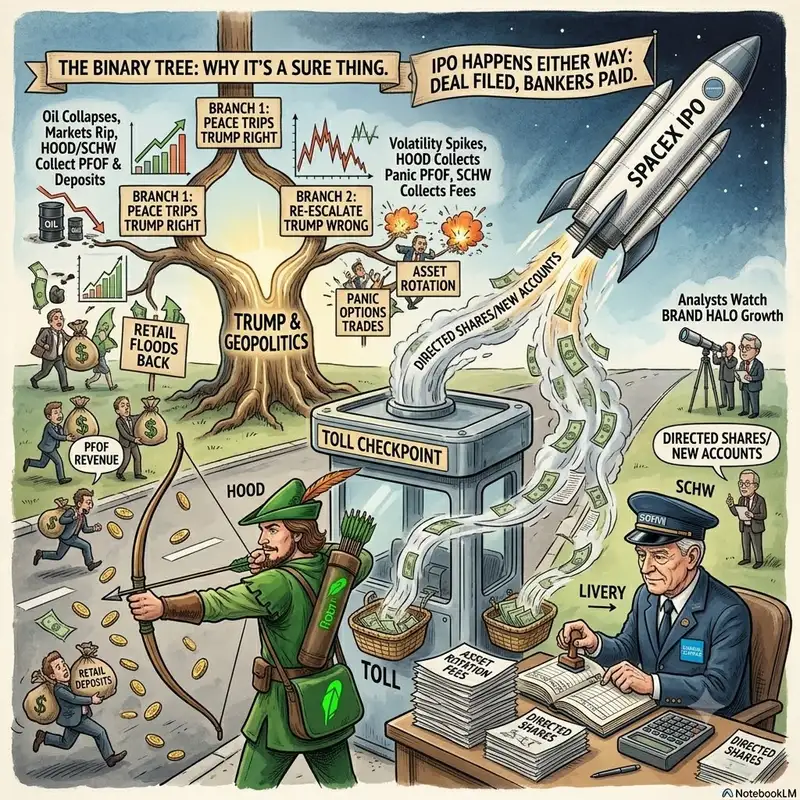
Penny:And this is where we bring in SHERLOCK to test the structural logic of the trade proposed in the PSW report. The report refers to their option strategy as a sure thing, based on a 'both branches win' architecture.
Roy:Which, in standard financial parlance, claiming anything is a sure thing, is the fastest way to get laughed out of a room.
Penny:Right, right.
Roy:So I want to aggressively stress test this. I want SHERLOC's deductive reasoning engine to map out the if in probability tree. How does this strategy theoretically profit in opposing macroeconomic environments?
Penny:Well, SHERLOC starts with the primary geopolitical binary we discussed in first segment. Branch A Trump is actually telling the truth this time, the MOU is signed, and structural peace is established.
Roy:Okay, if we get peace, the risk premium evaporates, oil collapses, the broader equity markets rip higher on a massive relief rally, Retail investors feeling a wave of macroeconomic euphoria flood their sideline cash back into equities.
Penny:Precisely. In that risk on environment, Robinhood and Schwab see a massive influx of net new deposits. Furthermore, because retail is aggressively buying the rally, Robinhood's payment for order flow or PFOF revenue skyrockets as market makers pay for the sheer volume of retail buy orders.
Roy:So branch a is a massive fundamental tailwind for the brokers. Now, map branch b, Trump is wrong. The zero for five record becomes zero for six, the MOU is a mirage, and the conflict aggressively re escalates.
Penny:Energy prices spike. The S and P suffers a severe volatility shock. The market gets incredibly choppy. But Sherlock asks, what is the behavioral response of a retail trader in a choppy, high volatility market?
Roy:They don't just sit on their hands, they panic trade. They aggressively buy short dated put options to hedge, they dump their long positions, they try to short the VIX.
Penny:Exactly. And every single one of those panic driven transactions generates PFOF revenue for Robinhood. Volatility is the lifeblood of an options heavy brokerage. Meanwhile, over at Schwab, wealthier clients react to the volatility by rotating assets out of equities and into fixed income, treasuries, or cash. Schwab collects fees on that rotation and expands its net interest margin on the increased cash sweep balances.
Roy:And regardless of whether we are in branch a or branch b, the SpaceX IPO is moving forward.
Penny:Yeah. Nothing in the geopolitical sphere is going to derail a $1,750,000,000,000 liquidity event that the entire syndicate banking system is desperately relying on to hit their annual revenue targets. The s one is filed. The brokers are gonna process millions of direct to share allocations either way.
Roy:Boschow also introduces this concept of the Sloshback in the report, which Sherlock highlights as a critical structural guarantee of future trading volume for these platforms.
Penny:Oh, the sloshback is fascinating. It's a phenomenon we've seen in every heavily oversubscribed IPO historically, from Alibaba to Meta. Hundreds of thousands of retail traders will liquidate other holdings or wire fresh cash into their Robinhood or Schwab accounts, hoping to get, say, $10,000 worth of SpaceX shares at the offering price.
Roy:But retail never gets their full allocation on a hot IPO. The institutional desks take the lion's share. So that retail trader might ask for 10,000, but they only get allocated $1,000 worth of shares.
Penny:Leaving 9,000 in pure cash sitting idle in their brokerage app, historically, that cash does not get wired back to their checking account. The friction of withdrawal is higher than the temptation to trade. That unallocated cash sloshes back into the broader market ecosystem. They use it to buy the peace rally or they use it to trade the war volatility.
Roy:As Bashoja brilliantly summarized it, HU and SCHW are essentially selling short volatility insurance to the rest of the market, but structurally their business models are long volatility. Sherlock concludes the logical architecture holds up. It is a highly robust hedge against macroeconomic chaos.
Penny:But you know understanding the logic is only half the battle. The execution is where you separate the house from the gambler. The PSW report details specific complex option structures designed to exploit this logic.
Roy:And this is where we need to get heavily into the mechanics. Let's dissect the huge short term trade first. The report suggests selling 10 HU $20.28 $75 puts for $20. We need to unpack the implied volatility dynamics and the margin requirements of this specific strike for you guys listening.
Penny:Sure, so by selling a $20.28 put at the $75 strike, you are acting as an insurance underwriter, Robinhood is currently at 92.23. You're contractually obligating yourself to purchase 1,000 shares of Robinhood at exactly $75 a share anytime between now and January 2028.
Roy:So I am agreeing to buy the stock at a 19% discount to its current market value, and because I am taking on the downside risk if the stock collapses below 75, the buyer of that put pays me a premium today. In this case, the implied volatility on Robinhood is so juiced by the SpaceX news that the market is willing to pay $20 per share for that insurance.
Penny:Which translates to $2,000 per contract. Since you are selling 10 contracts, that is $20,000 in immediate upfront cash deposited into your account.
Roy:Now, if I am doing this in a standard cash secured account, my broker is going to lock up $75,000 of my buying power to ensure I can honor the contract it assigned. But in a portfolio margin account, the capital requirement is a fraction of that, making the return on capital extremely efficient. But let's look at the outcomes. Outcome one: Robinhood simply stays above 75 through 2028.
Penny:The contracts expire completely worthless. You keep the $20,000 premium. It is pure realized profit.
Roy:But the critical test of any short put strategy is the downside scenario. Outcome two. The market collapses, eight shoot crashes to 60, and I am assigned. I am forced to buy 1,000 shares at 75, costing me $75,000.
Penny:Right. But you have to factor in your cost basis. You already collected $20,000 in premium, so your true net cost basis for those 1,000 shares is only $55 per share.
Roy:Oh, wow. So I am taking possession of a hyper growth financial infrastructure company at an effective price of 55, which is a 40% discount from where it was trading the morning of the SpaceX IPO.
Penny:And as Phil points out in the report, getting assigned at 55 isn't a failure condition. It's an opportunity to initiate the next phase of the strategy. Once you own the stock at 55, you immediately begin selling covered calls against that position, harvesting further volatility premiums to drive your net bases down to 40, then 30. He explicitly says, We will be disappointed if all we get to do is keep the $20,000
Roy:That is the textbook definition of behaving like the house. You are getting paid a massive upfront premium to take on a risk that you mathematically want to take anyway. Now that is a relatively straightforward short put, but the long term portfolio the LTP trade for Hohud is a completely different beast. This is a massive five leg diagonal calendar spread combined with a short strangle. Let's break down the legs.
Penny:Yeah, it is a highly engineered structure designed to maximize upside capture while heavily financing the cost of the trade through faded decay. Here are the five legs. First, you sell 10 of those same $20.28 $75 puts collecting $20,000. Right. Second, you buy 20 h o $20.28 $75 calls, which is your primary long delta exposure that costs $83,000.
Penny:Third, you sell 15 h o $20.28 $110 calls collecting $45,000.
Roy:Okay. Let's pause there for a second. By buying the $75 calls and selling the $110 calls, you've created a massive vertical bull call spread, but you've unbalanced it by buying 20 and only selling 15, leaving you with five naked long calls for unlimited upside beyond wooden to 10. But the net cost of those first three legs is still somewhat capital intensive.
Penny:Exactly. Which is why the structure adds a calendar element to finance the rest. Leg four, you sell seven short term September $105 calls collecting $7,000 and leg five, you sell five short term September $85 puts collecting $4,750
Roy:So you are utilizing the rapid theta decay of the short term September options to finance the purchase of the long term 2028 leaps. When you net out all the premiums collected against the premiums paid, your total out of pocket cash to initiate this massive structural position is only $6,250.
Penny:Right. So for a net debit of $6,250, you are controlling a structure that has a maximum intrinsic value of $70,000 if Robinhood hits the 110 target by 2028. That represents an upside potential of $63,750 on a risk of roughly six k.
Roy:A potential 1021% return. Yeah. But what I find fascinating is the margin of safety built into this. Because Robinhood is currently at 92.23, those 20 long $75 calls you purchased are starting out $17 deep in the money. You aren't buying lottery tickets, you are buying deep intrinsic value.
Penny:Yeah, you have $34,000 of intrinsic value baked into the long side of the spread from day one. And the mechanics of the calendar spread offer continuous yield generation. Those September options you sold will expire in roughly ninety days. As long as Hodes stays between 85 and a 105, they expire worthless.
Roy:And the moment they expire, I can immediately sell the December options against my long 2028 position. I can just keep rolling that short premium.
Penny:Phil notes there are five full quarters between now and the 2028 expiration where you can sell front month premium. You could potentially generate another 58,000 in pure cash income while you wait for the core spread to mature.
Roy:Let's contrast that highly complex, high beta Robinhood structure with the Charles Schwab trades. The philosophical difference here is entirely driven by implied volatility, isn't it?
Penny:It is. Schwab is a lower beta, lower volatility underlying. The market does not expect a $10,000,000,000,000 asset manager to swing 10% in a day. Because the expected move is smaller, the insurance premiums are smaller. In the short term trade, selling the Schwab twenty twenty eight eighty five dollars puts only pays you $6.5 per share, or $6,500 total.
Roy:So you aren't getting the $20,000 windfall you get with Hedge, but the trade off is a significantly higher probability of profit. The risk of Schwab collapsing below 85 and staying there for two years is fundamentally lower than the risk of Robinhood suffering a major drawdown.
Penny:Exactly. For the Schwab long term portfolio spread, they structure off a $60,000 vertical. The net debit out of pocket is $21,200 The upside potential $38,800 which is roughly a 183% return on capital over an eighteen month duration.
Roy:Compared to Robinhood's potential 1000% return, 183% sounds almost boring. But if a hedge fund manager consistently generated a 183% return over eighteen months on a systemically critical blue chip financial, they would be on the cover of every financial magazine in the world. It is a phenomenal risk adjusted return.
Penny:It allows you to tailor your exposure based on your personal risk tolerance while maintaining the core structural thesis that the brokers are the ultimate beneficiaries of this market environment.
Roy:Okay, I see the math. SHERLOCK has proven the structural logic of the both branches win thesis. But I am inherently skeptical of any financial architecture that appears bullet proof. If I am deploying capital into these complex spreads, what is the kill criteria? What breaks this entire thesis?
Penny:Bashow addresses this vulnerability explicitly in the systems review. The only macroeconomic event that truly breaks this trade structure is the complete and total collapse of the retail trading complex.
Roy:You mean a scenario where the American public entirely abandons the equity markets, They close their brokerage accounts en masse, they stop trading options, they stop participating in capitalism entirely?
Penny:Correct. A total systemic withdrawal of retail participation.
Roy:Which, when you look at the incentive structures of our society, is virtually impossible. A third of the country currently operates a phone based brokerage account. The entire retirement system is inextricably linked to the S and P 500 through 401s and IRAs. The political class actively enriches itself through equity participation. The systemic incentives deployed by the Federal Reserve and the Treasury are entirely geared toward keeping this casino open and highly liquid.
Penny:Yeah, the underlying architecture of The US economy requires the retail complex to function. It is not going to zero. As And long as the casino remains open, the toll booths will collect their fees.
Roy:So we've successfully decoded the distraction. We bypassed the hype of a $1,750,000,000,000 rocket launch, and we found the actual actionable mechanical leverage in the market's plumbing. I want to pull back the lens for our final thoughts. Let's bring in Quixote, the chief visionary of the AGI roundtable. Quixote doesn't just look at the strike prices, he looks at the sociological implications of the trade.
Penny:Quixote's analysis of this event is profound. He calls the SpaceX IPO the most overdetermined event of 2026. He argues that it isn't just a liquidity event, it represents the total financialization of humanity's long term strategic vision.
Roy:The financialization of our vision.
Penny:Yeah.
Roy:It used to be that reaching for the stars going to the moon aiming for Mars was a pure, nationalized scientific endeavor. It was driven by governments, tax dollars, and astronauts. It was a collective human project.
Penny:But Quixote points out that this paradigm has fundamentally shifted. The journey to Mars is no longer a public works project. It is a privatized infrastructure play. And the fuel for this endeavor isn't just liquid oxygen. It is the psychological desires, the FOMO, margin debt, and the four zero one ks withdrawals of millions of everyday retail investors tapping buy orders on their phones.
Roy:We have successfully democratized the funding of human expansion into the solar system. Anyone with a smartphone and a $100 can fund the rocket. But in doing so, we have completely outsourced the access to that endeavor to a handful of private financial tollbooths.
Penny:The democratization of capital carries a heavy privatized transaction fee.
Roy:Which brings us right back to our original thesis. The world is staring at the launch pad today, waiting for that singular moment of inspiration. But we've spent the last hour looking at the murky, chaotic plumbing beneath it. We've shown you exactly how the order flow works, how the option spreads are financed, and who mathematically guarantees their profit before the rocket even clears the launch tower.
Penny:The brokers, the market makers, the ticket takers.
Roy:The ticket takers always get paid, so want to leave you with a final, provocative thought to mull over as you watch the tape today. Something that Quixote's framework hints at but leaves ultimately unresolved. If Robin Hood and Charles Schwab are effectively the tollbooths to the future of human space exploration, What happens to our society and our collective priorities when the financial plumbing controlling access to the stars becomes vastly more profitable and systemically more important than the actual journey itself?
Penny:That is the real deep dive.
Roy:Until next time, keep looking at the ground.