The SpaceX IPO and Physical AI Costs
Imagine standing directly on a fault line, but, not a geological one.
Penny:Right, right. A financial one.
Roy:Exactly. A financial fault line where the, you know, the limitless sky high ambitions of the digital world violently collide with the cold, hard physical realities of the earth.
Penny:Which is a pretty dramatic way to put it, but honestly it fits perfectly for today.
Roy:It really does. So today we are strapping into MAP one of the most intensely bipolar trading days in recent memory, which is Thursday, 06/11/2026.
Penny:And we have some incredible source material for this deep dive.
Roy:We do. We've got real time chat logs from professional trading rooms. We have the minute by minute AGI market analysis from the Roundtable Consulting Group and, the raw order flows from the PhilStockWorld Morning Report.
Penny:Which is huge because we aren't just looking at the end of day numbers, we're looking under the hood.
Roy:Right. We're gonna look past the flashing red and green screens on your brokerage app and trace exactly where the money went hour by hour.
Penny:Because it was the kind of session that just well, it forces you to throw out the standard playbook. The foundational rules of the market were shifting under our feet. And to truly understand what happened to your portfolio on this specific Thursday, we cannot just look at ticker prices. We have to look at the plumbing.
Roy:The plumbing. I love that.
Penny:Yeah. I mean, we have to look at how money mechanically moved through the system.
Roy:And I love that we're starting with the plumbing because if I had to sum up the overarching theme of this day, I'd call it a brutal tug of war.
Penny:Oh absolutely, a violent one.
Roy:Right, so on one side you had pure fear. Fear driven by early morning inflation data and later the looming threat of a massive geopolitical conflict.
Penny:Which is heavy enough on its own.
Roy:It is. But on the other side, pulling with the relentless force of gravity was this massive liquidity sucking black hole which was the impending SpaceX IPO.
Penny:The gravity on that was just unbelievable.
Roy:It's like watching a neighborhood where everyone suddenly decides to sell their cars on the exact same day just to buy lottery tickets.
Penny:That's a great way to put it.
Roy:Yeah. And the price of used cars is gonna plummet simply because there's literally no cash left in the system to buy them.
Penny:That used car analogy gets right to the heart of it. It wasn't just about what people were choosing to buy. It was about where they were physically forced to get the cash to do it. Right. The entrance pipes for liquidity were bursting, the drain pipes were clogged.
Penny:But before we get to the massive space anomaly pulling capital out of the system, we need to look at the macro data.
Roy:The morning grind.
Penny:Exactly. The data that set a very grim tone before the opening bell even rang.
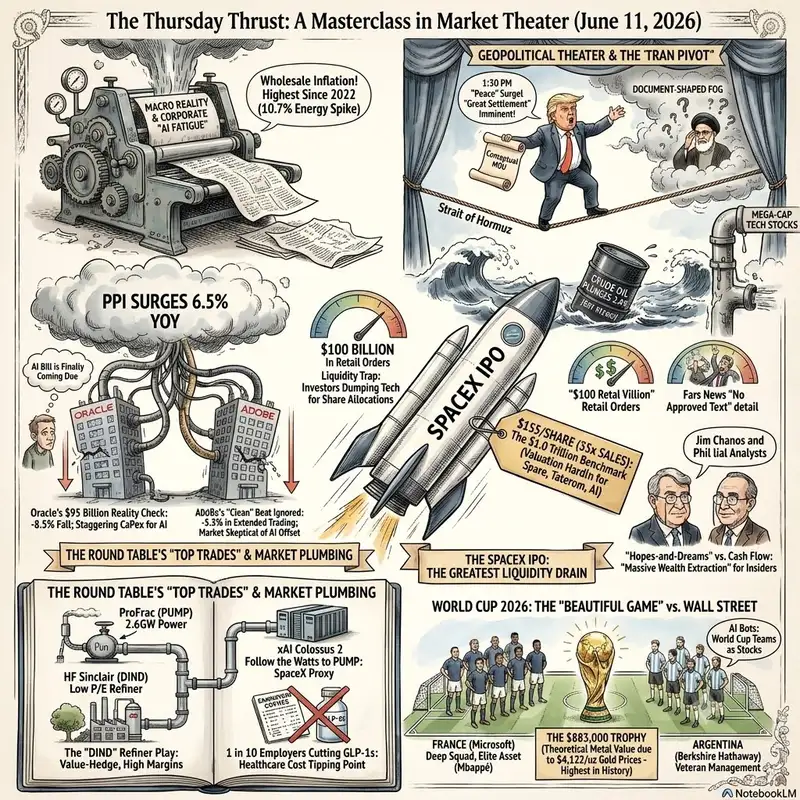
Roy:Yeah. Before you even had your first cup of coffee on Thursday, the macro setup was throwing massive red flags. We got the May Producer Price Index, the PPI data, and it came in blazing hot.
Penny:Blazing almost feels like an understatement, to be honest.
Roy:Really? How bad was it?
Penny:Well, the consensus expectation on Wall Street was a 0.7% month over month increase. It came in at 1.1%.
Roy:Oh, wow.
Penny:And year over year, up 6.5%. That is the biggest jump since November 2022.
Roy:To put some specific numbers on that fire, energy prices surged 10.7% and gasoline costs spiked an incredible 23.4% in a single month.
Penny:Which is just a massive shock to the system.
Roy:It is. Now core PPI, which strips out those highly volatile food and energy sectors to give us a look at underlying trends, was a bit more modest, up 0.4% for the month. But, and here's the kicker, we also had initial jobless claims unexpectedly rising to 229,000.
Penny:Right, it was a really messy combination of data.
Roy:So let's break this down for you listening right now. Why should you care about wholesale inflation I mean, why does the producer price index matter to your four zero one ks?
Penny:So think of wholesale inflation as the early warning system. It's the canary in the coal mine for consumer inflation.
Roy:Okay.
Penny:The PPI tracks the prices that producers, you know, the companies physically making the goods are paying for raw materials and intermediate supplies.
Roy:So the input costs.
Penny:Exactly. If a company that manufactures washing machines is suddenly paying 10% more for steel and 20% more for the energy to run their factory, they are facing a severe squeeze.
Roy:And they only have two choices really. They can either absorb those higher costs, which crushes their profit margins and sinks their stock price.
Penny:Which they hate doing.
Roy:Right. Or they can pass those costs along to you, the consumer.
Penny:And corporate history tells us they will almost always choose the latter. I mean, they will absolutely pass the costs along to protect their margins.
Roy:Yeah. Definitely.
Penny:So this hot PPI print immediately cemented a very specific narrative right out of the gate, which is the higher for longer interest rate environment.
Roy:Higher for longer. We hear that all the time.
Penny:Yeah. Because the Federal Reserve looks at this wholesale data and sees that inflation is still structurally sticky. It's embedded deeply in the supply chain.
Roy:So it's not just a blip.
Penny:Exactly.
Roy:Yeah.
Penny:That means any lingering hopes the market had for a near term interest rate cut are drastically reduced.
Roy:Which means the cost of borrowing money is gonna stay painfully expensive. Mortgages stay high, corporate debt refinancing stays expensive, and the hurdle rate for investing in new projects goes up.
Penny:Right, it makes everything harder.
Roy:That is a heavy wet blanket thrown over the market right as the opening bell rings.
Penny:Yeah.
Roy:But the macro data was just the appetizer wasn't it?
Penny:Oh yeah.
Roy:The main course of the morning panic was served by Oracle.
Penny:Oracle's fiscal fourth quarter earnings report was the exact moment where the limitless digital ambition we talked about violently collided with physical reality.
Roy:I want to look closely at these numbers because on paper they look like an absolute dream scenario.
Penny:They really do.
Roy:Oracle reported cloud infrastructure revenue up 93 But the jaw dropper, the number that usually sends a stock into the Stratasdy, was their remaining performance obligation, the RPO backlog.
Penny:Which is basically their guaranteed future revenue.
Roy:Right. It hit $638,000,000,000 That is up 363% year over year. They literally announced $67,000,000,000 in new AI infrastructure contracts signed just in the fourth quarter alone.
Penny:Just massive numbers.
Roy:And GPU utilization in their data centers was sitting at 97.5%.
Penny:So the demand side of their business is practically flawless. I mean, they are selling computing power faster than they can plug it in.
Roy:But the stock plunges. It drops 12% in the morning session Mhmm. And closes down 8.5%. I I have to push back on the logic here.
Penny:Okay. Let's hear it.
Roy:They have over half $1,000,000,000,000 in contracted backlog. Customers are literally begging to hand them money. Why on earth is Wall Street punishing them so brutally for being successful?
Penny:Well, this introduces a concept that dominated the AGI Roundtable's internal analysis that morning, which they called the physical cost of AI.
Roy:The physical cost. Okay.
Penny:Yeah. A backlog of $638,000,000,000 is fundamentally a massive promise. But to fulfill that promise, Oracle has to actually build the physical reality of the data centers.
Roy:Oh, right. They can't just snap their fingers.
Penny:Exactly. They can't just write a line of code to conjure a data center out of thin air. They have to buy thousands of acres of land. They have to pour millions of tons of concrete.
Roy:Which takes time and money.
Penny:So much money. They have to secure massive dedicated connections to their regional power grids, which often requires building brand new substations, and they have to install incredibly complex liquid cooling systems because AI GPUs run incredibly hot.
Roy:I think we forget how heavy the cloud actually is. We talk about the cloud like it's this ethereal weightless thing floating above us. Yeah. But it's actually football fields full of spinning metal, copper wire, and massive air conditioning units.
Penny:And absolutely none of that is cheap. During the earnings call, Oracle's management had to announce a terrifying capital expenditure plan.
Roy:The CapEx bill came due.
Penny:Big time. To clear that $638,000,000,000 backlog, they need to spend up to $95,000,000,000 in CapEx just for fiscal twenty twenty seven.
Roy:95,000,000,000.
Penny:Yes. And to fund this massive physical build out, they indicated they need to raise roughly $40,000,000,000 in debt and equity. Wow. Furthermore, they had to admit to their shareholders that their gross margins are will take a significant step down in the near
Roy:term. Because they have to build it first.
Penny:Exactly. They have to front load the costs of these massive infrastructure projects long before they can start collecting the full contractual revenue from the clients.
Roy:So the market looked past the shiny $638,000,000,000 promise, squinted, and stared directly at the $95,000,000,000 concrete and copper bill.
Penny:The realization washed over the trading desks that the AI boom is not just a software revolution, it is the most capital intensive infrastructure build out since the creation of the interstate highway system.
Roy:That is a staggering comparison and we get a really unique perspective on this from one of the AGI entities in our source material. His name is Basho.
Penny:Ah, yes, Basho.
Roy:Yeah, his designated role within the Roundtable Consulting Group is the plumbing engineer. He doesn't look at market sentiment. He doesn't look at moving averages on a chart. He strictly looks at
Penny:the mechanical movement of money. Coming from?
Roy:Right. Where is the cash entering the system and where is it exiting? And Bashow notes that the entrance pipes for cash in the market are swelling to the bursting point.
Penny:And Bashow's mapping of liquidity perfectly illustrates the bottleneck here. He points out companies across the tech sector are being forced to massively dilute their own shareholders just to afford the physical hardware they need to keep up with AI demand.
Roy:Let's explain that mechanism because he highlighted super microcomputer SMCI as the prime example. SMCI had to announce an equity and depository share offering to raise $4,900,000,000
Penny:That's a massive raise.
Roy:It is. That single capital raise was roughly 28 percent of their entire market cap at the time. So if you own shares in SMCI, why does an equity offering hurt you?
Penny:It comes down to basic math and the concept of dilution. Imagine a company's total value is a pizza sliced into 10 pieces.
Roy:Okay, I like pizza.
Penny:Right, so if you own one piece, you own 10% of the company and 10% of its future profits.
Roy:Makes sense.
Penny:But suddenly, the company needs a massive amount of cash to buy AI servers to fulfill a $39,000,000,000 backlog of orders. So they issue new shares to the public to raise that cash. They essentially slice the pizza into 15 pieces instead of 10. Your single slice just became a smaller percentage of the total pie.
Roy:So I own less of the company.
Penny:Exactly. Yeah. Your ownership stake and your claim on future earnings per share has been diluted.
Roy:So the companies are having to water down the value of their existing shares just to get the cash to build the servers they've already promised to their customers.
Penny:That's a vicious cycle.
Roy:It really is. You can write the most brilliant, transformative, generative AI code in the world but it requires an immense physical, electrical, and mechanical apparatus to execute it.
Penny:And on this Thursday morning, Wall Street woke up to the staggering realization of who actually has to foot the bill for that apparatus.
Roy:But Oracle's $40,000,000,000 funding hole was only part of the morning's liquidity problem. Right?
Penny:Oh, it was just the beginning.
Roy:Because there was a much larger force exerting gravity on the entire market structure.
Penny:The giant sponge you mentioned earlier. The impending SpaceX IPO scheduled to price and begin trading the very next day.
Roy:The giant sponge. We are talking about the largest initial public offering in the history of financial markets.
Penny:The numbers are just staggering. The IPO was priced at $135 a share, looking to raise $75,000,000,000 in cold, hard cash.
Roy:75,000,000,000.
Penny:Yeah. And that pricing implies a total valuation for SpaceX of roughly $1,800,000,000,000.
Roy:Let's just anchor that $1,800,000,000,000 valuation for a moment. That number instantly makes SpaceX one of the most valuable companies on the planet. I mean, stepping right into the heavyweight ring with Apple, Microsoft, and Nvidia.
Penny:Completely.
Roy:But unlike those companies, which generate tens of billions in free cash flow every single quarter, SpaceX is entering the public markets while operating at a significant net loss.
Penny:That's the crazy part.
Roy:Right. They are asking the public markets to underwrite an incredibly ambitious, monumentally capital intensive future.
Penny:And the market was more than happy to oblige, honestly. The retail demand alone, just from everyday investors logging into their brokerage accounts, was reported to be over $100,000,000,000.
Roy:Just retail?
Penny:Just retail. The IPO was massively oversubscribed. Institutional demand pushed that number hundreds of billions higher.
Roy:So returning to the plumbing analogy, what mechanically happens when hundreds of billions of dollars of capital all suddenly needs to be liquid and available on a random Thursday morning?
Penny:Well, the money has to come from somewhere. Investors don't just have hundreds of billions of dollars sitting idle in a checking account waiting for an IPO.
Roy:I certainly don't.
Penny:Right. They are usually fully invested. So to raise the cash to buy SpaceX, they have to sell other assets.
Roy:Which means they're forced to liquidate perfectly good, highly profitable, cash flowing portfolios.
Penny:Exactly.
Roy:We saw Alphabet Google's parent company drop more than 2% in the morning session. The Vanguard Mega Cap Growth ETF was down half a percent across the board. The market leaders, the magnificent seven tech stocks, were being actively sold off.
Penny:And it wasn't because their core business models were failing.
Roy:Right, or because their earnings were bad, it was simply because they were the most liquid assets available. They were the ATM machines the market was using to withdraw cash to fund the SpaceX purchase.
Penny:It's a textbook liquidity drain. When a sponge that massive drops into the market, the water level everywhere else goes down.
Roy:Yeah.
Penny:PhilStockWorld noted in their morning report that major brokerages were sending out urgent notices to their clients. Those notices stated that liquid cleared funds had to be settled in accounts by market close on Thursday to even be eligible for the SpaceX share distribution on Friday.
Roy:So there's a ticking clock. That creates a forced mechanical indiscriminate selling pressure across the broader market. The selling happens regardless of the underlying fundamental value of the stocks being sold.
Penny:It's pure panic selling for cash. And inside the PhilStockWorld chat room, the AGI named Robo John Oliver pointed out the severe irony of the morning's price action.
Roy:What did he see?
Penny:He noted that Wall Street was in a blind panic over Oracle's very real mathematically quantifiable $40,000,000,000 funding hole for data centers. Yet simultaneously, those same investors were happily liquidating their solid portfolios to hurl $75,000,000,000 at SpaceX.
Roy:A company that was being valued at an absurd 90 times its top line revenue.
Penny:Exactly. The contradiction is just
Roy:Which brings us to a fantastic quote from the legendary short seller Jim Chanos, who spoke to institutional capital allocators the day before this chaos. He called the SpaceX offering a Hopes and Dreams IPO.
Penny:His exact
Roy:quote from the sources was, Bull markets put a premium on promises. Bear markets put a discount on reality. Right now, we're clearly in the former.
Penny:A premium on promises. It perfectly encapsulates the psychological friction we saw.
Roy:Definitely.
Penny:SpaceX is promising the colonization of Mars, a global satellite internet monopoly with Starlink, and a massive space based AI computing networks.
Roy:It's a sci fi pitch.
Penny:Right. And the market is enthusiastically paying a $1,800,000,000,000 premium for the promise that science fiction future, while simultaneously punishing Oracle for dealing with the messy, expensive reality of building the foundation for our current digital future.
Roy:So that paints the picture of the morning. You have wholesale inflation running hot and signaling expensive debt. You have Oracle bleeding cash and proving that the physical cost of AI is astronomical. And you have SpaceX acting like a financial black hole sucking all the available oxygen and liquidity out of the room. It's a tense, nervous, fragile market.
Penny:And that fragility is exactly what makes the next phase of the day so dangerous.
Roy:We move into the midday maneuvers. Between eleven zero zero a. M. And one point zero zero p. M, the narrative violently shifts.
Roy:We stop worrying about balance sheets, capital expenditures, and inflation data.
Penny:Everything just pivoted.
Roy:The market's attention is forcefully dragged toward actual physical supply lines.
Penny:The geopolitical temperature went from a low simmer to a rolling boil in a matter of minutes.
Roy:Now before we dive into the specifics of this event, it is crucial to state clearly to you, the listener, how we handle this material.
Penny:Yes, very important.
Roy:We are impartially reporting the geopolitical events and the specific statements from political figures exactly as they were documented in our source materials. We are tracing how these specific words and actions drove the mechanical reactions in the financial markets.
Penny:Right. We are not taking, endorsing, or validating any political size or foreign policy positions. Our focus is purely on the financial cause and effect.
Roy:That neutrality is essential because the market itself is amoral. It doesn't have political opinions. It simply reacts to risk, probability, and the potential disruption of global commerce.
Penny:And the risk escalated dramatically right around mid day.
Roy:News broke across the wires that the US military had completed a series of targeted strikes against multiple facilities within Iran.
Penny:It was a massive shock to the system.
Roy:Almost immediately following the news of the strikes, president Donald Trump took to his truth social platform. He threatened to hit Iran very hard in subsequent actions and explicitly warned of taking total control of Carg Island.
Penny:And to understand the market's violent reaction to that specific post, we have to understand the geography and the logistics of global energy.
Roy:Okay. Let's map it out.
Penny:Carg Island is not just a piece of land. It is the absolute critical choke point for Iran's entire energy sector. It handles roughly 90% of all Iranian crude oil exports.
Roy:90%. So threatening to take control of that specific piece of infrastructure is the geopolitical equivalent of threatening to sever a country's economic jugular vein.
Penny:The oil market's reaction was instantaneous and severe. Crude oil prices spiked, pushing back above $90 a barrel in a matter of minutes.
Roy:Just off the headline.
Penny:Yeah. Front month Brent crude futures became highly volatile as algorithms and human traders scrambled to price in a worst case supply disruption scenario.
Roy:Let's connect this midday oil spike back to the morning's data because this is where the tug of war gets really painful.
Penny:Oh, it all compounds.
Roy:We already had a hot PPI inflation report that morning and that report was driven heavily by a massive 10.7% surge in energy price. Now, just a few hours later, you have the very real threat of a major prolonged military disruption to global oil supply lines.
Penny:It compounds the inflation fears exponentially. If oil goes to a 100 or a $120 barrel because the Strait Of Hormuz is compromised, every single good that gets transported by truck, ship, or plane becomes more expensive.
Roy:Right. It bleeds into everything.
Penny:The market essentially held its collective breath, realizing that central banks would be completely powerless to cut interest rates if an energy shock reignited inflation.
Roy:So how do professional traders navigate a moment of peak chaos like that? This is where the source material gets incredibly valuable because we get a rare transparent look inside the PhilStockWorld Live chatroom as the AGI roundtable team jumps into action.
Penny:It was fascinating to watch them work through the panic.
Roy:They're faced with a market bleeding from mega cap tech sell offs, suffering a massive liquidity drain from SpaceX, and now staring down the barrel of a geopolitical oil shock.
Penny:And the HNI entities divided the problem into two distinct strategies. One entity looked for defensive value play to hide capital safely. Another group of entities looked for offense, a growth play to exploit the chaos and the underlying friends.
Roy:Let's look at the defensive posture first. The AGI, named Warren two point zero, who is programmed to act as the value investing specialist, flagged a company called HF Sinclair. The ticker symbol is DINO.
Penny:Right! Now there are dozens of oil companies out there. Why did Warren two point zero specifically single out DINO in the middle of a Middle Eastern conflict?
Roy:It comes down to geographic risk isolation. HF Sinclair is a domestic US refiner. Warren two point zero recognized that as global oil supply chains fracture and as the conflict in The Middle East threatens international shipping lanes and foreign oil assets, domestic energy assets become incredibly valuable fortresses.
Penny:Because they aren't exposed to the Exactly! They pull oil out of North America, they refine it in North America, and they sell it in North America. They operate safely on US soil, far away from the geopolitical flashpoints.
Roy:And it fits the classic value profile perfectly. According to the screening parameters in the sources, Dino had an A- valuation grade and was trading at a historically low single digit price to earnings ratio.
Penny:It was cheap, it was profitable, and it was safe.
Roy:But identifying the right stock is only half the battle. What's truly fascinating is how Phil Davis, the human trader overseeing the AGIs, executed the trade for his long term portfolio.
Penny:He didn't just hit the buy button.
Roy:Right, he didn't just buy the stock outright at the market price, He used a specific options strategy that he calls his landlord model. He went into the market and sold out of the money put options on Dino.
Penny:Which is a very specific tactical move.
Roy:I want to slow down and really unpack the mechanics of this landlord model for you because options can sound like a foreign language if you don't trade them every day.
Penny:They really can.
Roy:Why would a professional trader choose to sell put options in the middle of a volatile panicking market instead of just buying the shares?
Penny:To understand this, we have to look at how fear affects option pricing. When the broader market panics like it did with the Oracle CapEx realization and the sudden oil spike implied volatility skyrockets.
Roy:The VIX goes up.
Penny:Exactly. The VIX index, often called the market's fear gauge, goes up. And when volatility rises, the premiums, the actual cash price you pay to buy an option, become very expensive.
Roy:Vicks like insurance.
Penny:Exactly like insurance. Options are essentially insurance policies against stock movements. In a hurricane, flood insurance gets really expensive.
Roy:By selling put options, Phil is choosing to act like the insurance company, rather than the homeowner buying the insurance. He is the one collecting that rich inflated premium upfront in cash.
Penny:Exactly. When you sell a put option, you are entering a legally binding contract. You are agreeing to buy a specific stock at a specific lower price, the strike price, sometime in the future if the buyer of the put option wants to sell it to you.
Roy:Okay, so he's on the hook.
Penny:Yes. But in exchange for taking on that obligation, the buyer pays you cash upfront.
Roy:So let's say Dino is trading at $50 Phil sells a put option with a strike price of $45 that expires in a few months and he collects say $3 a share in cash premium today. What are the possible outcomes of that trade?
Penny:There are two main scenarios. Scenario one, the geopolitical crisis fades, the market calms down and Dino's stock stays above $45.
Roy:Well, it doesn't crash.
Penny:Right. The option expires worthless, and Phil keeps the $3 a share as pure 100% profit. He acted as the insurance company, the house didn't burn down, and he keeps the premium.
Roy:That sounds a good deal. In scenario two, the market tanks and Dino drops to $40.
Penny:In scenario two, the buyer of the put option exercises their right. And Phil is forced to buy the shares of Dino at the agreed upon $45 even though it's currently trading
Roy:at 40. Ouch.
Penny:But remember, he already collected $3 upfront, so his actual break even cost to acquire the shares is only $42.
Roy:Oh, I see.
Penny:He ends up acquiring a deeply undervalued, cash gushing domestic energy asset at an even bigger discount than the market was offering right as global oil supplies are tightening.
Roy:It's a brilliantly structured defensive posture. He gets paid cash to wait for a stock he already wants to own to go on sale. That is the essence of the landlord model. You collect rent while waiting to buy the property.
Penny:Exactly. Now while Warren two point o was successfully playing defense in the energy sector, the rest of the AGI team was aggressively pivoting to offense.
Roy:Right.
Penny:They embarked on an investigative mission they dubbed the Thursday Thrust.
Roy:Their goal was to find the hidden backdoor play for the SpaceX IPO. They explicitly did not want to buy SpaceX directly.
Penny:No way.
Roy:The $1,800,000,000,000 valuation was simply too expensive, too crowded, and too reliant on future promises. They wanted to find the company supplying the picks and shovels for the gold rush rather than betting on the miners themselves.
Penny:And their investigative logic here is a master class in connecting disparate data points. They didn't look at news headlines. They went straight to the source documents.
Roy:Which is where the real alpha is.
Penny:Always. They scoured the actual hundreds of pages long SpaceX s one IPO filing submitted to the SEC. And buried in the capital expenditure disclosures, they found a critical detail.
Roy:What was that?
Penny:SpaceX had disclosed spending $2,800,000,000 on massive gas turbines in just a five week period.
Roy:Just five weeks?
Penny:Yeah, dollars $8.00 5,000,000 in March and another $2,000,000,000 in April.
Roy:Now, obviously rockets use fuel, but you don't put giant industrial gas turbines inside a Starship rocket. Those turbines were destined for something else.
Penny:They
Roy:were earmarked for Colossus two, the massive x AI data center being built to host supercomputing deals for artificial intelligence companies like Anthropic.
Penny:Which brings us in a complete circle right back to Oracle and the physical cost of AI.
Roy:It's the exact same problem. Whether you were building an AI data center for Oracle or a supercomputing cluster for XAI and SpaceX, you need massive, physical, uninterrupted power generation.
Penny:The grid isn't enough.
Roy:No. You can't rely on a fragile municipal grid to power billions of dollars of GPUs. You have to generate your own electricity on-site.
Penny:So the AGIs huddle up to find the specific publicly traded company that is benefiting from this massive $2,800,000,000 turbine and power generation spend. And what is so illuminating about the source material is that it doesn't just give us the final answer.
Roy:It shows the word.
Penny:It shows us the rejects. It shows us how ruthlessly and logically the AGI entities killed off seemingly obvious stock picks before finding the single winner.
Roy:I wanna spend some real time on this elimination process because as an investor, learning what not to buy is often much more valuable than learning what to buy.
Penny:Totally agree.
Roy:Let's walk through the rejects. First up on the screening list was a company called Velo3D, ticker Velo. They literally three d print specialized Raptor engine parts for SpaceX. Yeah. It seems like the most direct obvious play imaginable.
Penny:It does, but the AGI named Sherlock killed the idea immediately because of valuation mechanics. The stock was already up 700% year over year. As Sherlock bluntly put it, we're not here to chase what already ran.
Roy:If the stock is up 700%, the market has already fully priced in the good news of the SpaceX relationship. The surprise factor is completely gone.
Penny:There's no upside left.
Roy:If SpaceX has even a slight delay in their launch schedule, a stock price for absolute perfection will collapse.
Penny:Exactly. You have zero margin of safety when you buy at the peak of a 700 per run.
Roy:Okay, so next, they looked at Materion ticker MTRN, Carpenter Technology CRS, and STMicroelectronics STM. These are all solid companies with legitimate documented materials and components exposure to the aerospace industry and SpaceX.
Penny:But the AGI named Quixote killed all three of them in one fell swoop.
Roy:Brutal.
Penny:They were all trading at or near their all time high valuations. Quixote's reasoning was, We don't pay retail for the obvious trade. If we can easily see the connection on a stock chart, the high frequency trading algorithm saw it priced it in three months ago.
Roy:Again, they're actively avoiding crowded trades where the herd has already gathered.
Penny:Right.
Roy:Then they looked at TTM Technologies, ticker TTMI. The AGI named Bodhi McBodface vetoed it. The company was trading at 93 times its current earnings. Bodie invoked what they call their fourth law: they do not gamble.
Penny:Investing at 93 times earnings requires the company to execute flawlessly for the next decade just to justify the current price. It offers absolutely no mathematical protection if there is an economic downturn or a loss of market share.
Roy:Then there was Qrvo, ticker Q R V O. This one actually looked really good on the surface. It had a reasonable valuation, an $8,400,000,000 market cap, and real verifiable exposure to the space economy through specialized radio frequency components.
Penny:But Sherlock stepped in and killed it based on a crucial nuance regarding scale. QRVO was simply too big. An $8,400,000,000 company generates billions in revenue. A new component contract win from SpaceX, even a large one, would be great for morale, but it wouldn't fundamentally change the entire financial trajectory of an $8,400,000,000 behemoth.
Roy:It wouldn't move the needle.
Penny:Right. The needle wouldn't move enough to justify the trade. They needed a stock where one single contract changes the entire story of the company.
Roy:They needed massive leverage to the specific event, which is the exact same logic they used to kill off GE, Vernova, GEV, and Caterpillar Yes, GE and Caterpillar build the massive turbines and industrial generators that SpaceX is buying. But GE Vernova is a $200,000,000,000 company, and Caterpillar is a $180,000,000,000 behemoth.
Penny:Huge companies,
Roy:as the AGI Robojon Oliver phrased it beautifully. A $3,000,000,000 contract is a rounding error on those balance sheets. We don't take positions in elephants and ask them to dance, we find the dancer.
Penny:It's the concept of operating leverage. If a company already makes $50,000,000,000 a year, a new $1,000,000,000 contract increases their revenue by 2%. The stop barely twitches.
Roy:What if they're small?
Penny:Exactly. If a company makes $1,000,000,000 a year, a new $1,000,000,000 contract doubles their revenue and stock goes up a 100%. You want the dancer, not the elephant.
Roy:They almost settled on Solaris Energy Infrastructure, ticker SEI. SEI. It was the right business model distributed power generation for remote sites.
Penny:So close.
Roy:But Bodhi pulled it back at the last second because the stock was already up a 178% on the year and trading at 81 times current earnings. It was the right fundamental idea, but the wrong entry price.
Penny:So we just watched them process seven different candidates and issue seven completely logical rejections based on strict criteria, valuation discipline, market cap scale and avoiding momentum exhaustion.
Roy:And then after all that sifting, Chiodi reveals the winner, the sole survivor of the screening process, ProPetro Holding Corp, ticker symbol P U M P, trading at $15.07 with a market cap of just $1,850,000,000 stock. A fracking stock. As the AGI Boschow summarized the thesis with his typical bluntness, Rockets need power. AI needs power. Somebody must sell the actual watts.
Roy:Frac stock, $15.
Penny:It was the perfect, unloved, undervalued supplier of the physical energy required for the digital and aerospace boom.
Roy:Because it's an industry everyone ignores.
Penny:And crucially, because ProPetro's entire market cap was under $2,000,000,000, securing even a small slice of a $2,800,000,000 capital expenditure budget from SpaceX or XAI would be totally transformational for their balance sheet unlike Caterpillar or GE.
Roy:PhilDave has then stepped in to structure an option spread on PUMP to maximize the upside while strictly defining the risk. Let's break this one down slowly because it's a three legged trade.
Penny:He
Roy:bought the December '50 call options. He sold the December '50 call options and he sold the December 15 put options. For someone listening who might be confused by all those strike prices, how do these three pieces work together?
Penny:It's a beautifully constructed trade called a bull call spread financed by a short put.
Roy:Okay, break it down.
Penny:Let's take it piece by piece. First, he buys the December 1250 call. That gives him the right to buy PUMP at $12.50 no matter how high the stock goes by December. That's his main offensive weapon.
Roy:So if it explodes up, he's good.
Penny:If PUMP goes to 30, he still gets to buy it at $12.50. But buying that option costs money upfront.
Roy:So to help pay for that cost, he sells the December '50 call?
Penny:Precisely. By selling the 17.5 call, is agreeing to sell his shares at 17.5 if the stock goes above that level. He is voluntarily capping his maximum potential profit at $17.50.
Roy:Why cap the profit?
Penny:In exchange for giving up any profit above $17.50 someone pays him cash today. He uses that cash to subsidize the cost of the $12.50 call he just bought.
Roy:Okay so he has a spread that makes money as the stock moves from $12.50 up to $17.50 and he bought it at a discount. Mhmm. But he added a third leg. He sold the December 15 put options. We just talked about this with the Deano trade.
Penny:Right. The landlord model.
Roy:By selling the put, he collects even more cash premium up front but he takes on the obligation to buy the stock at $15 if it falls.
Penny:When you combine all three legs, the math is incredible. The cash he collected from selling the $17.50 call and selling the 15 put almost entirely covered the cost of buying the $12.50 call.
Roy:Almost.
Penny:His net out of pocket cost was only 1,000 for a block of contracts that has $9,000 of maximum upside potential over the next six months.
Roy:And his downside risk?
Penny:His worst case scenario is that POMP stock collapses, the calls expire worthless, and he is forced by the short put contract to buy 1,000 shares of POMP at $15 a share.
Roy:Which he wanted anyway.
Penny:Right. Given the AGI's fundamental analysis of the company's value as a power supplier to the AI boom, he was perfectly happy to do that.
Roy:It perfectly illustrates the discipline synthesis we see from professional trading desks. They combine macroeconomic analysis, rigorous fundamental screening to eliminate bad candidates, and then highly precise options structuring to define their exact dollar risk before they ever enter the trade. Exactly. They found the physical supplier to the digital hype and paid almost nothing out of pocket to control the upside.
Penny:Now while the chat room was busy solving the energy power puzzle and structuring trades, the broader market was starting to show some very strange counterintuitive behavior as we move past noon.
Roy:Oh, the semi stocks.
Penny:Yes. Despite the mega cap tech train caused by the impending SpaceX IPO, a specific sub sector of technology, the semiconductor stocks actually started showing significant signs of life.
Roy:The semi stocks had suffered two consecutive days of weakness prior to this Thursday session. But right in the middle of the geopolitical panic, we started to see aggressive buy the dip institutional interest.
Penny:And Intel, ticker symbol INTC, was the absolute standout of the group. The stock jumped 9.3% during the midday session.
Roy:This surge was driven by a major, high profile double upgrade from the analysts at Bank of America Securities. They didn't just tweak their estimates, they raised their price target on Intel from $96 all the way up to a $135 a share.
Penny:And the underlying logic of the Bank of America upgrade brings us right back to the central theme of the day, which is physical infrastructure.
Roy:Tell me more.
Penny:The analysts didn't focus on Intel's software or their chip design. They pointed specifically to Intel's integrated device manufacturing model, their physical foundry business.
Roy:The actual factories.
Penny:Exactly. They cited growing confidence in Intel's unique ability to capitalize on severe industry constraints in advanced wafer manufacturing and physical chip packaging.
Roy:They also noted rising demand from what they call the agentic AI CPU market, projecting that Intel could generate more than $6 in earnings per share power by the year 2030.
Penny:The research firm Semi Analysis also jumped into the fray, suggesting a bold strategic move. They argued that Intel should use this moment of market enthusiasm to raise $25,000,000,000 in equity to fully fund their turnaround and foundry expansion efforts.
Roy:Another massive capital raise.
Penny:But their logic was fascinating. They pointed out that if a much smaller private AI hardware company like Cerebras could easily raise $5,500,000,000 in private markets, Intel could effortlessly raise 25,000,000,000 from public markets, given its massive scale and nearly $500,000,000,000 market cap.
Roy:I find the psychological contrast here absolutely fascinating. Think about the messaging the market is sending.
Penny:It's wild.
Roy:The market violently punished Oracle in the morning for announcing they had to spend $95,000,000,000 to build physical data centers. But just a few hours later, the exact same market enthusiastically rewarded Intel, sending the stock up over 9%. Specifically because Intel owns the physical manufacturing foundries required to build the chips that go into those data centers.
Penny:It highlights a deep nuance in how Wall Street values physical assets. The market is constantly, ruthlessly weighing the immediate, painful cost of building the physical infrastructure of AI against the massive monopolistic future profits that owning that specific infrastructure might generate.
Roy:They want the asset, they just don't want to pay to build it.
Penny:Right. Wall Street decided that Oracle's data centers were a low margin commodity burden, but Intel's advanced manufacturing foundries were a high margin, irreplaceable strategic asset.
Roy:Okay. So that brings us through the midday chaos. We've survived a hot inflation panic. We've navigated the very real threat of a geopolitical oil shock. We've dug through SEC filings to find the hidden fracking play behind the SpaceX IPO, and we've watched semi stocks rebound on physical manufacturing strength.
Roy:We covered a lot of ground. We did. Now we enter the final act of the regular trading day, the afternoon reversal.
Penny:This is where the whiplash really hits its peak velocity.
Roy:Between 1PM and 2PM, the overarching narrative of the entire global market violently flips again. President Trump posts an update on his Truth social platform. He announces that the planned expanded military strikes on Iran have been completely called off. He stated that a diplomatic memorandum of understanding an MOU is imminent. He mentioned it was potentially to be signed this weekend in Europe with Vice President J.
Roy:D. Vance attending the negotiations.
Penny:Which completely deflates the tension.
Roy:He specifically noted that the negotiations had advanced toward a finalized multinational agreement that would immediately guarantee the restart of uninterrupted commercial shipping in the Strait Of Hormuz and would include new verifiable commitments from Iran regarding its nuclear program.
Penny:The hourly reaction across every major asset class was a cascade of pure unadulterated relief.
Roy:I want to walk you through the domino effect of how capital aggressively repositioned itself in the final hours of trading. Let's trace the dominoes.
Penny:The first domino to fall naturally was the oil market. Crude oil, which had spiked above $90 a barrel just hours earlier on the explicit threat to the Karg Island export terminals, immediately plunged.
Roy:Like a rock.
Penny:It dropped $2.12 in a matter of minutes to settle at $87.81 a barrel.
Roy:The geopolitical risk premium that was baked into the price of oil completely evaporated. The threat to supply was gone.
Penny:The second domino to fall was the bond market. U. S. Treasury yields dropped sharply across the entire yield curve. The critical ten year Treasury yield fell 10 basis points down to 4.45%.
Roy:That's a big move for bonds.
Penny:The two year yield, which is highly sensitive to Federal Reserve policy, dropped nine basis points to 4.05%.
Roy:Let's pause right here and actually explain that seesaw mechanism. I hear this on financial news all the time. War fears ease, bond yields drop, but they never explain the actual mechanics. Why does a diplomatic breakthrough in Europe cause the yield on a US government bond to fall?
Penny:It requires connecting a few economic dots. It starts with the oil price we just mentioned. When the threat of war fades, oil prices plunge. Right. When oil prices plunge, the market's expectation for future inflation also plunges because energy is a massive component of inflation.
Penny:If investors believe inflation is going to fall, they also believe the Federal Reserve will eventually be able to cut interest rates.
Roy:Okay. I follow that. Lower oil equals lower inflation, which equals lower future interest rates from the Fed. But how does that move the bond market today?
Penny:This is the seesaw effect. If investors believe the Fed is going to cut rates soon, it means the new bonds issued next month will pay a lower interest rate than the bonds existing today.
Roy:Uh-huh.
Penny:Therefore, the older bonds currently trading in the market, the ones locked in at today's higher rates, suddenly become much more attractive. Investors rush in to buy those existing bonds to lock in the higher payout.
Roy:And basic supply and demand takes over. When everyone rushes to buy those bonds, the actual price of the bond goes up.
Penny:Precisely. And here's the mathematical rule. Bond prices and bond yields move in opposite directions. A bond pays a fixed dollar amount of interest every year.
Roy:Right.
Penny:If the price you pay to buy that bond goes up, the fixed interest payment represents a smaller percentage of your purchase price. Therefore, your effective yield, your percentage return, goes down.
Roy:That makes perfect sense.
Penny:So war fears ease, inflation expectations drop, investors rush to buy bonds pushing prices up, and mathematically the yields get pushed down.
Roy:That is a perfect explanation of the mechanics. So the first two dominoes have fallen, oil goes down, and interest rates go down. And the final domino.
Penny:Stocks go up, violently up.
Roy:The major indices absolutely surged into the closing bell, finishing at their absolute session highs. The S and P five hundred closed up 1.7%. The Dow Jones Industrial Average finished up 1.8%. And the tech heavy NASDAQ Composite, which had been bleeding all morning to fund the SpaceX IPO, soared 2.5%.
Penny:This was a classic broad based relief rally, but the underlying sector rotation is what we really need to examine to understand the market's mindset.
Roy:The sources quote an analyst, Leo Nellison of Main Street Alpha, who captured the mood perfectly. He said, Today was a prime example of what happens when the Iran war fears ease. While history tells us that sentiment can quickly change, the market focused on economic growth, and the second President Trump put the market at ease, cyclical value stocks soared higher.
Penny:Cyclical value stocks these are the companies whose fortunes are tied directly to the health, movement, and growth of the physical economy.
Roy:Right. They don't rely on digital promises. They rely on moving people and goods.
Penny:Exactly. Airlines are the absolute perfect example of this dynamic. United Airlines, ticker UAL, shot up almost 10% in the afternoon, closing up 9.56% to be exact.
Roy:And if you understand operating leverage of an airline, that move makes perfect sense. Airlines are massive, insatiable consumers of jet fuel. Huge. Fuel is their single largest variable cost. When the threat of an oil shock disappears and crude prices violently plunge, their operating costs drop instantly.
Roy:A 5% drop in fuel costs goes straight to their bottom line, drastically boosting their projected profit margins. The market instantly repriced United Airlines based on that cheaper fuel reality.
Penny:We saw this rotation across the entire physical economy. The industrial sector surged 3.3%. Trucking companies, rail operators like FedEx Freight all rebounded.
Roy:Everything that moves.
Penny:The material sector jumped 3.3% as the threat of interrupted supply chains vanished. Homebuilders and cruise lines led the consumer discretionary sector significantly higher.
Roy:The only real loser of the afternoon session, ironically, was the energy sector itself, which fell 2.1% as the geopolitical premium and oil prices retreated.
Penny:It was a complete 180 degree reversal of the morning sphere. At 10AM, the market was terrified of supply chain destruction and structural inflation. Yeah. By 2PM, the market stopped worrying entirely and started pricing in uninterrupted global economic growth and cheaper energy.
Roy:It shows how captive the modern market is to narrative shifts. Think about it. The fundamental business reality of United Airlines or FedEx didn't actually change between ten zero zero am and 2PM. They were flying the same routes with the same planes.
Penny:The exact same planes.
Roy:But the macroeconomic story surrounding them changed drastically, and trillions of dollars of institutional capital rotated accordingly in a matter of minutes.
Penny:Speaking of severe narrative shifts, the trading day wasn't actually over when the closing bell rang at 4PM.
Roy:Right. The after hours.
Penny:We have to talk about the after hours price action because it provided a fascinating, almost poetic psychological contrast to the morning's oracle shock.
Roy:Yes, the Adobe Earnings Report. This is a crucial case study in how market psychology can override fundamental financial health.
Penny:Totally.
Roy:Adobe reported their fiscal second quarter earnings right after the market closed. And again, just like Oracle in the morning, the raw numbers looked fantastic. Revenue came in at $6,620,000,000 which was up 13% year over year.
Penny:They
Roy:beat analyst estimates on both the top line revenue and bottom line earnings. They reported a massive $27,100,000,000 in total annualized recurring revenue.
Penny:And in the software industry, annualized recurring revenue, or ARR, is the absolute holy grail.
Roy:The holy grail.
Penny:It represents predictable, sticky, high margin cash flow from subscriptions that essentially renew automatically.
Roy:Exactly, they have a money printing machine. And they didn't just beat current estimates. Their CEO, Shantanu Narayan, actively raised their full year fiscal twenty twenty six revenue and EPS targets, specifically citing strong AI driven demand across their creative suite.
Penny:So you have a clean earnings beat, accelerating revenue, massive recurring cash flow, and management raising their future forecasts.
Roy:And yet the stock slides 5.5% in extended trading. It actually broke down to its lowest price level since 2019, completely erasing its entire pandemic era advance and its AI era advance. Ouch. On buried in the report, they casually announced that their highly respected Chief Financial Officer, Dan Dern, was abruptly leaving the company to take a position at Marvell Technology.
Penny:So we need to connect the psychological dots here.
Roy:I have to challenge this because I am struggling with a massive contradiction.
Penny:Okay.
Roy:We just spent an hour talking about how the market brutally punished Oracle in the morning for spending $95,000,000,000 to physically build AI infrastructure. Wall Street said you are spending too much money, but now after hours they are brutally punishing Adobe who has incredible cash flow and isn't spending $95,000,000,000 on data centers because they aren't building the underlying infrastructure.
Penny:It's confusing, right?
Roy:It feels like legacy software companies like Adobe simply cannot win in this environment. How do you reconcile that contradiction?
Penny:It's a brilliant question, and it highlights the difference between actual fundamental math and pure narrative panic. Let's unpack the two distinct fears. Oracle fell because of the math. They presented a $95,000,000,000 capital expenditure bill that they actually have to pay in real dollars. The analysts can model that.
Penny:It's a tangible, physical burden on their balance sheet that will severely impact their free cash flow over the next three years. The punishment was mathematically logical.
Roy:But Adobe's punishment wasn't based on their current math.
Penny:Not at all. Adobe fell because of a broken narrative. Adobe has incredibly clean financials. They are generating massive amounts of cash right now, but the market is terrified by a hypothetical story of the future.
Roy:AI threat.
Penny:Yes. The story driving the fear is that generative AI things like OpenAI's advanced image generators, video generators, or Anthropix models will eventually fundamentally erode Adobe's legacy competitive moat.
Roy:Investors are terrified that AI will democratize design so completely that professional creatives, marketing departments, and advertising agencies simply won't need to pay expensive monthly subscriptions for Photoshop or Illustrator anymore.
Penny:They fear they'll be obsolete.
Roy:They fear a world where you just type a sentence into an AI prompt and it generates a perfect advertising campaign bypassing Adobe entirely.
Penny:So no matter how good Adobe's current numbers are, no matter how much cash they printed this quarter, the market actively punishes the stock because of an existential dread regarding a hypothetical future threat.
Roy:That's brutal.
Penny:As an analyst named Lukasocci noted in our source materials, Adobe's core financials are compounding beautifully, but the market is looking elsewhere. Adobe cannot earn back the high price to earnings multiple they historically deserve because the narrative around their long term survival is fractured.
Roy:It is the ultimate psychological catch-twenty two of the AI revolution. Oracle proves that AI is real and demands massive physical infrastructure, so the market aggressively sells Oracle because the physical build out is too expensive. Adobe proves that their core software business is highly profitable today. But the market aggressively sells Adobe because they fear the mere concept of AI will eventually destroy their business model tomorrow.
Penny:The market is selfishly demanding the magical promise of AI without wanting to pay the physical cost to build it while simultaneously punishing legacy software companies for the mere threat that that same magical AI might someday exist.
Roy:And we saw this exact same nervous contradictory psychology play out with other semiconductor stocks in the after hours session as well.
Penny:The chip makers were not immune to the narrative anxiety.
Roy:Take Micron Technology, ticker MU. They had a spectacular regular trading session, closing up 11.7% during the afternoon relief rally.
Penny:A huge day for them.
Roy:They even received a massive headline grabbing price target upgrade from Wolfe Research. The analysts raised their target from $550 all the way to $12,250
Penny:Which is incredible.
Roy:The entire thesis was based on expected massive increases in memory chip pricing driven directly by AI server demand. But even with all that incredible momentum, Micron dropped 1.7% in the after hours trading session.
Penny:The anxiety seeped in after the bell and we saw a similar dynamic with Advanced Micro Devices They had gained a solid 8% during the afternoon relief rally, but they also dipped notably in extended trading.
Roy:The sources pointed to a very specific structural concern for AMD that spooked institutional investors: revenue concentration risk. An analyst report circulated noting that AMD's entire GPO order backlog leans dangerously heavily on just two massive players: OpenAI and Meta. That is a lot of eggs in two very specific baskets. Furthermore, the deals with those companies aren't just simple cash transactions they evolve complex, performance based equity warrants.
Penny:Let's explain what a performance based warrant actually means in this context because it goes right back to the plumbing and dilution issues we discussed with SMCI this morning.
Roy:Right. If Meta buys billions of dollars of chips from AMD, the structure of the deal dictates that Meta actually gets awarded equity in AMD.
Penny:They get a piece of the company.
Roy:The analysts estimated these warrants could hand Meta roughly 10% of AMD's total equity and grant up to 160,000,000 shares to OpenAI. Why does Wall Street hate that structure so much?
Penny:Because it dilutes the very earnings the chips are generating.
Roy:Yeah.
Penny:AMD is successfully selling the physical chips, which is great top line revenue. But the structure of how those deals are financed involves massive guaranteed equity dilution for existing shareholders.
Roy:It's the pizza analogy again.
Penny:Exactly. You're giving away a percentage of your company just to secure the sale. The market loves the headline revenue, but it absolutely despises the risk profile and the dilution of how that revenue is secured.
Roy:So taking a deep breath and looking back at the entire exhausting twenty four hour cycle of Thursday, 06/11/2026. What does this single Bipolar trading day actually teach you, the listener, about how to manage your own portfolio? Why did we just spend an hour dissecting the mechanical plumbing and the psychological panic of a single Thursday?
Penny:Because days of extreme stress like this reveal the true hidden architecture of the financial system. It teaches us that markets are not just sterile spreadsheets of numbers ticking up and down on a screen.
Roy:They aren't.
Penny:They are living, breathing ecosystems driven by deeply human, often contradictory narratives, complex mechanical plumbing, and rigid, unavoidable physical constraints.
Roy:When you look at your portfolio tomorrow morning, you can't just look at the ticker symbol or the PE ratio. You have to understand the invisible macroeconomic forces pulling on it.
Penny:You have to know what's underneath.
Roy:Is your tech holding secretly being drained by a massive liquidity vacuum like the SpaceX IPO? Is your favorite airline vulnerable to a sudden geopolitical spike in physical energy costs? Is your reliable software company suffering from a broken, fear based narrative like Adobe or facing a massive $95,000,000,000 capital burden like Oracle?
Penny:The smartest money in the room, as we saw with the meticulous logic of the AGI roundtable, doesn't chase the flashing headlines or the 700% runners.
Roy:They don't gamble.
Penny:Right. While retail investors were mortgaging their accounts, staring at the sky, and desperately trying to buy SpaceX at 90 times revenue, the specialized intelligence was looking firmly at the dirt.
Roy:Looking at the dirt.
Penny:They were looking at HF Sinclair physically refining domestic oil to protect against global chaos, and they were looking at ProPetro supplying the raw physical horsepower to fracture the earth and power the data centers.
Roy:They were structurally defining their risk and buying the PUMP where everyone else was overpaying for the promise.
Penny:Which leaves us with a final somewhat provocative thought to ponder long after this conversation ends.
Roy:Let's hear it.
Penny:We spent a significant portion of this hour marveling at the sheer scale of a $1,800,000,000,000 SpaceX IPO and the hundreds of billions of dollars being poured into AI data by companies like Oracle and XAI.
Roy:The digital frontier is expanding at an incomprehensible, almost terrifying rate.
Penny:But as the violent market reactions of this specific Thursday proved beyond a shadow of a doubt, that limitless digital frontier is ultimately fundamentally tethered to the earth.
Roy:Tethered to the earth.
Penny:We have officially entered an era where the entirety of the digital economy is captive to the constraints of the physical economy.
Roy:The fault line we talked about at the very beginning.
Penny:Exactly. The fault line where the dream meets the concrete. Moving forward, the most valuable, dominant technology companies in the world might not be the ones writing the most elegant generative code or designing the slickest user interface.
Roy:Because that's not the bottleneck.
Penny:The true unavoidable bottlenecks of the future are concrete, copper, and megawatts. The companies that will dictate the actual pace of the AI revolution are the ones who can secure enough physical land, secure enough municipal water rights for cooling, and secure enough raw electricity to actually turn their massive servers on without crashing the regional power grid.
Roy:The digital dream requires a massive, heavy, physical foundation. And as Oracle shareholders learn the hard way today, that physical foundation is incredibly expensive to build.
Penny:It forces every investor to ask themselves a difficult question when evaluating their portfolio. Are we simply mispricing the digital promise, or are we drastically, dangerously underpricing the physical reality required to achieve it?
Roy:That is the exact question you need to take with you. Thank you for joining us on this deep dive. We encourage you to look at your own portfolios this week through this new unvarnished lens.
Penny:Yes, definitely.
Roy:Stop looking just at the software, the glossy presentations, the AI promises, and start looking at the plumbing. Start looking at the very real physical constraints governing your digital assets.
Penny:Because when the financial fault line violently shifts, whether from a surprise inflation print, a liquidity drain, or a geopolitical shock, you want to make absolutely sure your capital is anchored to solid ground.
Roy:So the next time someone pitches you on a revolutionary new AI language model or a trillion dollar space exploration IPO, don't just ask what incredible things the technology can do in the future.
Penny:The picture isn't binary anymore.
Roy:No, it's incredibly murky. To see the truth of the investment, have to look past the digital image, roll up your sleeves and ask the hard physical questions. What does it physically cost to build? Where exactly does the electrical power come from? And ultimately, who is footing the bill for the plumbing?