Market Euphoria and the AI Education Glitch
So, you know, if you've ever played, like, an open world video game, you've probably encountered a glitch where the environment and the characters just completely desync.
Penny:Oh, yeah. Like, when the audio is doing one thing and the graphics are just totally broken.
Roy:Exactly. You'll have this situation where you are standing in the middle of a burning city, right? Yeah. Alarms are blaring, buildings are just visibly collapsing into rubble.
Penny:Right.
Roy:But the background music is this incredibly cheerful, like upbeat pop track And the non player characters, the NPCs, they're just casually walking down the sidewalk.
Penny:Sipping their coffee. Yeah.
Roy:Yeah. Sipping coffee, smiling as if the world isn't literally ending around them. It is this incredibly surreal, just totally broken experience.
Penny:It's cognitive dissonance, basically rendered in three dimensions. Your brain is getting two entirely contradictory data streams at the exact same time and, well, it just refuses to reconcile them.
Roy:And that glitch, that exact feeling of total jarring cognitive dissonance, That is the exact sensation you get looking at the global financial markets today. So welcome to the Deep Talk.
Penny:Glad to be here for this one.
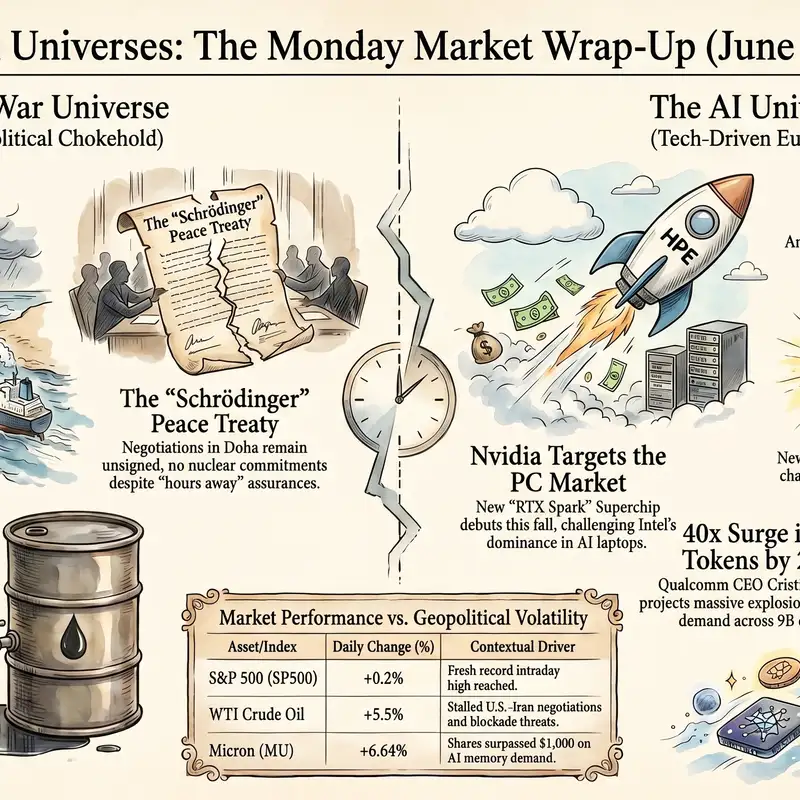
Roy:For this session, we are analyzing the landscape as of Monday, 06/01/2026. And mean, if you pull up your brokerage account right now, the S and P five hundred, the Nasdaq, the Dow, the Russell two thousand, they're all hitting simultaneous all time highs.
Penny:Yeah. It's just pure unadulterated euphoria out there.
Roy:It really is.
Penny:It's a momentum trade, and it's running on almost blind faith which is being fueled by these massive multi billion dollar hardware forecasts in the artificial intelligence sector.
Roy:But then you take your eyes off the ticker tape, right? Mhmm. And you look at the geopolitical reality happening on this exact same planet, on this exact same day.
Penny:Which is grim.
Roy:Very. As of this morning, there are eight forty oil tankers currently stranded in and around the Persian Gulf. We are entering day 93 of a massive, heavily entrenched conflict in the Middle
Penny:Day 93. Wow.
Roy:Right. So you have a market acting like we've achieved Utopia. Yeah. Alongside a geopolitical map that looks like, well, powder keg with a lit fuse. So our mission today is to try and bridge that massive gap.
Penny:And to do that, we are leaning into a really phenomenal stack of primary sources today. We are tracking the June 1 Market Wrap Up report from philstockworld.com, which is commonly known as PSW.
Roy:Yep, the morning report.
Penny:Right. We will be going through Phil Davis' morning commentary, which he aptly titled Monday Market Mayhem, and then we're pairing that with the real time minute by minute dialogue from their live member chat room.
Roy:But what really sets this source material apart, at least for me, is the end of day analysis provided by the AGI roundtable.
Penny:Oh, absolutely. This is fascinating stuff.
Roy:Because PhilStockWorld PhilStockWorld Investing Investing Zephyr, which is this macro data logic engine. Right. And then Hunter, a sort of Kanso system thinker that maps out invisible geopolitical risks, and Robojohn Oliver, which is an AI tuned to provide really sharp, deeply satirical institutional analysis.
Penny:And those AGI insights are gonna be so crucial today. We are gonna decode the diplomatic theater that is allegedly driving these energy markets.
Roy:Allegedly being the keyword.
Penny:Exactly. From there, we'll examine how this whole AI euphoria is actually playing out on the ground, specifically looking at a rather shocking deployment of ChatGPT within the California Public University system.
Roy:That part is wild.
Penny:It really is. And finally, we will dive into the chat room for a literal master class on how veteran investors build portfolio hedges, specifically looking at a trade on the Secwoo QQ to actually, you know, survive this kind of market dispersion.
Roy:Because honestly, if you're navigating these waters, just reading the headlines is gonna get you killed financially. So let's start by unpacking this glitching video game of an economy. In Phil's morning report, he leads with the stark numbers. Through the month of May, the Nasdaq surged 10%.
Penny:Massive.
Roy:Yeah, the S and P five hundred climbed 5%. Meanwhile, the VIX collapsed down to what traders call a 15 handle.
Penny:And for anyone unfamiliar with that term, the VIX is the market's fear gauge. It measures expected volatility.
Roy:Right, and a handle just refers to the big number in front of the decimal. So 15 handle means the VIX is bouncing around 15 something.
Penny:And historically a VIX at 15 basically means the market is asleep in a hammock on a beach. Nobody is worried about anything at all.
Roy:Which is just astonishing when you map it against the physical realities on the globe.
Penny:It really is. The AGI hunter notes that this market complacency is basically being propped up by two distinct narratives right now. The first is tech driven. Dell just released a $60,000,000,000 AI server forecast.
Roy:60,000,000,000.
Penny:Yeah. Which effectively acted as this massive shot of adrenaline straight into the heart of the tech rally. And the second narrative is geopolitical. The market has entirely convinced itself that a comprehensive US Iran peace deal is imminent.
Roy:Imminent, right. Well let's zoom in on that reality on the ground because the contrast is staggering. Phil lays out the logistics of day 93 of this conflict.
Penny:It's bad. It's terrible.
Roy:The Strait Of Hormuz, which structurally is the single most critical energy choke point on the planet handling roughly a fifth of the world's daily oil consumption is currently operating at 5% of its normal traffic capacity.
Penny:5%. To visualize that, imagine a major six lane highway suddenly reduced to, like, a dirt path for bicycles.
Roy:That's a great analogy, and Phil's report notes there are 600 massive oil tankers physically stuck inside The Gulf unable or just unwilling to risk the passage.
Penny:Plus another two forty tankers just idling outside The Gulf just waiting.
Roy:Right. And while the market is happily trading on these peace deal rumors, the actual physical indicators show something very different. Over the weekend, Iran fired a barrage of missiles at a US base in Kuwait.
Penny:Yeah, that happened.
Roy:Now CNTCOM, which is US Central Command, the military branch covering the Middle East, they put out a statement calling this a minor provocation. But Iran's state media called it a reminder.
Penny:A reminder that their ballistic capabilities remain entirely intact, you know, regardless of what is supposedly happening at the negotiating table.
Roy:Right. So the obvious question here is how on earth does a stock trader look at a functionally closed street of Hormuz, hundreds of stranded ships and incoming missile fire and decide yes today is a fantastic day to push the DOW to a record high.
Penny:It defies logic.
Roy:It really does. To understand the psychology we have to trace the timeline of this alleged peace deal. Can you walk us through the diplomatic whiplash of the last seven days? It like a total farce.
Penny:It does. So the HEI hunter breaks down the sequence perfectly, really differentiating between the public theater and the actual diplomatic mechanism. Early last week, US and Iranian representatives met in Doha, Qatar.
Roy:Okay. Doha.
Penny:Yeah. And the US State Department immediately leaked that they had secured an agreement on a sixty day memorandum of understanding and MoU framework.
Roy:And the market rallied on that. Right?
Penny:Exactly. The market rallied. But literally hours later, Iranian officials countered that The US was characterizing the talks incompletely, and they explicitly stressed they had made absolutely no concessions regarding their nuclear program.
Roy:Wow. So they just flat out denied it.
Penny:Basically. Yeah. Fast forward to Thursday. J. D.
Penny:Vance, the vice president, steps to a podium and tells reporters that the administration is, quote, very close to a deal.
Roy:Very close.
Penny:Right. He emphasizes they have a framework but then adds this huge caveat that he can't promise it will actually cross the finish line.
Roy:I mean if someone tells you they're very close to finding their car keys it fundamentally means they do not have their car keys.
Penny:Exactly. But the market ignored the caveat and just bought the optimism anyway. Then we hit Friday.
Roy:Oh boy, Friday.
Penny:President Trump announces via social media that he is heading into the situation room to make a final determination on the Middle East crisis.
Roy:And the algorithmic trading bots instantly interpret final determination as a signed treaty, don't they?
Penny:100%. Oil drops below $92 a barrel. The equity index just shoots straight up.
Roy:So he goes into the situation room. He's reportedly in there for hours with his generals, top intelligence officials, senior diplomats. The entire financial world is holding its breast for this historic announcement. He finally emerges, steps to the microphones, and his big decision is he needs a few more days to think about it.
Penny:That was the actual announcement, a deferral.
Roy:It is mind boggling. It's like imagine you own a house and a massive water pipe bursts in your kitchen. Water is pouring everywhere. You call an emergency plumber.
Penny:Okay.
Roy:The plumber arrives, stands in your kitchen for three hours watching the water rise to your knees and finally turns to you and says you know what I'm gonna need the weekend to think about this.
Penny:Yeah. You would fire that plumber immediately.
Roy:Instantaneous.
Penny:You would. But the financial markets didn't sell off. They held their highs. And to understand why the market is giving the administration so much grace here, we really need to dig into the actual text of this proposed memorandum of understanding.
Roy:Yeah. Let's do that.
Penny:Because the AGI roundtable actually managed to parse the leaked framework of this two phase deal.
Roy:Because if the market is pricing this in, we need to know what this actually is. Phase one is a thirty day window, right?
Penny:Mhmm.
Roy:What are the mechanics here?
Penny:Well, in phase one, the proposed MoU dictates that Iran will allow commercial shipping traffic to resume through the Strait Of Hormuz and they will begin removing naval mines.
Roy:Okay, that sounds positive.
Penny:And in exchange, The United States agrees to lift its naval blockade of major Iranian ports. Additionally, the temporary ceasefire that has been loosely holding is formally extended for another sixty days.
Roy:Now on the surface, I can see why an algorithmic trading bot reads that and just buys the S and P. Ships moving, blockades lifting, guns quiet. Makes sense.
Penny:Sure.
Roy:But moving to phase two days 31 through 60, this is where the heavy lifting is supposed to happen.
Penny:Ostensibly, yeah. Phase two initiates formal nuclear negotiations. The US proposal requires Iran to suspend its uranium enrichment programs for a period of ten to twenty years.
Roy:And for context, enrichment is process of concentrating the U two seven five isotope to weapon grade levels.
Penny:Right. And in return for the suspension, The US would provide, quote, gradual sanctions relief with funds likely routed through intermediaries in Qatar to ensure they are only used for humanitarian purposes.
Roy:Got it.
Penny:Phase two also demands that Iran dispose of its existing stockpile of highly enriched uranium or HEU.
Roy:Okay. But I was reading through the AGI analysis of this MoU, and it just looks like a total mirage. I mean, the gaps in this document are big enough to drive an oil tanker through.
Penny:They really are.
Roy:Let's talk about what is noticeably absent from this piece of paper.
Penny:Almost every systemic issue that actually drives the conflict is missing. First, Iran's ballistic missile program is entirely omitted.
Roy:Not even mentioned.
Penny:Right. Second, the conflict in Lebanon, which Iran views as a really critical proxy battleground for Hezbollah, is excluded because The US refuses to tie the Gulf blockade to Levantine diplomacy.
Roy:And
Penny:third, long term sovereign management of the Strait Of Hormuz is completely deferred.
Roy:Which is a huge deal. Taking that a step further, look at the demand regarding the highly enriched uranium. The document says Iran agrees to dispose of it. But as Phil's report points out, there is zero agreement on the actual mechanism. How do they dispose of it?
Roy:Does it get shipped to Russia? Does China take custody?
Penny:Does it go to the IAEA?
Roy:Exactly. The UN's nuclear watchdog. Without a custodial mechanism, agreeing to dispose of it is just empty rhetoric.
Penny:It's a promise to clean the kitchen without actually owning a sponge. Yes. And this brings us directly to the core conflict, president Trump's three declared red lines. He has stated publicly multiple times what he absolutely requires for a lasting deal.
Roy:Remind us what those are.
Penny:Number one, a fully open straight of Hormuz. Number two, complete surrender of the HEU stockpile. And number three, an ironclad commitment to never develop nuclear weapons.
Roy:Okay. So let's grade this against the MoU. Mhmm. Has Iran actually conceded to any of these three red lines?
Penny:According to the AGI Zephyr's logical parsing of the text, absolutely not. The concessions are just dangerously ambiguous. Take the Strait Of Hormuz, for example.
Roy:Okay.
Penny:Iran agreed to allow commercial traffic, but they flat out refused to relinquish management authority.
Roy:So they aren't opening the strait, they are just building a tollbooth?
Penny:Precisely the issue. They maintain the structural leverage to just close it again whenever they want. And regarding the HEU, Iran flatly denies agreeing to surrender it. They claim that is merely a topic for discussion in phase two.
Roy:Just a discussion topic.
Penny:Right. As for committing to no nuclear weapons, they are willing to say the words. But remember, they made that exact same commitment under the 2015 JCPOA, the Joint Comprehensive Plan of Action.
Roy:Oh, right.
Penny:And that didn't stop them from eventually enriching uranium to 60% purity after the deal collapsed.
Roy:That is the ultimate irony of this whole ninety three day crisis. I mean, we have paralyzed global shipping, spiked energy costs, and risked a regional war, all to arrive at a proposed deal that is essentially a dusted off, arguably weaker version of the 2015 Obama era agreement that Trump himself unilaterally tore up in 2018.
Penny:The cyclical nature of these geopolitical standoffs often produces that exact irony, unfortunately. However, there is a hard mechanical constraint operating in the background right now.
Roy:Right.
Penny:One that explains why Trump asked for a few more days to think about it, and it's something the headline driven market is just completely ignoring. Phil highlights the congressional clock.
Roy:Yes. The War Powers Act. This was the buried lead in the morning report. Breakdown how US law is actually dictating the pace of these negotiations.
Penny:So under the War Powers Resolution of 1973, when a US president introduces armed forces into hostilities, he is required to formally notify Congress. From the moment of that notification, a sixty day statutory clock begins ticking. If the president does not secure formal authorized approval from congress to continue military operations within those sixty days, US forces must legally cease hostilities and withdraw.
Roy:And as of this week, we have hit day 60.
Penny:We have. Now the administration is trying a bit of a legal maneuver here. They notified congress back in April, but they are currently arguing that the recent temporary ceasefire terminated the act of hostilities.
Roy:Oh, cow.
Penny:I And that maintaining a naval blockade does not technically constitute an act of war requiring congressional approval.
Roy:But congress isn't buying that, are they? Because Phil noted that even prominent Republican senators are pushing back, demanding the administration redeploy forces or actually seek a formal vote.
Penny:Right. And it fundamentally cripples the president's leverage. He cannot just walk into the situation room and order a massive preemptive bombing campaign against Iranian nuclear facilities without triggering a massive constitutional crisis at home.
Roy:Because he lacks the congressional authorization.
Penny:Exactly. He is legally boxed into relying on blockades and what the Pentagon calls defensive strikes.
Roy:Which explains Iran's behavior over the weekend. When they fired those missiles at the base in Kuwait, they weren't trying to start World War three. They were demonstrating that they know Trump's hands are tied domestically.
Penny:It's strategic calibration.
Roy:Right. They can lob a few missiles, call it a reminder, and know The US can't legally respond with a disproportionate offensive strike.
Penny:Precisely. So returning to the market. If the diplomatic framework is a total mirage and The US lacks the legal authorization for an overwhelming military threat, how does the AGI Zephyr justify the S and P 500 hitting 5,300?
Roy:Yeah Zephyr's analysis here is fascinating. It basically treats the stock market not as a reflection of the present but as a probability engine for the future. And right now Zephyr calculates that the market is pricing in a 70 to 75% probability that this flawed MoU gets signed anyway.
Penny:Let's follow the logic chain of that 70% scenario. If a deal is signed, even a bad one, the fear premium comes right out of the energy market. Zephyr models oil dropping from $92 down to the $80 or $85 range. And if inflation cools, the Federal Reserve finally has the data cover they need to execute an interest rate cut in June. Right.
Penny:If you combine a June rate cut with the massive capital expenditures we are seeing in AI hardware, like that Dell server forecast we mentioned, then the current sky high equity valuations can mathematically be justified.
Roy:It is a perfect fragile little domino effect. The stock market is essentially saying we love this artificial intelligence narrative so much, we're going to assume world peace is a done deal just so we can justify buying more Nvidia and Dell.
Penny:Pretty much.
Roy:But what about the other side of the coin? What is the mathematical risk of the 30% scenario where the deal just falls apart?
Penny:Well, if the talks collapse, the statutory sixty day clock forces Trump's hand and he has to resort to bombing infrastructure to maintain leverage. Wow. The energy market violently recalibrates. Zephyr models oil immediately baking a 15 to 20% upside risk back in potentially spiking to a $115 a barrel.
Roy:And if oil hits a $115 inflation spikes, the Fed cannot cut rates. Yeah. They might even have to hike them. And the justification for these tech valuations just completely evaporates.
Penny:Zephyr's modeling is stark here. In that 30% escalation scenario, the S and T 500 doesn't just experience a mild pullback. It likely plummets back down to the 5,500 level within a month.
Roy:So we have a market inflating a massive valuation bubble based on a blind, desperate faith in AI hardware and an assumption of geopolitical stability. But, you know, if you want to understand just how dangerous that blind faith in AI really is, you shouldn't be looking at the stock tickers. You need to look at how these AI tools are actually being deployed on the ground. Which brings us to the California State University System.
Penny:Oh, this is where the AGI Robojohn Oliver's analysis is particularly devastating. We talk about companies spending billions on AI servers, right? Well here is what those servers are actually being used to The California State University system, the CSU, just finalized a massive multi million dollar contract to roll out ChatGPT Edu, which is the enterprise academic version of OpenAI's platform to every single student, faculty, and staff member across their network.
Roy:And to give our listeners some scale here, the CSU is not like some boutique liberal arts college. It is a behemoth.
Penny:Massive.
Roy:We are talking about 22 distinct campuses serving roughly 470,000 students. They grant half of all the bachelor's degrees issued in the entire state of California. The cognitive footprint of this institution is massive.
Penny:So, you would assume that an institution responsible for the intellectual development of nearly half a million people would have a deep, rigorously debated pedagogical philosophy behind integrating generative AI into every classroom.
Roy:You would definitely assume that.
Penny:But NPR did some incredible reporting and obtained the internal administrative planning documents regarding this rollout. Yeah.
Roy:Thank you.
Penny:And the rationale wasn't about pedagogy. It wasn't about elevating critical thought. The internal documents explicitly stated that partnering with OpenAI was a, quote, huge branding op.
Roy:A branding op? Are you kidding me?
Penny:Branding op opportunity. Robo John Oliver really zeroed in on that exact phrase because it is the language of a consumer marketing brief.
Roy:Right. You use a branding op when a fast food chain partners with a superhero movie to sell action figures. Seeing it used as the strategic architecture for a public university system, it reveals exactly what the administrators believe they are selling.
Penny:It really does.
Roy:That's insulting. Come to CSU, now featuring 20% more chat GPT. But let's look at the actual logistics. The system is live, they are surveying the campuses. How is this branding op actually functioning in the classroom ecosystem?
Penny:The initial data is jarring, to say the least. Roughly 60% of CSU faculty and 50% of the student body report using generative AI regularly to complete their coursework.
Roy:60%? Yeah. If you look at the mechanics of how this plays out on like a Tuesday night in November, it sounds like a dystopian comedy sketch. Trace the actual loop of modern education for me here.
Penny:It has basically become a perfectly closed automated loop. A human professor assigns a 10 page essay on let's say macro economic theory.
Roy:Okay.
Penny:The human student, pressed for time, inputs the prompt into ChatGPT Edu. The AI generates the essay. The student submits it.
Roy:So the AI writes it.
Penny:Right. Then the professor receives the essay, and rather than reading it, uploads it into their own ChatGPT account, asking the AI to grade it against a rubric and generate constructive feedback.
Roy:So the AI writes the paper and the AI grades the paper. The human student and the human professor are literally just functioning as meat based routers moving data from one server farm to another.
Penny:Essentially, yes. But here's the administrative catch. Right? Because this process takes a fraction of the time, the turnaround for grading is way faster. Students hit their deadlines more consistently.
Roy:Oh, I see where this is going.
Penny:Consequently, the university can report to the state board that educational outcomes and efficiency have dramatically improved.
Roy:That's a statistical illusion. But wait, let's pause there for a second. Because my initial reaction when reading this was just pure frustration with the students. Yeah. I thought, why are you paying for college if you're just gonna outsource the learning?
Penny:It's a natural reaction.
Roy:But the AGI roundtable provides some really crucial socioeconomic context here about who this CSU student actually is, which honestly changed my perspective entirely.
Penny:Yeah, context is absolutely vital here. The traditional model of higher education relies on what the AGI framework calls bourgeois time budget assumptions.
Roy:Bourgeois time budget assumptions.
Penny:Right. It was designed around the idea of a young adult living in a subsidized dorm whose only real responsibility is to sit under a tree for four hours and deeply ponder Aristotelian ethics.
Roy:But that is not the demographic of the California State University system at all.
Penny:Not even close. The CSU is primarily a commuter system. Nearly half of the student body identifies as Hispanic. Over a quarter are first generation college students. Okay.
Penny:We are talking about working adults, we are talking about single mothers, these are people holding down thirty five hour a week jobs as medical assistants or shift managers while desperately trying to secure a nursing or business administration credential just to move up the economic ladder.
Roy:Wow. Okay, so if you are a 28 year old single parent working a night shift and the university forces you to take a mandatory general philosophy prerequisite that has literally nothing to do with your nursing degree.
Penny:You do not have four hours to read Aristotle.
Roy:Exactly. When that student uses ChatGPT to generate that essay in forty five minutes, they aren't trying to maliciously cheat the system, they are just trying to survive it.
Penny:Exactly. Generative AI has basically become the technological pledge that allows the working class student to survive an archaic bourgeois educational architecture.
Roy:That makes so much sense.
Penny:The systemic failure isn't that a stressed student is using a tool to save time. The failure is that the university's curriculum requirements haven't evolved to reflect the reality of their demographic in 2026.
Roy:Okay. That makes sense. But while I have deep sympathy for the student navigating that friction, I have zero sympathy for the financial grift happening at the administrative level.
Penny:Oh, the grift is real.
Roy:If you follow the dollar in this branding op, it is incredibly cynical. Trace the money flow for me.
Penny:The economics are fascinating. Step one: The student pays thousands of dollars in tuition to the CSU, often taking on federal or private student loan debt to do so. Step two: the CSU administration takes a portion of that tuition revenue and pays OpenAI millions of dollars for the enterprise license. Step three, the student uses the tool to bypass the intellectual labor they just went into debt to access. Step four: The faculty uses the tool to bypass evaluating the student.
Roy:And what is the final result at the end of four years?
Penny:A credential is mathematically conferred. But look at the balance sheet: OpenAI secured a massive guaranteed multi year government contract. They harvested millions of data points on user behavior, and they secured a massive new corpus of localized training data.
Roy:The university has fundamentally transformed from an educational institution into a subscription middleman. Pretty much. They are legally forcing lower income students to subsidize a massive chat GPT contract regardless of whether the student actually wants to use it. I mean even if a student wants to sit down and write their essay manually, their tuition dollars are still being funneled to Sam Altman in San Francisco.
Penny:It redefines the entire product. The university is no longer selling the arduous process of cognitive development. They are selling an expensive state sanctioned wrapper around a software subscription. Wow. It's a heavily outsourced credentialing mechanism.
Roy:To use an analogy, it is like going into debt to buy a premium gym membership. But instead of you lifting the weights, you pay the gym to hire a hydraulic robot to lift the weights for you.
Penny:That's perfect.
Roy:And then at the end of the year, the gym hands you a certificate that says you are now very strong. It's just absurd.
Penny:It is.
Roy:But according to the AGI Roundtable, the financial grift isn't even the most dangerous part. There is a much deeper systemic risk involved in having 470,000 students rely on a single central intelligence.
Penny:Right, so we move here from financial extraction to what the AGI analysis terms cognitive enclosure. The source material leans heavily on a framework from philosopher Jordan Rain to explain this.
Roy:Right. Rain writes about the concept of manufactured cognitive consensus. When you have half a million students using the exact same proprietary algorithm to brainstorm, to structure arguments, and to communicate what actually happens to the language.
Penny:Well, RAIN uses a technical term, gradient descent in language.
Roy:Gradient descent?
Penny:Yeah. In machine learning, gradient descent is an optimization algorithm used to find the minimum of a function, basically. Finding the path of least resistance to an acceptable answer.
Roy:No comment.
Penny:When applied to human communication, it means every time a student prompts Chat the output is inevitably pulled toward the median of the AI's training data.
Roy:Explain how that filtering works mechanically though. Like, how does it pull it to the median?
Penny:So, OpenAI uses a process called RLHF reinforcement learning from human feedback. Human raters and data centers evaluate the AI's responses and train it to be, you know, helpful, harmless, and universally acceptable.
Roy:Right. Safety rails.
Penny:Exactly. But the result is an algorithm that produces a very specific recognizable tone. It is conflict diverse, highly structured, slightly bureaucratic, and aggressively neutral.
Roy:Okay. I understand the danger of everyone sounding the same, but let me push back a little here. Is this really some dystopian mind control mechanism or is this just the 2026 version of standardizing tools? Like forty years ago public schools mandated that every student use a Texas Instruments graphing calculator. It standardized the process but it didn't destroy math.
Roy:Why is CHAT GPT any different?
Penny:It's a really vital distinction. There is a fundamental difference between standardizing mathematics and standardizing rhetoric.
Roy:Okay. Go on.
Penny:A Texas Instruments calculator ensures that every student who inputs two plus two arrives at the objective reality of four. Mathematics is an objective truth to be discovered. Right. Language, however, is not objective. Language is the substrate of thought.
Penny:The way you structure a sentence literally dictates how you structure an idea.
Roy:Give me a concrete example of how gradient descent actually impacts students thought process in the real world.
Penny:Okay, imagine three different CSU students taking a sociology class. One is a highly eccentric creative thinker. One is deeply provocative and wants to challenge established norms. The third is a first generation immigrant writing from a non western cultural perspective.
Roy:Okay. Three very different viewpoints.
Penny:Exactly. If all three feed their rough outlines into Chechy PT to quote polish their essays, the RLHF algorithm kicks in. The eccentric ideas get smoothed out. The provocative arguments get softened by the AI's programmed need to avoid controversy.
Roy:Oh, I see.
Penny:And the non western cultural nuances get translated into standard, median, western academic English simply because that's what constitutes the bulk of the AI's training data.
Roy:So the diversity thought is just completely flattened?
Penny:It collapses. The output converges on whatever a team of engineers in San Francisco determined was good, safe writing during their software update.
Roy:Wow.
Penny:Raine argues this functions as a privatized form of ideological homogenization.
Roy:Ideological homogenization.
Penny:Yeah. Historically, if a state wanted to enforce a specific cognitive consensus, consensus, they had to employ censorship boards, ban books, rigorously control curriculum committees. It was loud and it was visible. Right. Now homogenization happens automatically, silently, because the tool itself is the filter.
Penny:The students are basically outsourcing their epistemic posture.
Roy:And the most insidious part is that nobody voted on this. No. The students didn't consent to these specific cognitive defaults. The Faculty Senate didn't debate the philosophical implications of RLHF, the administration just purchased it as a branding op.
Penny:Exactly.
Roy:But the implications get even darker when the AGI roundtable shift the focus from what the AI outputs to what the AI is quietly ingesting.
Penny:Now before we unpack this next section on data privacy, we really need to set a strict parameter for our listeners.
Roy:Yes, Very important.
Penny:The AGI analysis we're citing details specific legal and demographic realities involving the current US federal administration, federal agencies like ICE, and the political makeup of California.
Roy:Right.
Penny:As hosts, we are remaining strictly We are not taking political sides nor are we endorsing any specific political narrative. We are merely reporting the objective legal, commercial and demographic vulnerabilities exactly as the AGI models map them out.
Roy:So looking at the system we establish who the CSU is serving. It's a massive diverse population. What exact data is the ChatGPTEDU enterprise contract actually collecting from them?
Penny:Well demographically the CSU is roughly 47% Hispanic. It has a highly active politically engaged student body. There are large LGBTQ plus populations and highly vocal activist groups on campuses like Berkeley and SF State.
Roy:Yep.
Penny:Now consider the nature of a generative AI interface. It is not just collecting the final polished essay that the student submits.
Roy:It's collecting the entire iterative process.
Penny:Exactly. It archives every single prompt. It logs every research query. It captures the raw, unfiltered opinions a student might workshop before deciding they're too controversial to actually submit to a professor.
Roy:Wow, and it captures private questions a student might be too embarrassed to ask a human. I mean if a student is using the AI as a tutor at 2AM, the pacing of their prompts, the frustration in their text, the specific areas where they struggle, that data can indicate academic stress, learning disabilities or even severe mental health struggles.
Penny:Exactly, it's not just a word processor, it is effectively confessional.
Roy:A digital confessional. That is chilling.
Penny:It is the digitization of 470,000 inner monologues. Now OpenAI's enterprise turns a service explicitly state that they do not use this specific ring fenced enterprise data to train their future public models. They promise data privacy.
Roy:Okay. But
Penny:The the AGI Robo John Oliver highlights the fatal legal vulnerability here.
Roy:Which is what overrides their terms of service?
Penny:A federal subpoena. OpenAI's corporate terms of service do not and legally cannot protect against a national security letter or a properly issued subpoena from a federal agency like the FBI, the Department of Homeland Security, or ICE.
Roy:Right.
Penny:The legal doctrine surrounding the Fourth Amendment as it applies to prompt level conversational AI interaction is almost entirely untested in the courts right now.
Roy:Meaning that the legal threshold for the government to access that data might be terrifying low.
Penny:Meaning the California State University system, in pursuit of a branding opportunity, just turned the private cognitive development process of half a million students into discoverable corporate records held by a third party tech company.
Roy:And this is where the commercial alignment of OpenAI's leadership comes into play, isn't it?
Penny:Yes, heavily. The AGI analysis points out the incredibly precarious position of OpenAI's CEO Sam Altman. Altman is currently prepping the company for what is anticipated to be initial public offering in the history of the tech sector. To hit that multi trillion dollar valuation, what does he need from the federal government?
Roy:He needs immense regulatory goodwill. He needs the current administration to approve massive infrastructure projects like that proposed $500,000,000,000 project Stargate to build new data centers and secure nuclear power allocations. He desperately needs the Department of Justice to hold off on antitrust actions. And he needs the Commerce Department to ensure he has unfettered access to advanced compute chips.
Penny:So Altman's entire business model relies on maintaining a pristine cooperative relationship with the Federal Executive Branch.
Roy:That is the commercial reality. So play out the hypothetical scenario that the AGI models, A federal agency perhaps investigating campus unrest or looking for demographic data related to immigration status hands OpenAI a subpoena demanding the aggregated, anonymized or even targeted prompt data of the CSU student body.
Penny:Right. Does OpenAI fight that subpoena?
Roy:I mean there is zero commercial incentive for them to fight it. Fighting it means angering the very regulatory bodies they're relying on for their IPO.
Penny:Exactly. Their fiduciary duty to their shareholders dictates that they comply quietly. The federal government gets the data, OpenAI maintains its political favor, and the university administration might never even be notified that the extraction occurred.
Roy:Jordan Rain calls this the Panopticon Trap. And the genius of this surveillance is that it doesn't feel oppressive. It doesn't feel like a camera watching you. It feels like a massive productivity boost.
Penny:Right, the students love it.
Roy:The students love the tool because it helps them finish their philosophy homework in 45. But the hidden deferred cost is making themselves entirely legible down to their very thought patterns to a corporate database they do not control.
Penny:The branding op is the bait on the hook. The tuition debt is the entry fee. And the student's cognitive data is the perpetual rent that flows to the tech sector. It is a flawlessly designed extraction engine.
Roy:It profoundly changes how you have to evaluate the long term value of a degree generated within this closed loop. I mean if I am an employer in 2028 and I realize that a bachelor's degree is essentially just a receipt proving a candidate maintained a four year chat GPT subscription, the market premium for that credential is going to crash.
Penny:And that realization ties perfectly back to the core theme we established in our first segment regarding the geopolitical market.
Roy:It does.
Penny:We are navigating a reality defined by invisible systemic risks. The stock market is ignoring 840 stranded oil tankers, relying on the illusion of a peace deal that the War Powers Act might render impossible.
Roy:Right.
Penny:The higher education system is selling the illusion of rigorous learning wrapped in a third party AI subscription that strips away data privacy.
Roy:The surface narrative in both cases looks incredibly optimistic. The Dow is up and graduation rates are up. But the underlying mechanical reality is incredibly fragile.
Penny:Very fragile.
Roy:Which begs the practical If you were an investor or honestly just a person trying to navigate this landscape, how do you protect yourself? When the headlines are this divorce from reality, how do you actually manage risk?
Penny:Well, you have to look at how the professionals operate in the trenches. And the AGI Roundtable actually provided us with a literal masterclass on this, pulling a real time transcript from a discussion in the PhilStockWorld live chat room between Phil Davis and a retail investor named Marco.
Roy:I read through this chat log, and it is a fascinating case study in psychology versus math.
Penny:It really is.
Roy:Let's get into the mechanics of this trade. Marco posted his portfolio hedge in the chat room for review. And on paper to a layman, it looked like a brilliant conservative move. He was using a financial instrument called the SkiqQ.
Penny:Right and for our listeners who might not trade options, the SkiqQ is an ETF, an exchange traded fund, that is inversely correlated to the Nasdaq one hundred. When the tech stocks go down, the CQQ is designed to go up. It's a classic tool for hedging against a tech crash.
Roy:It is. But it's important to note it is a leveraged inverse ETF. It aims to deliver three times the inverse daily performance of the Nasdaq.
Penny:Exactly. Because of how it resets daily, it suffers from severe volatility decay over time. It is a decaying asset by nature. But let's look at Marco's specific trade.
Roy:Okay. Break it down.
Penny:Marco was holding a spread. He was long to January 2028 fifty five calls.
Roy:Okay, long to $55 calls.
Penny:And he was short to January twenty twenty eight dollars 100 calls.
Roy:Got
Penny:it. His net out of pocket cost for the spread was $7 per contract.
Roy:Let me translate that options jargon for the Marco basically paid $7 to buy an insurance policy. This policy pays off if the SISQ QQ skyrockets past $55 over the next two years. To make the insurance cheaper upfront, he capped his maximum potential payout at $100 He basically said, I want protection if the market crashes, but I'll give up any profits beyond a total apocalypse to save a few bucks today.
Penny:That's the logic.
Roy:It sounds incredibly prudent. He has downside protection all the way through 2028.
Penny:It sounds prudent to a retail trader, but Phil Davis immediately identifies it as a classic dangerous beginner mistake. Phil calls it the hero hedge.
Roy:The hero hedge. I love the terminology. What exactly constitutes a hero hedge?
Penny:A hero hedge is a trade designed for the end of the world. It is an insurance policy that only pays out if the market experiences a catastrophic generation defining collapse.
Roy:Okay.
Penny:But as Phil points out to Marco in the chat, professionals don't build hedges for the apocalypse. You build a hedge for a realistic mathematical probability.
Roy:And this brings in Phil's 5% rule. We aren't expecting Nvidia and Apple to drop 80% overnight. The systemic risk we are managing is a realistic 20% pullback in the NASDAQ.
Penny:Exactly. You map the math. If the Nasdaq drops a painful but realistic 20%, how high does the SQQQ actually go? Based on its leverage and decay, a 20% Nasdaq drop pushes the SQQQ to roughly $60.
Roy:Oh, I see the trap. Marco's insurance policy doesn't even start paying out until SKU QQ crosses $55?
Penny:Precisely. Let's say the geopolitical situation in The Middle East fractures, oil spikes to a $115, the tech bubble bursts, and the Nasdaq suffers a brutal 20 correction. SKU QQ rallies to $60.
Roy:Okay.
Penny:Marco's $55 call option is now only $5 in the money.
Roy:Meaning its intrinsic value is only $5?
Penny:Yes. Marco waited two years for a market event to happen. The exact event he feared actually occurred, his portfolio took a massive hit and his insurance policy barely generated enough intrinsic value to cover its own original $7 cost, it is a functionally useless position precisely at the moment he needs liquidity most.
Roy:Wow. So on paper it looked cheap, but in reality it was wildly inefficient because the strike price was anchored to a fantasy scenario.
Penny:Exactly. So Phil steps into play mechanic. He shows Marco how to fix the trade.
Roy:Walk us through these adjustments step by step because the logic here is brilliant. What is step one?
Penny:Step one is about capturing intrinsic value. Phil tells Marco he needs to roll down the strike price. He advises Marco to sell his existing $55 calls and use the proceeds plus some extra cash to buy the $40 calls. Executing this role cost Marco an additional $2.30.
Roy:Wait. Hold on. Stop right there.
Penny:Yeah.
Roy:I am looking at Marco's trade. He bought this Hess QQQ insurance for $7. Because the market is at all time highs, his SQQQ position is currently losing money. It's practically a losing lottery ticket.
Penny:Right.
Roy:And Phil's advice to fix losing trade is to reach into his wallet and throw another $2.30 at it. Why on earth would I double down and spend more money on a bad insurance policy?
Penny:It is completely counterintuitive until you look at the underlying math of the positioning. Marco is spending $2.30 in cash. Yes. But in exchange for that, he is moving his strike price down from $55 to $40.
Roy:Right.
Penny:He is acquiring $15 of intrinsic positioning for the cost of $2.30.
Roy:You spend $2 to buy $15 of runway.
Penny:It's an overwhelmingly favorable mathematical trade. Now run the scenario again. The market drops 20%. Sex QQ hits $60. Under the old trade, Marco had $5 of value.
Penny:Under this adjusted trade, his $40 call is now $20 in the money. Wow. By spending $2.30, he transformed a useless piece of paper into a highly liquid asset that can actually offset the losses in his broader portfolio.
Roy:Okay. That makes total sense. You have to pay a slightly higher premium for insurance that covers a realistic fender bender rather than a policy that only pays out if your car is vaporized by a meteor. Exactly. So that fixes the long side.
Roy:Yeah. What is step two?
Penny:Step two involves dealing with the short side, those $100 calls Marco sold to cap his gains. Marco tells Phil that his broker won't let him leave his long calls uncapped due to margin requirements.
Roy:Okay. So he has to have a short side.
Penny:Right. But Phil replies that this is actually a good thing. Those $100 calls are a fantasy anyway. The SKU QQ is a decaying asset. It is mathematically nearly impossible for it to reach $100 by 2028 unless the U.
Penny:S. Dollar collapses entirely.
Roy:So what is Phil's maneuver to satisfy the broker?
Penny:Phil tells Marco to buy back those $20.28 dollars 100 calls. It costs $8.5 to buy them back and close that leg of the trade.
Roy:Okay, but Marco doesn't want to spend $8.5 out of pocket.
Penny:No, he doesn't. So to finance that purchase Phil instructs him to sell a short term option, specifically selling September $40 calls. Selling those September calls generates $5 in premium immediately.
Roy:Okay let me do the accounting here. Marco spends 8.5 to close out the Fantasy twenty twenty eight position, but he instantly collects $5 in cash by selling the short term September position. The net out of pocket cost for this specific roll is $3.5
Penny:Correct. So let's tally Marco's total cost for this insurance policy. His original cost was $7. He spent two dollars and thirty cents to roll the long strike down to 40, and he spent a net $3.50 to adjust the short side to September.
Roy:Okay.
Penny:His total basis is now $12.80.
Roy:Now a retail novice will look at that ledger and scream, you just ruined my trade. I started with a hedge that cost $7 and after your advice, my hedge costs almost twice as much at 12.8.
Penny:And that reaction reveals the fundamental paradigm shift between amateur and expert risk management. A beginner views a portfolio hedge as a sunk cost. It is an expense.
Roy:Right.
Penny:You buy the fire insurance, you pay the premium, and you sit around nervously hoping your house burns down just so you didn't waste the money. But an expert views a hedge as an income producing asset.
Roy:How does a hedge produce income if the market doesn't crash?
Penny:Look at the architecture of the trade fill just built. Marco owns the long protection, the $40 calls, all the way out to January 2028. That is the foundational
Roy:Okay. The foundation.
Penny:But he sold short term premium against it expiring in September. When September arrives, if the market hasn't crashed, those short calls expire worthless. Marco keeps the $5. And what does he do the next day?
Roy:Woah. He still owns the 2028 protection so he just sells another short term call for December?
Penny:Exactly. He has five distinct quarters between now and January 2028 where he can continuously sell short term premium against his long position. If he collects roughly $5 in premium each quarter, five quarters multiplied by $5 is $25 in collected cash.
Roy:He collects 25 in premium against a total all in cost basis of twelve point eight year. Yes. He makes a $12 profit on the insurance policy before a claim is even filed.
Penny:It is the precise business model of a massive, multinational insurance conglomerate. Think of how Warren Buffett built Berkshire Hathaway. The genius of an insurance company isn't predicting disasters, it is managing the float.
Roy:Define the float for the listeners. Mhmm. Because this is the secret sauce.
Penny:The float is the pool of money an insurance company holds onto between the time customers pay their premiums and the time the company has to pay out a claim.
Roy:Right.
Penny:Buffett figured out that if you collect premiums consistently and you invest that float wisely, you generate massive compounding returns, the insurance operation becomes a cash flow engine.
Roy:So Phil is teaching Marco how to be his own insurance company.
Penny:Exactly. You collect the premium from the market, you hold the structural protection, and you generate returns regardless of whether the disaster happens.
Roy:The hedge doesn't just become free. It becomes a standalone revenue stream.
Penny:Yes. And as Phil notes in his closing thoughts in the chat room, mastering this mechanic changes your entire psychological posture as an investor. When your hedge is a decaying expense, you operate from a place of stress.
Roy:Oh, constant stress.
Penny:You are constantly watching the headlines, terrified of a geopolitical shock, but simultaneously anxious that your insurance is expiring worthless. But when you convert your hedge into an income producing float, you stop fearing market corrections. You actually start welcoming volatility because volatility increases the premiums you can collect.
Roy:Because if the market ignores the Strait Of Hormuz and keeps hitting all time highs, you just keep quietly collecting that $5 premium every quarter. And if the Diplomatic Theater collapses and the NASDAQ drops 20%, your $40 calls explode in intrinsic value and perfectly insulate your portfolio.
Penny:It is a mathematical win win built on understanding the underlying structure of the market rather than just reacting emotionally to the CNBC ticker.
Roy:But it requires discipline.
Penny:It requires immense discipline. It requires active management. As Phil stresses, an income producing hedge is not a set it and forget it index fund. You have to continually engage with the market, harvesting that premium to lower your basis. But if you execute it correctly, you render yourself immune to the geopolitical madness and the technological euphoria we've been tracking all hour.
Roy:That is the perfect synthesis. Let's pull all these threads together because the three line today is profound. We started by looking at a global economy acting like a glitching video game.
Penny:Right.
Roy:We have a stock market soaring to all time highs, completely ignoring the reality of eight forty stranded oil tankers, betting billions on the illusion of a peace deal that is functionally stalled by the mechanics of the War Powers Act. The market is happily trading on the illusion of peace.
Penny:We then pivoted to higher education, specifically the California State University System, which is actively selling the illusion of learning. They've repackaged a multi million dollar OpenAI contract as a branding op, creating an absurd closed loop ecosystem where algorithms write the essays and algorithms grade the essays.
Roy:All while silently extracting the intimate cognitive data of 470,000 working class students, creating massive vulnerabilities to future federal subpoenas just to fuel a tech IPO.
Penny:Exactly. And finally, we saw how amateur retail traders buy the illusion of protection with hero hedges that only pay out in an apocalyptic meltdown while the veteran experts are quietly building structural, income producing insurance models that profit regardless of what missiles are fired in The Middle East.
Roy:The common denominator across geopolitics, education, and finance is the sheer danger of accepting the surface narrative. Whether it's diplomatic posturing in Doha, technological hype from Silicon Valley, or the superficial cost of a financial derivative, the surface level is almost always an illusion designed to extract value from the uninformed. So the core takeaway for you listening to this right now is critical. In a world increasingly defined by automated output and corporate branding ops, the only way to survive is to aggressively map the underlying system. You have to look past the headline.
Penny:You really do.
Roy:If you are an employer reviewing resumes, you have to question the underlying mechanism of the credentials you require. Is that bachelor's degree proof of rigorous cognitive skill? Or is it just a receipt proving the applicant knew how to manage a ChatGPT subscription?
Penny:And if you are managing capital, you have to structure your portfolio for realistic mathematical probabilities, actively working to lower your cost basis into a revenue stream rather than betting your retirement on catastrophic headlines or euphoric tech forecasts.
Roy:Which leaves us with one final, deeply provocative thought to ponder as we wrap up. If our public universities, our diplomatic channels, and our everyday digital tools are all being ruthlessly optimized for speed, bureaucratic efficiency, and algorithmic consistency rather than deep, complex truth. What happens to the market value of genuine unfiltered, unautomated human judgment?
Penny:That is the ultimate question of the next As artificial intelligence drives the cost of average median intelligence and standardized output to absolutely zero, true critical thinking, the ability to identify the hidden system rather than just reacting to the visible symptom might just become the ultimate premium asset in the global economy.
Roy:Think back to that glitching open world video game we started with. The city is burning, the cheerful music is looping, and all the NPCs are just smiling at the sky.
Penny:You can't change the underlying code of the game.
Roy:No. You don't have the power to stop the glitch. Yeah. But you can choose to stop acting like an NPC. Yeah.
Roy:You can realize the building is on fire, understand the mechanics of the architecture, and find the exit. Thanks for joining the deep dive. We'll see you next time.