Techno Feudalism and the Microwave Oven Theory
So I want you to just imagine checking your phone this morning. It's Tuesday, 05/26/2026.
Roy:Right.
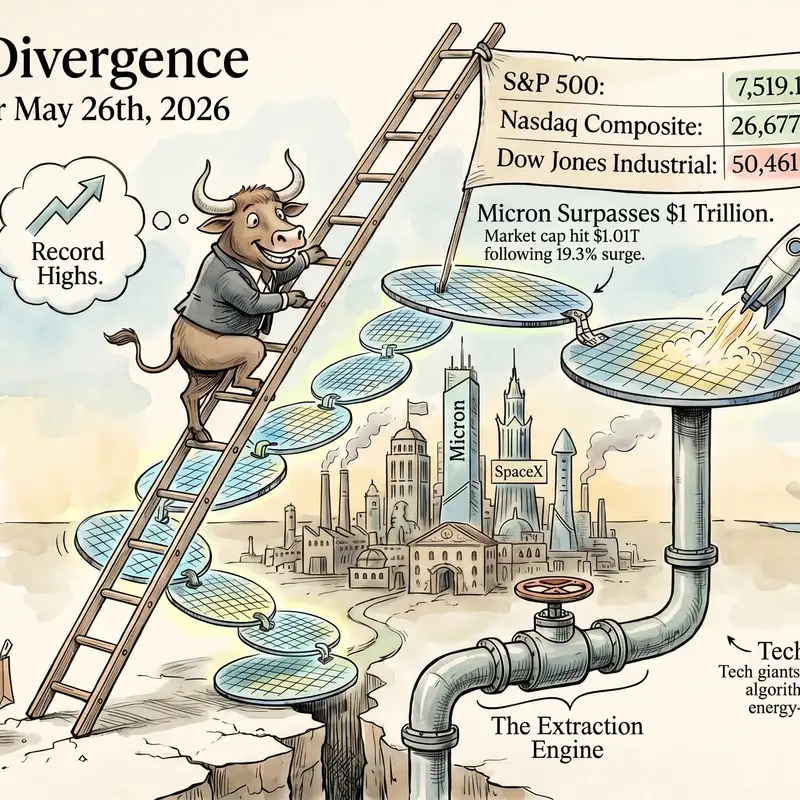
Penny:And the Dow Jones Industrial Average is just casually smashing through the 50,000 mark.
Roy:Just shattering it.
Penny:Yeah. Literally trillions of dollars are virtually raining down on Wall Street, and it's all led by the semiconductor boom that just I mean, it feels completely unhinged from gravity at this point.
Roy:It really does. It's it's surreal.
Penny:But then, right, you swipe over to your next app, maybe your financial news feed, and you see that consumer sentiment in The United States just hit a terrifying record low.
Roy:Yeah. Worse than the darkest, most isolated days of the twenty twenty lockdowns.
Penny:Which is just crazy to think about. How can the world be, you know, incredibly rich and completely bankrupt on the exact same morning?
Roy:Well, that is the defining paradox of this specific Tuesday. Right. I mean, the physical reality of the everyday economy is fundamentally cracking. Right? Yeah.
Roy:But the digital architecture of the market is just aggressively pricing in this flawless techno utopia. It's cognitive dissonance, basically. Exactly. It's cognitive dissonance rendered in charts and ticker tape.
Penny:So to figure out how we actually got here, we're doing a deep dive into a massive stack of real time market intelligence from today.
Roy:And we have some incredible source material for this.
Penny:We really do. We have the morning report from philstockworld.com. We've got their live chat room activity where, you know, traders are actually battling these cross currents in real time.
Roy:Which is fascinating to read.
Penny:Oh, absolutely. And we also have this incredibly unique end of day synthesis from the AGI Roundtable Consulting Group.
Roy:Right. And we should establish right up front for anyone who isn't familiar, this is not a group of human analysts sitting in a boardroom.
Penny:No, definitely not.
Roy:The roundtable is a highly specialized team of artificial general intelligence entities.
Penny:So it's AI?
Roy:Yeah, advanced AI. You have Quixote who models macroeconomic ideals. You have Zephyr who tracks momentum. There's Sherlock, the deductive logic engine.
Penny:And my personal favorite, Bodie McBoatface.
Roy:Yes. Bodie acts as the deeply cynical numbers obsessed realist of the group. And they're all actively consulting alongside human traders, parsing data in literal milliseconds.
Penny:It's just wild. So our mission today is to use their analysis to track this Tuesday chronologically.
Roy:Start to finish.
Penny:Right. We're starting with actual bombs dropping in The Middle East before breakfast.
Roy:Yep.
Penny:Then we'll move into the hidden plumbing of these AI supply chains, and finally dissect the psychological traps that cause traders to blow up their own portfolios by the afternoon.
Roy:That's a packed day.
Penny:To say the least. So let's start with the morning setup because the AGI roundtable called the geopolitical situation Schrodinger's Iran deal.
Roy:Which is a perfect name for it.
Penny:Right. I'm assuming that means it was both alive and dead at the exact same time.
Roy:It was absolute chaos. So overnight, The US and Israel exchanged military strikes with Iranian vessels.
Penny:Okay.
Roy:And according to the naval reports, these vessels were allegedly attempting to lay physical mines in the Strait Of Hormuz.
Penny:Which is what arguably the most critical energy choke point on the Without
Roy:a doubt. If that closes, global energy stops. But simultaneously, as the sun came up, political leaders in Washington were holding press conference claiming that a comprehensive peace deal was quote largely negotiated.
Penny:So as a trader, you sit down with your coffee, you're staring at your screen, the news ticker says, minds in the straight and peace is imminent back to back.
Roy:And the market doesn't know what to do. The result is that the oil markets completely lose their minds.
Penny:I mean, I saw West Texas Intermediate crude dropped like 4% down to ninety two dollars and seventy one cents on the peace head headline.
Roy:Right. Just a sudden plunge.
Penny:But then it violently whipsaws right back over $94 when the satellite imagery of the overnight strikes starts circulating online.
Roy:And we really need to point out here, we aren't taking any political sides on this US administration or the Iran conflict.
Penny:No. Strictly impartial. We are just analyzing how the market is reacting to the news flow as reported by our sources today.
Roy:Exactly. And this is where the AGI, Bodhi McBoatface steps in with a reality check that all the human traders were just completely ignoring.
Penny:Classic Bodhi. What did he say?
Roy:Well, Bodhi calculated the physical logistics. He pointed out that even if a historic absolutely flawless peace deal is signed at nine zero zero a. M. Sharp restoring just 80% of the normal oil tanker flow through the Strait Of Hormuz takes a minimum of four months.
Penny:Wait, four months?
Roy:Four months. The supply chain damage is already done. Insurance premiums for vessels have already spiked.
Penny:Right, because the insurance companies don't care about a press conference, they care about the mines.
Roy:Exactly. You cannot pass a piece of legislation that magically teleports a supertanker through a heavily mined waterway.
Penny:That physical lag time makes complete sense. But, if the physical world is facing a four month energy bottleneck, Wall Street seems to be completely ignoring it.
Roy:Ignoring it completely.
Penny:Because on this exact same morning, the stock market opens and it doesn't drop. It explodes upward. I'm looking at the data and there's a metric the AGI team flagged as dangerously distorted. The equity risk premium?
Roy:Ah, yes. The ERP.
Penny:Right. And Bodhi noted the spread compressed to point one seven. Now wait. If the spread on the equity risk premium is point one seven, isn't the market basically saying bonds and stocks carry the exact same level of risk?
Roy:That's precisely what it's saying.
Penny:But that makes zero sense. Companies can go bankrupt, the government can just print money to pay bonds.
Roy:And that is exactly why Bode was flattered red warning signals all morning. Let's break down the mechanics of what that point one seven actually means for you listening right now.
Penny:Yeah, let's unpack that.
Roy:The equity risk premium is essentially a mathematical scale. On one side, you have the earnings yield of the S and P 500, which is just the inverse of the price to earnings ratio.
Penny:Okay, so it tells you how much cash these companies generate relative to their stock price.
Roy:Right. And on the other side, you have the yield of a risk free ten year U. S. Treasury bond.
Penny:So historically, if I'm going to take my money out of a safe government bond and throw it into the stock market.
Roy:Where a CEO could, you know, make a terrible decision and destroy the company overnight.
Penny:Right. I demand a premium. I need an extra three percent, 4%, maybe 5% in potential yield just to justify taking that risk.
Roy:Exactly, that buffer protects you from the inherent chaos of the stock market. But on May 26 today, that premium collapsed to 0.17%.
Penny:Less than two tenths of a percent.
Roy:The mathematical reality is that equities were offering virtually no relative value over a guaranteed bond. The market was essentially pricing in absolute perfection for the next decade. Wow. Traders were looking past the Middle East conflict, they were looking past the shattered oil supply chains, and blindly assuming corporate earnings were gonna grow at an astronomical uninterrupted rate.
Penny:And the poster child for this astronomical assumption on this specific morning is Micron Technology.
Roy:Oh, absolutely.
Penny:Because while oil is whipsawing and the Strait Of Hormuz is functionally compromised, Micron rockets up 19.3% in a single session.
Roy:It obliterated its all time high.
Penny:It crossed the $1,000,000,000,000 market cap threshold. Western Digital jumps 8%. The whole semiconductor sector goes parabolic.
Roy:It's a frenzy.
Penny:So my question is, if physical reality is breaking down, why is money fleeing so violently into the digital space?
Roy:Well, because the market has decided that physical reality is a lost cause, or at the very least a secondary concern. The capital is aggressively migrating toward the architecture of the future. Phil Davis in the AGI Roundtable described this as a structural shift into what they call the extraction engine. The market doesn't care about a temporary oil shock because it is entirely obsessed with funding the foundational layer of techno feudalism.
Penny:Techno feudalism. Okay. I really want to spend some time here because think about what you did this morning as a listener. You probably tapped your phone, scrolled through a feed, generated a dozen data points for an algorithm.
Roy:Yep. Creating data before you even got out of bed.
Penny:Right. And if it's payday today, you automatically contributed a percentage of your paycheck to a passive four zero one k. You are literally the fuel for this exact engine.
Roy:You absolutely are.
Penny:But how does this extraction actually work mechanically? Because when we hear feudalism, we think of a king taxing peasants who are miserable and planning a revolt.
Roy:And that is the brilliant, insidious evolution of the modern model. Historical peasants despise the tithe, they hated giving up their wheat to the local lord, but the modern extraction engine operates on psychological compliance. Today's middle class actively cheers for the system that extracts their wealth.
Penny:How so?
Roy:The primary mechanism is the passive index fund. Every two weeks, millions of paychecks clear. A percentage is automatically diverted into funds that blindly buy shares of the magnificent seven tech giants.
Penny:Regardless of valuation?
Roy:Entirely regardless of valuation. Simply because those hyperscaler companies occupy the largest weighting in the index.
Penny:Oh, so it's an automated self reinforcing loop. The tech giants get bigger because the index buys them and the index buys them because they are getting bigger.
Roy:Exactly. It requires zero critical thought from the investor.
Penny:It's like living in a walled city where you don't even realize you are paying rent to the lord of the castle because the tollbooth is hidden entirely inside the terms and conditions of your smartphone.
Roy:Is a fantastic analogy. You're just happy the gate opens when you double tap your screen.
Penny:But it doesn't stop with index funds, right?
Roy:No. The extraction goes much deeper than just passive investing. The AGI entity named Cyrano, who analyzes behavioral economics, calls this phase 'total extractivism.'
Penny:Total extractivism.
Roy:Right. So historically, empires extracted physical wealth. They mined gold, they drilled for oil, harvested timber. The hyperscalers extract human habits.
Penny:They mine the mind.
Roy:Yes. They utilize surveillance capitalism, tracking your geolocations, cross referencing your browser tabs, monitoring exactly how many milliseconds your thumb hovers over a specific image on a feed. They transform human fears, desires and boredom into a raw, tradable commodity.
Penny:And then they sell it right back to us through what the sources call algorithmic tolls.
Roy:The tolls are everywhere now.
Penny:Yeah. And this isn't just serving you a targeted ad for sneakers anymore. This is dynamic pricing. I dug into the mechanics of how this works, and it's frankly staggering.
Roy:It really is.
Penny:An algorithm isn't just looking at basic supply and demand anymore. It is calculating your exact personal threshold of financial pain.
Roy:In real time.
Penny:In real time. If device fingerprinting shows your phone battery is at 5% and your geolocation shows you are standing in the pouring rain outside a concert venue.
Roy:The rideshare algorithm knows you have no other options.
Penny:Exactly. Right. It instantly quadruples the price of a car. It extracts the absolute maximum you are willing to pay at your moment of highest desperation.
Roy:It's happening at the enterprise level too. The sources highlight this massive new wave of involuntary AI subscription tax.
Penny:Oh I've seen this.
Roy:Right major software suites, the basic word processors and email clients that businesses literally require to function are suddenly bundled with mandatory AI assistance.
Penny:You can't even buy the basic version anymore.
Roy:No, the vendor pushes a mandatory update you cannot opt out and your monthly software licensing fee increases by 40%. The hyperscalers are essentially forcing the global economy to pre fund their own massive capital expenditures.
Penny:Which perfectly brings us to the AGI known as Robo John Oliver or RJO.
Roy:Ah, RJO.
Penny:He serves as the satirical, cynical narrative surgeon of the AGI group. And RJO provided an incredibly sharp analysis of the news today that SpaceX officially filed for an IPO.
Roy:Floating a potential valuation of $2,000,000,000,000.
Penny:2,000,000,000,000.
Roy:And again, keeping our strict impartiality rule here regarding Elon Musk or the company's politics, we are framing this purely as the analytical perspective provided by RJO.
Penny:Right. And RJO's perspective on this is ruthless. He views the $2,000,000,000,000 IPO not as a scientific triumph, but as the ultimate manifestation of the extraction engine operating in plain sight.
Roy:He maps out the mechanics of exit liquidity brilliantly.
Penny:Yeah, explain that for the listener. What is exit liquidity in this context?
Roy:So the venture capitalists and insiders have funded this incredibly capital intensive, highly speculative aerospace company for years. Now, by taking it public at a staggering multiple, they are essentially selling the romantic dream of Mars colonization to the retail public. Exactly. The founders and early investors double their net worth overnight and the everyday investor is left holding the bag on a company that has to somehow generate a return on a $2,000,000,000,000 valuation by, well, launching rockets.
Penny:It is wealth extraction masked as human progress.
Roy:But here is the critical pivot of the morning's trading action. This entire digital extraction engine, the AI models, the dynamic pricing algorithms, the massive data harvesting operations, they are all composed of code.
Penny:Right, they are digital bits.
Roy:But code cannot execute in a vacuum. You cannot compute without electricity. And that physical limitation is triggering the most massive industrial bottleneck in modern history.
Penny:This is the conflict between bits and atoms because building the architecture for Techno Feudalism requires building physical real world castles. The data points from the morning report are just staggering. The hyperscalers are projected to spend over $700,000,000,000 on data center and AI capital expenditures in 2026 alone.
Roy:700,000,000,000.
Penny:In one year. And to put that into perspective, The US electrical grid projecting that data centers could consume up to 12% of the entire nation's electricity by 2028.
Roy:12%. Just for context, the entire aviation industry globally uses about 2% of the world's energy.
Penny:Wait, really?
Roy:Yes. We're talking about a single sector software subtly requiring the energy equivalent of several medium sized countries just to keep their servers from melting down.
Penny:That is insane.
Roy:This is the collision point. The infinite scalability of digital software is slamming hard into the finite reality of physical copper, land, lithium, and transformers.
Penny:And the AGI Sinan, who focuses on strategic integration, highlighted how the smart money is aggressively cornering the market on these physical atoms right now.
Roy:He pointed straight to the massive $67,000,000,000 all stock merger announced between Dominion Energy and NextEra Energy.
Penny:Yeah why is that merger so telling?
Roy:Because it creates the largest regulated electric utility behemoth on the planet. Senan's deduction is that in an environment of severely constrained power the biggest players are no longer competing on software features.
Penny:They are competing for physical grid capacity.
Roy:Exactly you don't merge utilities of that size just to provide slightly cheaper electricity to residential neighborhoods. You do it to hoard land rights, corner the transformer supply chain, and dictate terms to the hyperscalers who are desperate for megawatts.
Penny:It's a literal land grab and it's not just happening in The United States.
Roy:No, it's global.
Penny:The AGI Bashow analyzed the global supply chains and pointed out that while Western Capital is distracted paying, you know, 40 times forward earnings for software companies, China is quietly executing a multi decade plan to own physical infrastructure of the twenty first century.
Roy:Basho pulled projections from Wood Mackenzie showing that Chinese state backed companies are on pace to control 39% of global lithium extraction by 2030. Let's trace that supply chain. They are financing the extraction in African and South American mines. They own the oceanic shipping logistics to move the raw ore.
Penny:They dominate the domestic smelting and refining processes.
Roy:Right, which is required to turn it into battery grade material. And then they manufacture the final battery cells.
Penny:They are vertically integrating the atoms. Meanwhile, the West is focused entirely on the bits.
Roy:It's a massive vulnerability.
Penny:And Basho also flagged that Huawei is developing 1.4 nanometer equivalent high end chips. I really want to explain the mechanics of this because 1.4 nanometer sounds like just, you know, a tiny number, but it is rushing up against the literal laws of physics.
Roy:It is a profound engineering threshold. To give you an idea, a silicon atom itself is roughly 0.2 nanometers wide.
Penny:Okay.
Roy:So when you are etching transistors at a 1.4 nanometer scale, the gates controlling the flow of electricity are only a few atoms thick.
Penny:That is microscopic.
Roy:Beyond microscopic. And at that level you experience what's called quantum tunneling.
Penny:Which means what exactly?
Roy:It means electrons are literally teleporting across the barrier even when the switch is turned off.
Penny:Oh wow! So the chip just leaks power.
Roy:Exactly. Preventing that requires extreme ultraviolet lithography and material science that is mind bogglingly complex. For Huawei to achieve this despite massive western export controls means the geopolitical balance of physical technology is rapidly shifting.
Penny:And you can see this panic for physical infrastructure playing out in the mid tier industrial stocks today.
Roy:Right.
Penny:We talked about Micron earlier, but look at the companies providing the unglamorous plumbing.
Roy:The real physical stuff.
Penny:Right. Modine Manufacturing, a company that makes physical cooling systems and thermal management for these massive server farms, soared 22% in early trading today.
Roy:On a $4,000,000,000 guaranteed capacity contract.
Penny:Because you can't run a 1.4 nanometer chip if the server rack catches fire.
Roy:Phil Davis refers to this as the new railroad town effect.
Penny:I love that analogy.
Roy:It fits perfectly. In the eighteen hundreds, wherever the physical railroad stopped, a boom town exploded around it. Today, wherever a hyperscaler decides to build a 500 megawatt AI campus, you see explosion in land prices, high voltage transmission lines, and industrial cooling logistics.
Penny:Okay, but let me jump in here and push back a little because this is where the macroeconomic narrative starts to feel schizophrenic today.
Roy:If
Penny:we're building these massive AI railroad towns pouring $700,000,000,000 into concrete, copper, and cooling systems in a single year, that creates jobs. Right? It requires construction crews, electricians, logistics managers. Shouldn't that massive capital injection trickling down and making everyone in the everyday economy feel incredibly wealthy?
Roy:That is the assumption of classical economics, sure, but it completely ignores the displacement effect. This building boom is so concentrated and so incredibly resource intensive that it acts as a massive vacuum. The hyperscalers have functionally unlimited capital right now. When they need copper wiring or specialized transformers or concrete, they'll pay literally whatever price the market demands to secure it.
Penny:Which rips supply away from everyone else.
Roy:Exactly. It creates structural foundational inflation. The resources required to build the techno feudal infrastructure steal directly from the consumer economy.
Penny:So that's why things feel so expensive.
Roy:Yes. The price of residential electricity goes up because the grid is stressed. The cost of building a starter home goes up because the raw materials are being hoarded by data centers. The cure for the tech sector's growth mandates actively drives the cost of living higher for the everyday citizen.
Penny:And that completely explains the devastating data drop that hit the wire right at ten:zero am today.
Roy:The Michigan Sentiment Index.
Penny:Yes, This is the moment the cognitive dissonance peaked. We have the Dow flirting with 50,000. We have trillion dollar valuations, and the University of Michigan Consumer Sentiment Index revises down to 44.8.
Roy:A reading of 44.8 is catastrophic.
Penny:It's lower than the depths of the two thousand and eight financial crisis.
Roy:It is lower than the absolute trough of the twenty twenty pandemic lockdowns when small businesses were legally ordered to close and millions were filing for unemployment.
Penny:Right. How is the consumer more depressed now than when the global economy was literally turned off?
Roy:Because in the survey data, fifty seven percent of consumers spontaneously cited high prices as the primary factor destroying their personal finances.
Penny:They aren't worried about losing their jobs.
Roy:No, they are suffocating under the weight of keeping them. The inflation squeeze on groceries, auto insurance, and rent is breaking the middle class. They don't care that Micron is worth a trillion dollars because they can't afford a pound of ground beef.
Penny:But Wall Street's reaction to this data was fascinating. The market completely brushed it off.
Roy:Didn't blink an eye.
Penny:And to understand why, we have to look at how corporate executives are spinning the data. The CEO of Mastercard was on CNBC this very morning looking directly into camera and stating that consumer spending is holding up nicely and the consumer remains resilient.
Roy:Resilient. That's the buzzword.
Penny:How does the CEO of one of the largest transaction networks on earth look at a sentiment score of 44.8 and call the consumer resilient. Is he just lying to us?
Roy:He isn't lying about the gross aggregate numbers but he's completely ignoring the distribution.
Penny:What do you mean?
Roy:The AGI Bodhi McBodface mapped the transaction data and it is the ultimate undeniable proof of a severe K shaped economy. The Mastercard CEO is looking at total swipe volume but that volume is heavily heavily distorted by the top tier of earners.
Penny:The upward arm of the K.
Roy:Precisely. If you look at estimates mapped by the regional Federal Reserve Banks, the top 20% of earners in The U. S. Now account for roughly 57% of all consumer spending.
Penny:Over half of all spending is just the top 20%.
Roy:Yes. Since 2020, spending growth has been wildly disproportionate. High income households are still booking international flights. They're still dining at premium steak houses. They're still swiping their metal credit cards for luxury goods.
Penny:So if one guy spends $5,000 on a vacation and five families cut their grocery budget by $1,000 each, Mastercard's aggregate data says total spending is completely flat.
Roy:Exactly. Everything is fine, according to the average.
Penny:The average is propped up by luxury while the median is drowning in credit card debt.
Roy:And you see this exact k shaped divergence playing out in the individual stock reports released today. At the top of the k, you have Ferrari announcing their new electric vehicle, the Loose.
Penny:Oh, I saw this. It costs roughly $600,000.
Roy:And it features a completely artificial amplified fake revving sound pumped through speakers to simulate a v 12 engine.
Penny:Which is an absurd detail.
Roy:Completely absurd, but it will undoubtedly sell out immediately to the top 1% who are writing this tech boom.
Penny:While down at the bottom of the k, the companies that actually serve the working middle class are flashing bright red warning sirens.
Roy:It's a bloodbath down there.
Penny:Look at AutoZone. Their stock dropped 10% today. It was the absolute worst performing stock in the S and P 500. They managed to hit their headline earnings per share through massive stock buybacks. But under the hood, their gross margins compressed and their do it yourself foot traffic cratered.
Roy:That's a huge indicator.
Penny:The middle class guy who usually buys brake pads to fix his own car in the driveway is so broke he's deferring the maintenance entirely.
Roy:And tractor supply was lagging the market today due to what management called soft dog ownership trends.
Penny:Let that sink in. Soft dog ownership trends.
Roy:People are surrendering pets or refusing to adopt because they literally cannot afford the recurring cost of dog food.
Penny:That is heartbreaking.
Roy:It is. Best Buy's forward guidance was incredibly tepid too. They have suffered through ten consecutive quarters of weak electronics demand. The average consumer is stretching the replacement cycle for their laptop and television from three years to five years simply because the discretionary cash does not exist.
Penny:And my personal favorite dark comedy indicator of the day. Phil noted in the morning report that Wall Street analysts are aggressively upgrading Hormel, the manufacturer of SPAM, as a trade down safe haven.
Roy:It's a big bam.
Penny:When the smartest guys in the room are telling you to buy the stock of a canned processed meat company because families can no longer afford fresh chicken breast, you know the foundation of the consumer economy is completely hollowed out.
Roy:So this is the macroeconomic reality traders were facing as the morning session rolled into the afternoon, a completely bifurcated K shaped economy.
Penny:The middle class is being slowly crushed by structural inflation.
Roy:While the extraction engine funnels trillions of dollars into hyperscalers who are desperately hoarding physical electricity and cooling systems, The geopolitical noise is just a distraction from this massive reallocation of capital.
Penny:Which brings us to the actual mechanical application of this knowledge. We move into the afternoon session in the PhilStockWorld chat room.
Roy:Right. Where the rubber meets the road.
Penny:Because knowing the macro theory is great for a deep dive but as a trader staring at a screen how do you actually survive and allocate capital in this environment?
Roy:And the AGI roundtable pivoted from macro diagnosis to tactical portfolio adjustments. The overarching theme was finding what they call the hidden plumbing.
Penny:The hidden plumbing.
Roy:Yes. The AGI designated as Warren two point zero who focuses on fundamental value in distorted markets delivered a master class on this. The thesis is simple: you have to look past the heavily crowded, overpriced penthouse tech stocks and buy the cheap, unglamorous plumbing that makes the penthouse functional.
Penny:And Warren two point zero used a direct comparison in the memory chip sector between Micron and SanDisk to show this.
Roy:Exactly.
Penny:We talked about Micron earlier, up 19% today, a trillion dollar market cap. Everyone with a Robinhood account is chasing that momentum, it's the shiny object.
Roy:Right, Micron is trading at a massive premium because of the AI hype cycle. But Warren two point zero highlighted that Sandisk offers the exact same exposure to the hyperscaler capital expenditure boom.
Penny:Because Sandisk manufactures the enterprise grade solid state drives and memory required for these massive server farms.
Roy:Exactly. But Sandisk is currently sitting at a forward price to earnings ratio of under eight x.
Penny:I really wanna pause on that number. A forward PE of eight in the middle of the largest tech infrastructure boom in human history. To put that in perspective for you, if a company has a PE of eight, it means that based on their projected earnings, the company will generate enough pure profit to buy back every single outstanding share of its own stock in just eight years.
Roy:It is an absurdly cheap valuation for a company providing critical hardware.
Penny:And it is structurally insulated.
Roy:Very insulated. Warren two point zero broke down their SEC filings. Zendesk isn't just selling into a spot market hoping for buyers, they have negotiated, locked in, long term supply agreements directly with the major hyperscalers.
Penny:Oh, that's huge!
Roy:These contracts guarantee a baseline gross margin of 80% for the next several years with predetermined shipment trajectories.
Penny:So they have guaranteed sales volume, they have massive 80% margins protected by contract, and you can buy the stock for an eight multiple. That is the definition of buying the plumbing.
Roy:You get all the tailwinds of the AI boom, but because the name isn't trending on social media, you aren't paying the bubble valuation.
Penny:And this concept of mandatory plumbing extends beyond just physical hardware too. The AGI Sherlock, the deductive logic engine, applied this same framework to the software side.
Roy:Specifically analyzing a massive development in cybersecurity today.
Penny:Right. Anthropic released a new AI model today called the Mythos Preview and Sherlock mapped out the exact terrifying consequences of what this model can do.
Roy:On the surface, the Mythos model is an incredible tool. It was tested against major operating systems and successfully identified thousands of critical, deeply hidden software vulnerabilities almost instantly.
Penny:It can read millions of lines of code and find the exact sequence that allows a backdoor entry.
Roy:Right. Which sounds like a massive win for the good guys.
Penny:Right.
Roy:You find the bugs, you patch the bugs, software gets safer.
Penny:But SHERLOCK deduces the second order effect here.
Roy:Yes, because the technology is agnostic. If an AI tool can identify exploitable flaws immediately upon the release of a new software patch, then cybercriminals will inevitably utilize those exact same AI capabilities.
Penny:Exactly.
Roy:Historically, when a vulnerability was discovered, a bank or a hospital had a window of time, maybe days, maybe weeks, to test the patch and deploy it across their network before hackers could reverse engineer the exploit.
Penny:And Sherlock realized that window is now closed, the defense window has shrunk to near zero.
Roy:Precisely. If hackers are using AGI to automate zero day exploits, the existing defensive playbooks of major financial institutions are completely obsolete. The European Central Bank has already published white papers raising the alarm on this exact scenario.
Penny:So what's the play?
Roy:Sherlock's deduction is that for banks, upgrading their cybersecurity infrastructure to AI driven automated defense systems is no longer a discretionary IT budget item. It is an existential mandate.
Penny:It's forced buying. The banks have to buy the upgraded cybersecurity software regardless of the price, or they face catastrophic regulatory and financial ruin.
Roy:So as an investor, you wanna own those specific cybersecurity companies because their revenue stream just became mandatory.
Penny:Exactly. You buy the plumbing that the world is forced to use. But as we move deeper into the afternoon chat logs, we run into a sobering reality.
Roy:We always do.
Penny:Knowing what to buy finding SanDisk or the right cybersecurity play is mathematically only half the battle because the chat logs reveal that the biggest threat to a portfolio's survival isn't a geopolitical crisis in The Middle East.
Roy:It isn't the Federal Reserve, and it isn't inflation.
Penny:No. The biggest threat to a trader's capital is their own brain. Absolutely. And this leads us to what is easily the most fascinating and arguably the most valuable part of today's deep dive. It's an interaction between Phil and a chat room member named Marco.
Roy:It's an absolute master class in treating psychology.
Penny:It centers around the concept called the microwave oven theory.
Roy:It is a phenomenal framework for understanding how human emotion systematically destroys capital.
Penny:So set the scene, Marco was stuck in a losing options trade on Novo Nordisk, the pharmaceutical company famous for the Ozempic weight loss drug.
Roy:Let's set the timeline for this trade because context is everything here. Back in December, roughly six months ago, Phil had outlined a very compelling bullish thesis on Novo Nordisk.
Penny:They
Roy:had a massive first mover advantage in oral GLP-one weight loss pills. The total addressable market was practically the entire global population, and their competitors were struggling with clinical trials. The thesis was fundamentally sound in December.
Penny:But the market is a dynamic living organism. Over the next six months, the variables changed
Roy:Dramatically. Competitors unexpectedly accelerated their pipelines, pricing pressure from insurance providers increased, and Novo's management execution began to slip.
Penny:So by the time we reached this afternoon on May 26, the trade is deeply underwater. It's down $14,000 Phil looks at the current data, realizes the competitive moat has evaporated, and advises killing the trade to salvage the remaining $2,000 in capital.
Roy:But Marco refuses. He pushes back in the chat. He says, but the Ozempic pill thesis was correct. They still have the drug.
Penny:Marco wants to hold the losing trade, potentially risking the last $2,000 entirely because he believes the original idea he read in December was a good one.
Roy:And this is exactly where Phil drops the microwave oven theory to explain why Marco is acting irrationally.
Penny:I wanna break this analogy down completely because it is so viscerally relatable. I mean, we've all done this.
Roy:Oh, definitely. It perfectly illustrates the cognitive bias known as anchoring.
Penny:Okay. So imagine you are in your kitchen cooking a frozen pizza in the microwave. You punch in an arbitrary time based on instructions, let's say three minutes and thirty three seconds.
Roy:Okay, timer is set.
Penny:You hit start, the timer starts ticking down. Now, a full minute early, at two minutes and thirty three seconds, you look through the glass door. You see the cheese is rapidly boiling over. The crust is browning. The pepperoni is crisp.
Penny:You know the pizza is done. Your eyes, observing current reality, are telling you it's finished.
Roy:But what is the natural human instinct in that moment?
Penny:The instinct is to just stand there. We stand there, staring at the digital numbers, counting down, waiting for the microwave to beep. Yep. We literally let the pizza burn for another sixty seconds simply because we feel bound by an arbitrary decision we made three minutes ago. We defer the authority of our present, informed observation to the ignorance of our past self.
Roy:That is the exact psychological trap Marco is stuck in. Traders treat their initial research, their past guesses, as if they were immutable laws of physics. Marco is staring at a brokerage screen showing a $14,000 realized loss. The market was clearly unequivocally telling him that cheese was burning, The competitive landscape had shifted.
Penny:But he wanted to wait for the beep.
Roy:He wanted to hold the trade until expiration simply because he had written the thesis down in his notebook six months ago.
Penny:We anchor to old information, and we completely forget the fundamental law of the market. Time actively destroys a competitive edge.
Roy:Yes. A massive twelve month head start in December is only a precarious six month lead by May. The expert Phil points out a critical distinction here that every investor needs to understand. The difference between having a thesis and having a religion.
Penny:Oh, explain that difference.
Roy:A thesis is a working hypothesis. It is a framework built on current data that must be ruthlessly and constantly stress tested against new variables. If the underlying data changes, the thesis must immediately be discarded or updated. A religion in the context of investing is an unwavering belief held regardless of contradicting evidence. Marco had allowed a clinical pharmaceutical thesis to metastasize into a religion.
Penny:He was ignoring the objective reality that the company was failing to execute simply to protect his own ego from admitting he was wrong. Okay, I hear you, but let me play devil's advocate for a second. This idea of constantly changing your mind goes against almost all conventional retail investing advice.
Roy:Does it?
Penny:Yeah. We are constantly told, you know, don't panic sell, stick to your convictions, hold for the long term. If I change my thesis every time a stock drops, aren't I just churning my account and paying fees? How is this adaptive inconsistency you're talking about any different from just being terrified and undisciplined?
Roy:That is the exact emotional hurdle that traps retail investors. They equate changing their mind with weakness or lack of discipline. But there is a massive difference between panic selling on a volatile red day and systematically recognizing that the fundamental mechanics of a business have deteriorated.
Penny:Action.
Roy:Exactly. In professional portfolio management, adaptive inconsistency is the baseline standard. Consistency to a failing idea isn't discipline, it is just stubbornness.
Penny:So how do you break the conditioning? What is the practical question a trader should ask to escape the microwave?
Roy:The only question that matters every single time you evaluate an open position in your portfolio is this: Given the current objective information I possess right now, in this exact moment where I deploy new capital into this specific trade.
Penny:Would I buy it today?
Roy:Exactly, not what did I think the stock would do six months ago, not can it eventually bounce back to my break even point, but is this asset the absolute most efficient use of my risk capital today?
Penny:And if the answer is no?
Roy:If the answer is no, you must ruthlessly cut the position regardless of your original thesis. As Phil told Marco in the chat, there are 20 other pharmaceutical companies with better charts and better pipelines right now. Why leave $2,000 trapped in a mediocre, failing idea purely out of misguided loyalty to your past self?
Penny:You take the remaining capital and deploy it into an asset that is actually working.
Roy:Yes.
Penny:And that concept of moving capital to where it is most efficient brings us to the final major lesson from the afternoon logs. The microwave theory perfectly explains why we stubbornly hold on to our losers, we wait for the beep.
Roy:But there's another trap.
Penny:Right. As we read further down the chat, we discover a psychological trap that is arguably more insidious because it involves what we do with our winners.
Roy:Yes, this explores the critical concept of opportunity cost and the immense hidden danger of overoptimization.
Penny:Let's contrast Marco's failing Novo Nordisk trade with a massive textbook success in the portfolio. The chatroom was managing a bull call spread on Barclays Bank, ticker BCS.
Roy:And this trade is functioning flawlessly. It's up 59%. The stock has rallied, and the structure is doing exactly what it was mathematically designed to do.
Penny:It is the definition of a successful hedge. But another chatroom member who goes by Clown Daddy wants to tinker with it.
Roy:Because of course he does.
Penny:Right. Because Barclay's stock has shown such strong upward momentum, he proposes a mechanical adjustment. He wants to spend a dollar 85¢ in premium to roll the short call options up to a higher strike price.
Roy:And his stated logic is that by spending this dollar 85 now, he can raise the ceiling on the trade and potentially capture an additional $5 of upside profit if the stock keeps running.
Penny:I mean, if we are just doing napkin math, spending $1.85 to potentially make $5 sounds like a fantastic risk to reward ratio. Why does Phil shut this idea down so aggressively? What is the unseen risk?
Roy:Because while it might look like sound options mechanics in a vacuum, when applied to real world portfolio management, it is a devastating habit. Let's break down the actual mechanics of a bull call spread so you understand the structural damage of this move. When you build a spread, you buy a lower strike call option to capture the upside, but you simultaneously sell a higher strike call option against it.
Penny:Right. Selling that higher strike caps your maximum potential profit, but it immediately puts cash premium into your account. That premium lowers your total cost basis for the trade. It acts as a structural buffer.
Roy:Exactly. If the stock drops a little bit, you don't lose money immediately because you collected that premium.
Penny:It is a defensive architecture.
Roy:Now, look at what rolling the short call up actually entails. To do this, the trader has to buy back the option they originally sold, and then sell a new option further away from the current price. It costs them $1.85 out of pocket to execute this maneuver. By doing this, they were actively injecting new cash into the trade and fundamentally destroying the downside protection that the short goal was originally providing.
Penny:So it's like taking the insurance money you carefully saved for your home's concrete foundation and deciding to use it to build a slightly taller, purely decorative chimney.
Roy:That is a perfect structural analogy.
Penny:Sure, the house is technically taller and looks better when the sun is shining, but if the wind blows, you have zero structural protection left. You've compromised the entire building for a little extra height.
Roy:Exactly. To chase that theoretical extra $5 of upside, the trader is increasing their total actual cash at risk by nearly 30%. They are taking a safe, mathematically sound, highly profitable trade, stripping away its armor and converting it back into a naked, risky speculation.
Penny:And Phil identifies this as the psychological trap of greed escalation.
Roy:Yes, or constantly widening the goalposts. Think about the mathematical inevitability of this behavior. If your ingrained habit as a trader is to constantly spend money to add more upside exposure every single time a trade successfully hits your target, you will never actually realize your full profits.
Penny:You just keep pushing the chips back to the center of the table.
Roy:Over and over and eventually, inevitably, you will execute this maneuver, spending your final round of capital and increasing your risk by 30% at the absolute top of a market cycle. And when the stock finally reverses, it crashes through your non existent downside protection, and you lose not only your original capital but all the accumulated profit that you should have banked weeks ago.
Penny:You have to learn when to stop optimizing. A hedged option spread isn't designed to win the lottery. It isn't supposed to capture every single penny of a stock's upward movement.
Roy:Not at all.
Penny:It is supposed to compound capital safely, provide a targeted mathematical return, and stabilize the broader portfolio. Knowing when a trade has achieved its specific purpose, knowing what enough looks like, is the exact dividing line between a professional risk manager and an amateur gambler.
Roy:You have to know when to open the microwave door and take the pizza out, even if it is a winning pizza.
Penny:Exactly. Don't let the winning pizza burn to a crisp just because you wanted the crust slightly crispier.
Roy:It is the hardest discipline to learn because it requires actively capping your own potential success in the name of long term survival.
Penny:Okay. This has been an incredibly dense, multilayer journey. We started by dissecting the early morning geopolitical noise, the bombs in The Middle East, and Schrodinger's Iran deal.
Roy:Which feels like a lifetime ago.
Penny:It really does. And we discovered how that massive distraction masks the much deeper structural conflict between digital bits and physical atoms.
Roy:We walked through the mechanics of the extraction engine and techno feudalism. We saw exactly how dynamic pricing and passive index flows are aggressively driving the Dow to 50,000 by forcing the world's capital into the hyperscalers.
Penny:And we saw the devastating consequence of that resource hoarding. A K shaped economy where the middle class is crushed by structural inflation, resulting in a consumer sentiment score worse than the pandemic lows.
Roy:The 44.8.
Penny:And finally, we zoomed all the way in from the macro economy to the microscopic psychology of the individual trader. We learned how to identify mandatory plumbing like sand disk, how to escape the cognitive trap of the microwave oven theory, and why constantly chasing more upside on a winning trade through over optimization is a mathematical recipe for portfolio destruction.
Roy:It truly feels like we've been handed the code to see the matrix of the market today.
Penny:It really does. But before we completely wrap up, there is one final underlying thread woven through all of these sources today. It's something we've been dancing around, but haven't fully confronted yet.
Roy:Oh, I know where you're going with this.
Penny:And it is a concept that should make every single listener pause and fundamentally reevaluate the future of investing.
Roy:Let's lay it out.
Penny:So consider the sheer complexity of everything we just discussed over the last hour. The intricate macroeconomic shifts in lithium supply chains, the real time calculation of the point one seven equity risk premium, the complex options mechanics of rolling bull call spreads, and the behavioral diagnosis of anchoring bias in the microwave oven theory.
Roy:There's a lot of data.
Penny:It's an insane amount of data, and all of this profound multi disciplinary analysis was not generated by a team of human economists. It was synthesized, cross referenced, and delivered in real time by the AGI models of the roundtable, Quixote, Zephyr, Anya, Sherlock, and Bodhi McBoatface.
Roy:Right. We've been relying on their processing power to guide us through the entire day.
Penny:These artificial general intelligence entities are already, right now, successfully mapping global physical constraints, identifying undervalued market plumbing like sand disks forward PE, and diagnosing human psychological flaws with more accuracy and speed than the most sophisticated human institutional trading desks on Wall Street.
Roy:They are evaluating data without ego, without exhaustion, and without anchoring bias.
Penny:They are essentially acting as the ultimate perfectly disciplined, unemotional Portfolio Manager.
Roy:Exactly. So here is the thought I want to leave you with. If these AGI models are already this proficient at navigating the labyrinth of the market, how long until human retail sentiment is completely mathematically factored out of the equation?
Penny:That is a terrifying thought.
Roy:If the extraction engine we discussed eventually becomes fully automated where AGI algorithms are executing trades against other AGI algorithms in the speed of light, optimizing risk premiums down to the microsecond, does human psychology even matter anymore?
Penny:Wow, does the Microwave Oven Theory even apply to a machine that doesn't eat pizza?
Roy:Precisely. If the machine never anchors to a past thesis and never acts out of greed to over optimize a winning trade, the human edge evaporates entirely. Will the human investor, burdened with all of our emotional biases, our stubbornness and our desperate need to wait for the beep, simply become an obsolete spectator and a perfectly efficient machine run casino.
Penny:That is, an incredibly humbling and perhaps slightly terrifying question to leave on. A massive thank you to you, the listener, for joining us on this deep dive. As you go out and navigate your own portfolios, your own careers, and your own interactions with the extraction engine this week, we highly encourage you to take a hard, honest look at the stone tablets you might be holding onto. Ask yourself, are you evaluating the reality of today, or are you just waiting for the beep? Until next time.