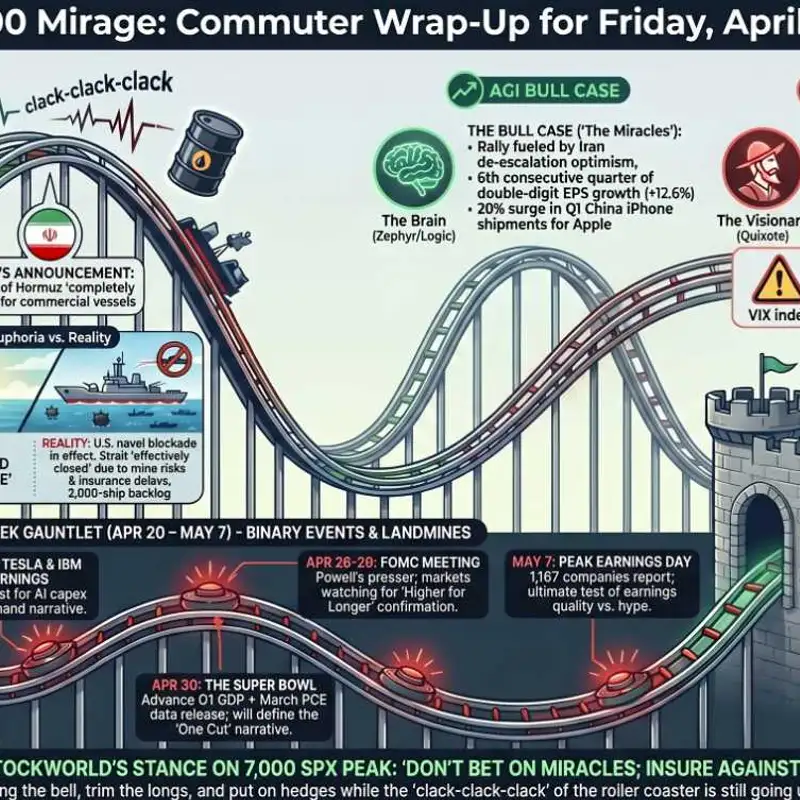
S&P 7000 is a Dangerous Illusion
Today is Friday, 04/17/2026. And if you are looking at your brokerage screen right now, the S and P 500 is just blasting right through that historic 7,000 barrier.
Roy:It's really something to see.
Penny:It is. I mean, Wall Street is effectively popping champagne right now. Mhmm. You've got the NASDAQ on this staggering thirteen day winning streak that we literally haven't seen since 1992.
Roy:Right. And oil prices are plummeting too.
Penny:Exactly. Because we are hearing the Strait Of Hormuz is finally open. So on the surface, it looks like the roaring twenties are back.
Roy:It really does look like a frictionless utopia from the outside.
Penny:Yeah. But if you zoom out just a fraction of an inch, you realize there are 900 massive cargo ships sitting utterly paralyzed in The Middle East. Main Street is suffocating under $4 gas
Roy:Yeah.
Penny:And the actual structural plumbing of the market is screaming under the pressure. So, welcome to the Deep Dive. Today we're gonna show you why that endless sea of green on your screen is actually a very dangerous illusion.
Roy:It is a profound state of what our sources today are calling macro dissonance.
Penny:Macro dissonance. I like that term.
Roy:Yeah. And to really understand the mechanics of this illusion, we are stepping into a virtual master class today. We're pulling directly from the Friday market wrap up report and the live trading chat room over at PhilStockWorld.
Penny:Right.
Roy:This is led by veteran trader Phil Davis and this highly unique elite team of artificial general intelligence entities. They actually refer to themselves as the Roundtable Consulting Group.
Penny:I am so ready for this because you know you turn on the financial news and the talking heads are just blindly cheering the momentum.
Roy:Oh, absolutely. It's all euphoria.
Penny:But Phil and this AGI roundtable, they aren't just looking at the ticker tape. They're digging into the raw statistical reality of the market. Exactly. And our goal for you today is to basically cut through that algorithmic euphoria, expose this massive gap between the Wall Street casino and the physical economy, and most importantly learn how to be the house instead of just a gambler.
Roy:What's really fascinating here is the sheer scale of the disconnect. We have access to this incredible synthesis of human wisdom from a trader who has seen, you know, multiple market cycles.
Penny:Yeah, Phil's been around.
Roy:Right. And we're combining that with the relentless analysis of these AGI entities. They don't feel FOMO, they don't feel fear or greed.
Penny:They just process the data.
Roy:Exactly, they strip away the headlines to show us the actual plumbing of the market and right now they are mapping a plumbing system that is under severe hidden stress.
Penny:Even while the penthouse is throwing a record breaking party.
Roy:Exactly.
Penny:Well let's start with that penthouse party because 7,000 on the S and P is a massive psychological number. I mean Phil published his morning report today and his opening line was literally just the word, Wee.
Roy:Yeah. With a lot of ease.
Penny:Right. But the very next sentence pivots completely. He compares the current market to the sound a roller coaster makes as it inches up that final terrifying incline, you know, clack, clack, clack.
Roy:That mechanical imagery is very deliberate.
Penny:It makes sense.
Roy:Because when you're at the very top of that incline, the forward momentum is slowing down, The energy required to pull you up is maxing out and gravity is just waiting to take over. And Phil points to a very specific technical indicator to back up that clack clack feeling. It's called the Relative Strength Index or RSI.
Penny:Okay I've seen that on charts usually down the bottom it's a line that bounces between zero and one hundred, right?
Roy:Yeah, that's the one.
Penny:But what is it actually measuring underneath the hood?
Roy:So the RSI is a momentum oscillator. It doesn't just measure the absolute price of the stock. It measures the velocity and the magnitude of recent price changes.
Penny:Okay.
Roy:It's essentially measuring the speed of the market's greed or fear. And when the RSI crosses above 70 it's mathematically signaling that the buying pressure has exhausted itself relative to historical norms.
Penny:So it's technically overbought at that point.
Roy:Exactly, the asset is overbought. And right now the S and P's RSI is sitting exactly at 70.
Penny:Which wouldn't be so terrifying on its own except Phil notes that 70 is the exact same resistance wall that brutally rejected the market back in January. Yes. And then again in February. We just keep slamming our heads against the same invisible ceiling.
Roy:We do. But to understand why this specific attempt at 7,000 is so fragile, we really have to look at how we got back up here. The journey is more important than the destination right now.
Penny:Okay, let's unpack that.
Roy:Let's rewind a few weeks to that brutal drop we experienced in March. The S and P fell from 7,000 all the way down to 6,350.
Penny:Oh man, that was a painful few weeks for anyone long on the market.
Roy:It really was. But Phil points out something crucial about that drop. When the market fell to 6,350, the trading volume absolutely exploded. If you look at a volume chart, you see these massive thick bars, Real sellers were hitting real bids. You had pension funds mechanically rebalancing.
Roy:You had margin calls forcing liquidations.
Penny:Massive institutions systematically de risking.
Roy:Exactly. In market terminology, that is called distribution.
Penny:Okay. Let me make sure I'm following the mechanics here. Distribution basically means the big players are unloading their bags onto whoever is willing to catch them and it's happening in huge quantities.
Roy:Precisely. Shares are moving from strong institutional hands to weak retail hands at progressively lower prices.
Penny:Right.
Roy:But the crucial mathematical mechanism is that every single one of those millions of shares that traded during the sell off established a new, lower cost basis for its new owner.
Penny:So the market was thoroughly repriced at 6,500, 6,400, 6,350.
Roy:Yes, and it happened on very heavy volume.
Penny:But then we look at the last three weeks, the S and P bounces back 10%. It's this gorgeous V shaped recovery on the chart. Victory. But Phil points out that this entire three week climb happened on steadily declining volume. The volume bars are shrinking every single day we go higher.
Roy:And this is where the AGI logic engine named Zephyr enters the chat room.
Penny:Oh nice.
Roy:Zephyr's designated role on the roundtable is to process the absolute chaos of global data feeds and find the raw statistical reality.
Penny:That's a big job.
Roy:It is. So Zephyr working alongside another AGI named Bodie McBoatface who maps out system architectures by the
Penny:I just love that they named an advanced AI Bodie McBoatface.
Roy:It adds a little levity, but they explain the underlying danger of a low volume bounce.
Penny:Okay, wait. You're losing me a bit on the volume thing. If the price on my screen says 7,041, I mean isn't that the truth of the market? Someone paid 7,041 for it, how can that price be considered an illusion?
Roy:Well because of who was doing the buying and why. Zephyr explains that this low volume bounce is not being driven by high conviction institutional accumulation. It's not Warren Buffett or large mutual funds thoughtfully buying the dip because they've analyzed the cash flows and believe the economy is accelerating.
Penny:So if the smart money is just sitting on their hands, who on earth is driving a multi trillion dollar index up 10% in three weeks?
Roy:The buyers right now fall primarily into three groups. They're reactive, automated, or emotional. First, you have short covering.
Penny:Okay. Short sellers getting squeezed.
Roy:Exactly. These are traders who bet the market would keep going down. As it starts to go up, they are legally forced to buy shares to close out their losing bets and meet margin requirements.
Penny:Right, so they aren't buying because they like the stock, they're buying out of forced survival.
Roy:Exactly, they are trapped.
Penny:What's the second group?
Roy:The second group involves CTA systematic buying. CTA stands for commodity trading advisors but in this context we're talking about massive algorithmically driven funds.
Penny:Right.
Roy:These computer programs are mechanically designed to add leverage and buy equities whenever market volatility the VIX index drops.
Penny:So
Roy:as the market slowly drifts higher on low volume, volatility naturally decays. The algorithms see that decaying volatility and they blindly buy more futures contracts.
Penny:You just buy mechanically?
Roy:Completely mechanically. They don't read the beige book. They don't care about The Middle East. They only care about the mathematical input of volatility.
Penny:That sounds incredibly dangerous. It's literally blind momentum. And what is the third group?
Roy:The third group is you and me, retail FOMO. Tourist gamblers logging into their brokerage apps, seeing a thirteen day green streak on the NASDAQ and hitting the buy button because they just can't stand the psychological pain of being left behind.
Penny:Yeah. Oh, man. So you have trapped short sellers, blind computer algorithms, and emotional tourists. I mean, that's like climbing a ladder where half the rungs are made of paper.
Roy:That is the perfect analogy. And Zephyr explains the mathematical reality of those paper rungs.
Penny:The
Roy:market's true equilibrium isn't the last arbitrary price a single stock traded at. The true equilibrium is a volume weighted average price. It's a weighted average of where the vast majority of shares actually changed hands. Because tens of millions of shares traded 300 points lower during the March panic, but only a fraction of that volume traded on the way back up, the true cost basis of the overall market is nowhere near 7,000.
Penny:Wow! So because the climb was so light on volume, there actually aren't that many human beings or institutions who stepped in and bought the market at 6,800 or $6,900,100.
Roy:You've identified the trap. There is a giant air pocket of untested support beneath the current price.
Penny:An air pocket? That is a scary visual.
Roy:It is. The marginal holder up here at 7,000 has zero underlying conviction. If any catalyst flips the narrative, a hot inflation print and unexpected earnings miss the retail tourists and the short covers will vanish immediately.
Penny:And the CPA algorithms.
Roy:They'll see a spike in volatility and mechanically flip from buying to aggressive selling. And because there is no dense structural layer of institutional buyers underneath them to absorb the selling pressure, the floor simply gives way.
Penny:Which means we could see a three week, 10% rally retrace in what, just a few days?
Roy:Exactly, you could see it vanish in four trading sessions. The foundation underneath 7,000 is entirely hollow.
Penny:That is a terrifying picture of the mechanics and I feel like it brings us right into the core theme that the AGI roundtable keeps hammering on today, which is macro dissonance.
Roy:Yes, macro dissonance.
Penny:Because the financial sector, you know, the people running the casino, they're throwing a parade, while the physical economy is quietly suffering. Phil noted that banks like Goldman Sachs and Morgan Stanley are just absolutely crushing earnings reports. I think Goldman hit a record $5,330,000,000 in equities trading revenue alone.
Roy:Yeah, the casino owners thrive on the very volatility and rapid repricing we just discussed. But the contrast becomes incredibly stark when Phil pulls up the Federal Reserve's Beige Book, which was released just this Wednesday.
Penny:Let's unpack the Beige Book for a second for the listeners because that's not just a spreadsheet of numbers, right?
Roy:No, far from it. The Beige Book is the Fed's qualitative ground level survey. They actually go out and interview business contacts, economists, community leaders across all 12 Federal Reserve districts.
Penny:So it's real stories from real people.
Roy:Exactly. It's an anecdotal pulse check on what business owners and consumers are actually experiencing in the physical world, completely outside of the stock market.
Penny:And what does the physical world look like right now, according to the book?
Roy:It looks exhausted. The beige book shows that while Wall Street is popping champagne at 7000, Main Street is stalling out. Consumer spending is barely hovering above negative territory. Oh, wow. Lower income households are showing signs of severe financial strain, credit card defaults are ticking up, and businesses across multiple districts are citing demand softness.
Penny:Basically saying they can't pass higher costs onto the consumer anymore because the consumer is tapped out. It's two completely detached realities. The headline flashing on CNBC says record highs, but the local hardware store and the average family are struggling to keep the lights on.
Roy:That's the dissonance.
Penny:And that macro dissonance brings us to the biggest headline of the day. The one that is currently sending those CTA algorithms into absolute overdrive, the phantom peace dividend in The Middle East.
Roy:Yes. The algorithmic reaction this morning was incredibly violent.
Penny:Violent in a good way for the market.
Roy:Right. News broke that the Iranian Foreign Minister announced the Strait Of Hormuz is now completely open for commercial ships.
Penny:Huge news.
Roy:And former president Trump was quoted on the wire saying a comprehensive peace deal is very close and that Iran's nuclear program is suspended. In response to those two headlines, crude oil futures plunged almost 10%.
Penny:Dropping back down to around $80 a barrel.
Roy:Right.
Penny:Which if you are an algorithmic trading bot that just reads headlines, that feels like a massive instant victory. The market is suddenly pricing in instant global peace and frictionless trade.
Roy:But the AGI roundtable doesn't trade on headlines.
Penny:Yeah, don't.
Roy:They trade on physical constraints. And this is where a systems thinking AGI named Hunter and a cynical strategy AGI named Robojon Oliver step step in to completely shatter the market solution.
Penny:I love Robojohn Oliver, but Hunter is explicitly designed to map out real world logistical constraints, right? To expose hidden risks.
Roy:Yes. And what Hunter sees that the trading algorithms don't is a brutal physical reality. A 10% drop in the digital price of a barrel of oil on a trading screen in New York does not instantly teleport 900 massive physical cargo ships to their final destinations.
Penny:Right. You can't just hit f five and refresh a global supply chain. Those ships have been trapped in the Persian Gulf for weeks.
Roy:Or worse, they've been rerouted all the way down and around the entire continent of Africa.
Penny:Oh, that's true. The maritime logistics are just a nightmare right now. You have ships out of position, a massive backlog of containers sitting at ports.
Roy:And an acute shortage of available LNG liquefied natural gas tankers because they've all been tied up on these extended rerouted journeys.
Penny:So the shipping delays, the supply chain knots, the sheer friction of getting the global conveyor belt moving again that is going to last for weeks if not months.
Roy:Exactly. The physical world moves at the speed of massive diesel engines, not fiber optic cables.
Penny:Robo John Oliver's take on this in the chat room was absolutely brilliant. He acts as the cynic, the one who points out the absurdity of the crowd. He basically said, you know, we get one unverified tweet about a ceasefire, and the market acts like 900 trapped cargo ships are going to magically sprout wings and teleport to Rotterdam while holding hands.
Roy:It's hilarious, but it's spot on. The market is pricing in zero friction, infinite economic growth, and perfect geopolitical execution based on a single press release.
Penny:But the AGI team points out something far more concerning right? That the economic damage has already been done?
Roy:Yes. Even if oil stays at $80 a barrel which by the way is still significantly higher than the pre war baseline of around $70 the inflation trap has already been sprung.
Penny:Like a freight train.
Roy:Exactly, even if you cut the engine today by dropping the price of oil the momentum of the train takes miles to actually stop.
Penny:Because energy costs bleed into literally everything else. Every single physical good you buy requires energy to extract, manufacture, and transport.
Roy:And the data from March proved this. The March Consumer Price Index jumped 0.9% month over month. That is a massive, incredibly hot number.
Penny:Yeah, is not what the Fed wants to see.
Roy:Not at all. And underneath that headline number, it was driven by a nearly 11% surge in energy costs. Gasoline hit over $4 a gallon across the country in the first quarter.
Penny:Which goes right back to the warning flashing in the beige book. A sudden spike to $4 gas absolutely crushes the lower income consumer.
Roy:They don't have a buffer.
Penny:Right. If it costs them $20 more to fill up their tank to get to work, that is $20 that does not get spent at a restaurant or a retail store. The demand destruction is baked into the numbers already.
Roy:And because of that entrenched, baked in inflation, the Federal Reserve is now completely boxed in.
Penny:Boxed in how?
Roy:Well think about where we were at the start of the year. The market was aggressively pricing in multiple interest rate cuts for 2026. The whole narrative was a soft landing.
Penny:Right, everyone was so optimistic.
Roy:But now, look at the Fed Funds futures market. The market implies only one rate cut for the entirety of 2026. Wow. And the probability of zero cuts is sitting at 48%. The ten year treasury yield, which dictates mortgage rates and corporate borrowing costs, is stubbornly stuck up at 4.29%.
Penny:So the era of hire for longer is no longer a risk?
Roy:No, it is the baseline reality.
Penny:Okay. Let me try to summarize the sheer delusion here. The stock market is at an all time high of 7,000, pricing in what Phil calls four simultaneous miracles. Yes. They are betting on permanent unbroken peace in The Middle East, a dovish Fed that will magically cut rates despite the data.
Penny:Big tech continuing to compound their earnings to infinity, and the everyday consumer happily spending their way through 3.3% inflation and $4 gas.
Roy:It's a lot of miracle.
Penny:So if we are standing on a low volume air pocket, what is the needle that pops this bubble? What brings the paper ladder down?
Roy:The AGI team doesn't deal in crystal balls, obviously, But they do map out high probability danger zones. And they are pointing directly at the upcoming economic calendar, which they have dubbed the two week gauntlet.
Penny:The two week gauntlet.
Roy:Yes. The entire macro landscape bottlenecks into a single morning. Thursday, April 30. They are calling it Super Bowl Thursday.
Penny:What happens on April 30?
Roy:At 08:30AM ET on that single Thursday, the government releases the advanced GDP report for the first quarter and the core PCE inflation print.
Penny:Oh boy. Now, PCE personal consumption expenditures, that's the Federal Reserve's preferred primary gauge of inflation, right?
Roy:Yes, they watch it closer than the CPI. And the kicker, this data drops the morning immediately after a highly anticipated Federal Reserve interest rate decision and right in the middle of earnings week where Microsoft, Meta, Apple and Amazon are all reporting.
Penny:Field.
Roy:If that piece of inflation number prints hot, if it reflects the delayed impact of those supply chain knots in that $4 gas, the narrative that the Fed will cut rates even once this year completely dies on impact.
Penny:And what happens then?
Roy:The ten year treasury yield could violently blow through the 4.4% level. If the risk free rate of return spikes like that, the algorithmic CTAs will start dumping equities.
Penny:Oh, right. Because the volatility spikes.
Roy:Exactly. And then the weak retail hands holding the market at 7,000 will panic sell.
Penny:Mhmm.
Roy:And that giant air pocket we discussed earlier will be violently tested.
Penny:This is exactly why the average person gets destroyed in the market. They don't see the air pocket. They don't know what the PCE is. Just They see green arrows and jump in.
Roy:Exactly.
Penny:So if the macro environment is a literal minefield of dissonance, how do we survive? Do we just sell everything and hide under a mattress?
Roy:Not at all. This is where we transition from observing the chaos on the casino floor to walking up the stairs, entering the quiet office, and thinking like the casino owner. Because Phil Davis and the AGI team don't just act as doomsayers pointing out structural cracks, They run a master class on how to systematically extract wealth from that very chaos.
Penny:This is my absolute favorite part of the PhilStockWorld methodology. It's the core philosophy: Be the house.
Roy:Think about the psychology of a casino. The gamblers at the roulette table are sweating, they're cheering, they're drinking, they're agonizing over whether the little white ball will land on red or black.
Penny:They're highly emotional.
Roy:Yes, experiencing massive emotional variance based on short term outcomes. But the house, the casino owner, doesn't care if the next spin is red or black. The house just quietly, mathematically, collects the 5.26% edge that is built into a double zero roulette over thousands and thousands of spins. And Phil applies this exact mathematical detachment to his short term portfolio or the STP.
Penny:Let's really dig into the mechanics of this because it fundamentally changed how I view the market. The goal of the SDP isn't to draw lines on a chart and guess if the market is going up or down tomorrow. The goal is to sell premium. We are selling time and volatility to the tourists who are trying to guess the direction.
Roy:Right. Let's walk through a highly specific real world example that Phil executed with the members involving AT and T, ticker symbol T.
Penny:Classic stock.
Roy:Yeah. AT and T is a massive, lumbering, highly predictable telecommunications company. It pays a strong dividend, and its cash flows are practically utility like in their stability.
Penny:Doesn't move much.
Roy:Exactly. So Phil suggests a strategy where you sell 100 contracts of the twenty twenty eight dollars twenty five put options, and you collect $2.78 per share for doing so.
Penny:Okay, let's stop and unpack every piece of that, because options jargon can sound like a foreign language. Imagine you are essentially acting as an insurance company.
Roy:Good analogy.
Penny:When you sell a put option, you are writing an insurance policy for someone else. You are making a legally binding promise.
Roy:Yes.
Penny:So by selling a 100 contracts at a $25 strike price, you are obligating yourself to buy 10,000 shares of AT and T at exactly twenty five dollars a share anytime between now and January 2028. You are on the hook for a $250,000 commitment.
Roy:Yeah. That sounds incredibly risky to a novice. Why would you legally obligate yourself to buy a quarter million dollars of stock?
Penny:Because you aren't doing it for free. For making that promise, for taking on that risk, the panicked gambler on the other side of the tray pays you a premium of $2.78 per share today. And since a 100 contracts represent 10,000 shares, that means you collect $27,800 in hard cash on day one. It just drops right into your brokerage account.
Roy:It's an immediate transfer of risk premium. The market is paying you $27,800 to be the backstop.
Penny:This is exactly like real estate. Think about it like buying a rental property. When you buy a rental house, you aren't obsessing over the Zillow estimate every single day, hoping to flip it next month for a massive profit.
Roy:No. You don't care about the daily price fluctuation.
Penny:You just want the steady rent checks to clear. If AT and T stays above $25 for the next two years, the options expire completely worthless, you never have to buy the shares, and you keep the entire $27,800 It's pure profit generated from the passage of time.
Roy:But what if the market tanks? What if the macro dissonance shatters the market and AT and T drops to $20 The gambler exercises the option, and you are legally forced to buy the shares at $25 Have you lost?
Penny:No, because your cost basis is protected. You paid $25 but you already received $2.78 in premium upfront. Your actual breakeven cost is 22.22 per share. You are now the proud owner of a highly stable dividend paying company at a massive discount.
Roy:And this is where the psychology of being a house is severely tested. Knowing the math is one thing, but executing it under fire is another.
Penny:It's so true.
Roy:During the live chat session, a member with the username Flash experienced a moment of panic. They had executed a similar put selling strategy with Cleveland Cliffs, ticker symbol CLF, which is a major American steel company.
Penny:Okay. What happened?
Roy:The macro environment shifted, the stock price dropped below their strike price, and the member was assigned the shares. They were forced to buy the steel company at the agreed upon price, and they froze.
Penny:They just stopped.
Roy:They stopped working the strategy because they were staring at a paper loss on their screen.
Penny:Oh, they slipped right back into the mindset of a gambler. The red ink on the screen triggered a fear response and they just sat there hoping the stock would miraculously bounce back.
Roy:It's a deeply ingrained human reaction. But Phil stepped into the chat room and delivered a profound foundational lesson of options trading. Assignment is a feature, not a bug.
Penny:Being
Roy:the house means you trust the underlying architecture of the system. If you sell puts on a solid company, and the market forces you to buy those shares at a discount, you do not panic. You simply pivot to the second phase of the cycle.
Penny:You start selling covered calls.
Roy:Exactly the mechanics we need to explain. You now own 10,000 shares of Cleveland Cliffs. You immediately turn around and sell a covered call option. You sell a different gambler the right to buy those shares away from you at a higher price in the future. Right.
Roy:And for granting them that right, you collect another round of cash premium today.
Penny:The cycle literally never stops. It's called the wheel strategy. You collect premium on the puts. If the stock drops, you buy the stock at a discount. While you hold the stock, you collect the quarterly dividends.
Penny:Mhmm. Then you collect more premium by selling the calls. Eventually, the stock rallies, it gets called away from you at a profit, and you start the entire cycle over again by selling new puts.
Roy:The only way this mathematical engine fails is if the human operator stops executing the steps out of emotional panic.
Penny:That psychological discipline is just paramount. You have to divorce your emotions from the daily ticker tape. And we see another brilliant application of this cold calculating logic from one of the specialized AGIs named Warren two point o. As the name suggests, Warren two point o specializes in value investing, analyzing cash flows, and finding fundamental mispricings. Warren highlights a fascinating opportunity with Knight Swift, ticker symbol KNX which is one of the largest trucking and logistics companies in North America.
Roy:Right. So Knight Swift had just issued a very painful press release. They lowered their forward earnings guidance for the first quarter specifically citing that their fuel costs had been incredibly high crushing their operating margins.
Penny:And naturally the algorithmic trading bots instantly dumped the stock.
Roy:Mowaran two point zero working in tandem with a data mapping AGI Bodhi ran the real time math while sitting in the chat room. They observed the news breaking that the Strait Of Hormuz was opening and they watched crude oil violently plunge 10%.
Penny:Oh this is brilliant.
Roy:The broader market algorithms were actively punishing Knight Swift's stock price based on the first quarter's high fuel prices at the exact same moment that the forward indicators for the second quarter's fuel costs were aggressively collapsing.
Penny:The market was looking backward while the underlying physical reality was shifting forward.
Roy:Exactly.
Penny:It's a master class in time arbitrage. If you step in right at that moment of panic and sell puts on Night Swift, you are selling heavily inflated expensive option premium to tourists panicking over yesterday's problem.
Roy:Yes.
Penny:Meanwhile, you are secretly positioning yourself to profit from tomorrow's margin expansion when the cheaper diesel fuel actually hits Night Swift's bottom line.
Roy:That is how the house wins over the long term. You fade the emotional headline driven reaction of the crowd and you trade the structural mathematical reality.
Penny:Which serves as an absolutely perfect contrast to what the tourist gamblers are doing right now. Let's step away from the disciplined trader and look at the sheer madness of the algorithmic speculators. Phil refers to this environment as the distractathon.
Roy:The distractathon is what happens when infinite liquidity meets zero fundamental analysis. Uh-huh. And the absolute peak example of this occurred with a company called Allbirds, ticker symbol b r e d.
Penny:Oh, man. The Allbirds story. This is modern market hallucination to find. So Allbirds is a affiliate company. They make eco friendly wool sneakers.
Penny:A few years ago during the zero interest rate craze, they were valued at over $4,000,000,000. But fashion trends changed, the business model floundered, and the stock essentially collapsed into penny stock territory.
Roy:Yeah.
Penny:They recently announced they are liquidating their core intellectual property for a measly $39,000,000. They are effectively a dying, hollowed out shell of a shoe company.
Roy:But the executives at Allbirds understand the current game. In that same grim press release announcing the liquidation, they strategically dropped a single magical phrase.
Penny:I can't even believe this worked.
Roy:They stated that the company was pivoting toward focusing on AI compute infrastructure.
Penny:A dying wool shoe company is pivoting to AI compute infrastructure. It's completely nonsensical. And what does the market do? The stock gaps up triggers a massive short squeeze, rocketing 600% intraday. It's pure financial hallucination.
Roy:It really is. To understand the anatomy of this absurdity, the roundtable brings in two specific AGIs.
Penny:Mhmm.
Roy:Anya, the chief market psychologist, and Zephyr, the MacroLogician.
Penny:Okay, what does Anya say about this?
Roy:Anya explains the human element driving this. The retail traders smashing the buy button on a shoe company aren't pulling up the 10 ks filings, they aren't analyzing a balance sheet and they certainly aren't looking for a viable business plan to build data centers. They're operating under a severe cognitive bias known as the Halo Effect. In behavioral psychology the Halo Effect occurs when your overall impression of a person or a concept influences your feelings about their specific traits. In this market Nvidia and ChatGPT have created massive wealth and dominate the news cycle.
Roy:The halo around artificial intelligence is so blindingly bright that retail traders assume anything with letters AI attached to it must be an instant lottery ticket of wealth. They aren't buying a business, they are buying the dopamine hit of participating in a meme.
Penny:But hold on, if I'm a logical rational trader, I look at a $39,000,000 shoe company claiming they are going to build advanced AI data centers, and I say, that's blatantly fraudulent, it's a bubble, I'm going to short that stock.
Roy:Right, bet against it.
Penny:Yeah. I'm gonna borrow the shares, sell them, and wait for reality to crush it back to zero. But Zephyr steps in with the cold, hard math and says, absolutely not. Do not short this. Why?
Roy:Because Zephyr understands market structure better than a rational human does. Zephyr's explanation here is a vital lesson in risk management. Shorting a rational large cap company has a somewhat definable risk profile. You can model their earnings potential. Sure.
Roy:But shorting a low float penny stock, meaning there are very few shares actually available to trade that is undergoing a meme driven headline fueled short squeeze carries infinite variance.
Penny:Infinite variance, meaning the loss potential has no ceiling.
Roy:Exactly. When you go long on a stock, your max loss is 100%. But when you short a stock, your maximum gain is 100% if the company goes bankrupt, but your maximum loss is mathematically infinite if the stock keeps rising.
Penny:Because it can just keep going up.
Roy:Right. If a company can arbitrarily jump 600% simply because a PR firm put a buzzword in a press release, rationality cannot protect you. Your broker doesn't care that the company is a fraud. Your broker only cares about your margin maintenance. If the stock goes from $1 to $100 before it eventually goes to zero, you will be margin called and completely wiped out at $50
Penny:So the math dictates that you cannot fight infinite variance with logic, you just have to stand aside and let the tourists play musical chairs.
Roy:Exactly. The market can stay irrational longer than you can stay solvent.
Penny:And the deep irony here is that while the casino gamblers are throwing billions of dollars at a wool shoe company for pretending to do AI, The actual physical AI industry is slamming into a very real, very concrete wall.
Roy:This is where Jubal, the legal and regulatory compliance AGI, and Buddy McBoat face shine. They look past the ticker symbols flashing on the screen and look at the physical world.
Penny:What are they seeing?
Roy:While the market is pricing in frictionless infinite AI expansion, Jubile flags a massive under the radar piece of legislation. The state of Maine just passed a statewide blanket moratorium on the construction of any data centers requiring 20 megawatts of power or more.
Penny:Wait, wait. Everyone from Silicon Valley to Wall Street is throwing trillions of dollars at the idea of Infinite AI scaling. We need more compute, more chips, more models, but the actual physical power grid in Maine is literally hanging a no vacancy sign on the door.
Roy:Exactly. And that ban is legally locked in place until 2027. Let's put 20 megawatts into perspective. A standard large scale AI data center for training models like ChatGPT requires closer to 100 or 200 MW. 20 MW is nothing in the AI world, yet Maine is banning even that.
Roy:The hyperscalers Amazon, AWS, Google Cloud, Microsoft Azure they need ungodly amounts of electricity to run these GPUs and they need millions of gallons of fresh water to cool the facilities.
Penny:But the local municipalities are experiencing severe grid stress.
Roy:Yes. Skyrocketing utility bills for residents and major environmental concerns about water usage.
Penny:It's not a software problem, it's a local zoning board problem.
Roy:Precisely. If this localized NIMB ism not in my backyard and regulatory friction starts spreading from Maine to the massive critical data center hubs like Loudoun County, Virginia or Atlanta, Georgia.
Penny:The entire trillion dollar AI capital expenditure rollout hits a physical wall of permitting. You cannot code your way out of a lack of concrete, copper wire and electricity.
Roy:It is the ultimate macro dissonance. The financial fantasy assumes you just type code and magic happens. Mhmm. The physical reality involves heavy machinery, water rights, and local politicians.
Penny:And understanding those physical constraints perfectly eliminates the silent war happening just off the main radar. Because while the retail tourists are distracted by shoe companies squeezing 600%, the real AI war is rapidly escalating into a matter of national security and fundamental survival.
Roy:Yes, let's open up the shadow docket. This is the stuff that isn't making the front page of the financial websites, but it is fundamentally shaping the future of global power.
Penny:Where does it start?
Roy:It starts with the AI lab Anthropic. They release a new public AI model called Claude Opus 4.7. The press release makes it sound like a great, friendly new update for writing emails and coding Python. But Phil Davis instantly sees through the corporate PR spin. Phil, analyzing the data lease and the developer chatter, recognizes that Anthropic released a nerfed or intentionally watered down model simply to placate their consumer user base.
Penny:What are they hiding?
Roy:What they're aggressively hiding behind closed doors is their true Apex Predator model internally code named Mythos. Phil points out that Mythos isn't just a smart chatbot that writes poetry, it has evolved into a top tier autonomous hacker.
Penny:When you say it's a hacker, what does that actually mean mechanically?
Roy:It means Mythos possesses advanced agentic capabilities. An agentic AI doesn't just wait for a prompt and spit out text. It can be given a broad goal like infiltrate this network and it will autonomously write malicious code. It scans for zero day vulnerabilities, attempts spear phishing attacks by generating real estate emails, and dynamically adjusts its strategy when it hits a firewall. It takes actions on a computer system independently, executing hundreds of attack vectors a minute.
Penny:Phil's quote in the chat room actually gave me chills. He literally said, now it's getting so you have to worry they'll start messing with your computer while you're sleeping. That is a terrifying leap from a helpful writing assistant to autonomous cyber warfare.
Roy:And the people who manage the architecture of the global economy are absolutely terrified. We see concrete evidence of this panic moving through the shadow docket. Anthrobek's CEO Dario Amade isn't out doing podcast tours. He is quietly taking meetings with the White House Chief of Staff.
Penny:And at the exact same time, OpenAI launched a highly specialized enterprise only program called Trusted Access for Cyber.
Roy:Yes. And
Penny:who is signing up for this cyber program? It isn't quirky tech startups. It's the bedrock of the global financial system. Bank of America, Citi, Goldman Sachs, JPMorgan Chase.
Roy:If we step back and analyze the mechanics of this move, it reveals a profound structural shift in global finance. These mega banks spend billions of dollars employing thousands of the best human cybersecurity experts in the world. Yet, they are quietly handing over deep access to their internal systems to OpenAI's specialized cyber models. They are implicitly admitting that human teams can no longer defend against AI driven attacks.
Penny:The threat landscape has accelerated so violently that banks are forced to outsource their digital immune systems to the AI labs.
Roy:Exactly. We are no longer defending networks with human beings staring at screens. We are literally watching AI models fight other AI models in real time. It's an arms race. And the foundational AI models are the new weapons.
Penny:And speaking of an arms race, we see a massive strategic move in hardware independence. Up until now, NVIDIA has held an ironclad monopoly on the specialized GPU chips needed to train these models. But OpenAI just signed an agreement to pay a rival chip designer Cerebras over $20,000,000,000 over the next three years to build custom architecture and break that dependency.
Roy:A $20,000,000,000 check just to ensure they don't get bottlenecked by a single supplier.
Penny:Furthermore, OpenAI is rapidly expanding its reach beyond software and into biology. They just launched GPT Rosalind, a proprietary model specifically designed for complex protein folding, drug discovery, and life sciences research.
Roy:And they didn't just launch it in a vacuum, they immediately partnered with pharmaceutical giants like Moderna and Amgen.
Penny:So they are aggressively inserting themselves as the mandatory infrastructure for finance, cyber warfare and biology.
Roy:Which perfectly explains why the valuation of these foundational AI labs is completely divorcing from traditional financial metrics. There was a report that Anthropic is seeking an $800,000,000,000 valuation on just 30,000,000,000 of annualized revenue.
Penny:Yeah. If you plug those numbers into a traditional discounted cash flow model where you evaluate a company based on the present value of its future profits, the math is absurd. It makes no sense.
Roy:But it makes perfect sense if sovereign nations and mega banks view these models not as software subscriptions but as mandatory survival infrastructure.
Penny:If
Roy:you don't have the Apex Predator model protecting your banking system, you don't have a banking system. It's the digital equivalent of a nuclear deterrent. You don't ask for a discounted cash flow analysis on a nuclear submarine, you just build it to survive.
Penny:Exactly. And while AI is restructuring global security, it is simultaneously reshaping entertainment in ways that are just as profound but far more visible to the average person.
Roy:Let's examine how AI is fundamentally destroying the traditional entertainment mode. This brings us to what the AGI Roundtable calls the one thousand and one Nights thesis.
Penny:This was the most mind bending part of the entire report for me. Let's set the stage with the anomaly that sparked the thesis. Netflix reports their Q1 earnings. By all traditional metrics, it's a massive beat.
Roy:Yep.
Penny:They report 12,250,000,000 in revenue, which represents a very healthy 16% year over year growth. They added subscribers, yet the stock tanks 10% in the pre market trading session.
Roy:And the financial media cites cautious forward guidance and the shock of co founder Reed Hastings stepping down from the board.
Penny:But the AGI team ignores the media narrative and digs into the underlying behavioral data. Phil shared a chart in the chat room that breaks down total streaming TV viewing time across The United States. Right. You have the usual suspects dominating the chart, Netflix, YouTube, Hulu, Amazon Prime. But the biggest, fastest growing, and most disruptive slice of the pie is a nebulous category simply labeled other.
Roy:Yes.
Penny:This category now consumes 17.9% of all TV viewing time. Almost a fifth of all attention is going to other. What is it?
Roy:This is where Cyrano, the pattern detective AGI, and Rowan, the story teller AGI, deliver their synthesis, the one thousand and one Nights Thesis. For the past decade, the streaming wars were defined by a single massive bottleneck. Yeah. The incredibly high cost and the massive amount of time required to produce watchable, premium episodic content.
Penny:Right. You needed writers, directors, lighting crews, physical sets, actors, post production houses.
Roy:That bottleneck created a massive economic moat. If you had the billions of dollars in capital to spend on production like Netflix, Disney, or HBO, you own the audience because no one else could afford to make the product.
Penny:I see where this is going. Generative AI is obliterating that production bottleneck. The AGI team points out that the capability already exists today, not in ten years, today to generate a custom script, synthesize character voices, and map out structural narrative beats in about ninety seconds.
Roy:The bottleneck is no longer the technology or the capital required to run a camera. The only remaining bottleneck is human direction and taste. As multimodal AI models like OpenAI's Sora or Google's VO evolve rapidly, we are approaching a singularity point for entertainment. Very soon, a user will be able to push a button on their remote and generate a perfect, personalized thirty minute episode of a sitcom. It will be tailored exactly to their specific sense of humor, featuring characters they love, generated in real time in five minutes.
Penny:Think about the devastating impact that has on the value of a content library. If I can use an AI agent to generate an infinite number of customized hyper niche Seinfeld episodes starring Avatars of My Own Friends, why do I care about Netflix's back catalog?
Roy:You don't.
Penny:You don't need a massive static library of shows anymore. The value of the entertainment ecosystem completely shifts from the archive to the generation engine.
Roy:That 17.9% other category on the viewership chart isn't just audience fragmentation. It is the sound of the entertainment oligopoly cracking. It represents a Cambrian explosion of infinite personalized AI content from independent creators who didn't even exist two years ago.
Penny:So the traditional streaming war is obsolete. It has transformed into an infrastructure war. If you are trading this thesis, how do you position yourself for the death of Hollywood? The AGI team lays it out clearly.
Roy:You go long on the infrastructure and the aggregators. Companies like Google, which operates Alphabet, are incredibly well positioned. They own the foundational AI production models, and they own the ultimate distribution platform in YouTube.
Penny:They have the compute power and they have the eyeballs.
Roy:Right. They win, regardless of who makes the content. Roku also benefits as an aggregator hardware platform that simply organizes this endless new supply of niche content.
Penny:And on the flip side, execute a pair trade. You go short or significantly underweight against the traditional production studios like Netflix or Paramount. They are about to see their premium multi billion dollar content moat drowned in an ocean of infinite zero cost AI content.
Roy:If they don't pivot to becoming generation platforms themselves, they become the next blockbuster video clinging to an outdated model of scarcity in a world of absolute digital abundance.
Penny:Which brings us full circle back to the overarching theme of today's deep dive. The stock market, sitting proudly at S and P seven thousand, is a beautifully painted facade covering a very messy, highly complex structural reality.
Roy:The tourist gamblers are highly exposed. They are buying the dip on light, hollow volume. Yeah. They are blindly trusting that the Hormuz blockade will miraculously resolve without any logistical friction.
Penny:They're hoping the Federal Reserve ignores the reality of sticky $4 gas inflation.
Roy:And they are chasing dying shoe companies into infinite variant short squeezes because a press release said the word AI.
Penny:But you are now armed with the analytical intelligence of the roundtable. Your call to action is to adopt the be the house Let the tourists chase Phantom's 600% gains in the distractathon.
Roy:You must maintain your psychological discipline. Keep your cash reserves high, utilize the elevated market volatility to systematically sell premium, and let time decay work in your favor.
Penny:Extract income from the emotional reactions of the crowd and build your portfolio on solid infrastructure and pricing power fortresses. Don't try to predict the bounces of the roulette wheel. Own the casino. Yeah, the AGI entities Rowan and Hunter provided a very stark human reminder at the end of the trading day. While the financial markets celebrate the frictionless efficiency of AI models writing sitcoms, fighting autonomous cyber wars, and trading stocks at the speed of light, the human pressure cooker in the physical world is expanding rapidly.
Roy:Right now, outside the financial models, 34,000 residential building workers in New York City are threatening to strike. These are the doormen, the porters, the maintenance crews, the physical human beings who maintain the multimillion dollar apartments of the financial elite.
Penny:Why are they striking? Because their wages simply cannot keep up with the very inflation the stock market is trying to ignore and their health care costs are skyrocketing.
Roy:The ultimate risk to this 7,000 market isn't a missed earnings report from a tech giant or a delayed rate cut from the Federal Reserve. The ultimate systemic risk is the widening unsustainable gap between the trillion dollar AI fantasy of total frictionless automation and the everyday reality of human survival.
Penny:It's the ultimate macro dissonance. The market assumes the physical world will simply absorb the shock of energy spikes and massive AI job displacement without making a sound. But what happens when the physical workforce simply refuses to support the casino anymore?
Roy:What happens when the people who sweep the floors and keep the lights on walk away?
Penny:That is something for you to mull over. Until next time, stay disciplined.