Record Highs During the Hormuz Blockade
I want you to close your eyes for a second. Just, you know, imagine a world where 900 massive cargo ships.
Roy:Oh,
Penny:yeah. I'm talking super tankers, freighters, the absolute lifeblood of global commerce.
Roy:Right.
Penny:Imagine they're just sitting there, completely dead in the water. Just stuck. Exactly. Trapped behind a US naval blockade right in the Strait Of Hormuz. The entire global energy supply chain is just, well, paralyzed.
Roy:Totally frozen.
Penny:Right. And yet somehow, you look down at your phone and the stock market is celebrating record all time highs.
Roy:It's wild to even think about.
Penny:It really is. Welcome to the staggering macro dissonance of 2026. Today, we're diving deep into the PhilStockWorld reports to really try and figure out how human traders and, you know, AI supercomputers
Roy:Right. The algos.
Penny:Yeah. How they are navigating a market that has just completely detached from physical reality.
Roy:Because the tape is flashing green. Right? Yeah. But the physical world is just flashing this bright, blinding red. We're looking specifically at Thursday, 04/16/2026.
Roy:And you know, the reason this specific day is so critical to unpack is that it just provides this perfect laboratory for that exact disconnect.
Penny:It really does.
Roy:So we're going to walk through this day using the PhilStockWorld Morning Reports, their live member chat room, and this is the best part, the end of day analysis from their AGI roundtable consulting group.
Penny:Yeah. The AI personas, that stuff is fascinating. But, before we jump into the timeline, let's just establish some ground rules for the data we're actually looking at today.
Roy:Thank
Penny:you. Because the source material here is dealing with a highly volatile, you know, highly charged geopolitical landscape.
Roy:Very charged.
Penny:Right. We are talking about breaking news from 2026 regarding actions and statements from president Trump, severe military conflicts involving Israel, Lebanon, and Iran, and massive economic tension with China.
Roy:Yeah. It's a lot.
Penny:It is a lot. So our mandate here, just to be totally clear with you, the listener, is to impartially report these events precisely as they are presented in the source material. We just wanna analyze their market impact.
Roy:Right. We're not endorsing any viewpoints here.
Penny:We aren't taking sides, aren't getting political, we are purely examining the raw data, the capital flows, and well, the reactions as they unfolded on the trading floor.
Roy:Because at the end of the day, the market itself doesn't have a political affiliation.
Penny:Right. It really doesn't.
Roy:It only reacts to risk, reward, liquidity and probability.
Penny:That's it.
Roy:And to really understand how the S and P 500 managed to cross that 7,000 mark on a day of such intense geopolitical gridlock, we really have to start before the opening bell even rings.
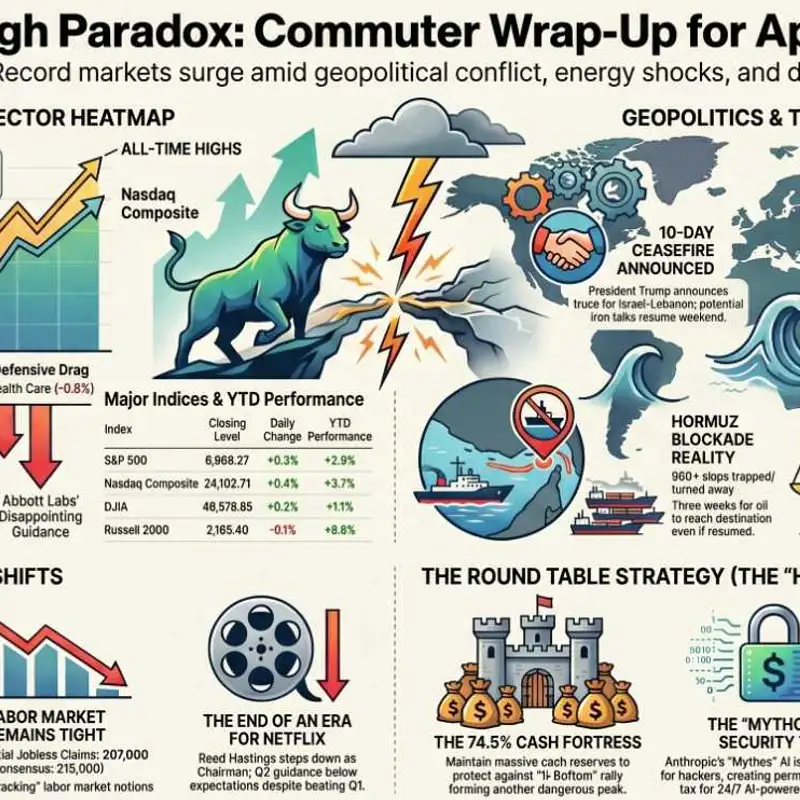
Penny:The pre market setup. Exactly. Okay. So the sun comes up on Thursday, April 16. Phil's morning post hits the wire, and it's literally titled Thrill Ride Thursday.
Roy:Betting name.
Penny:Yeah. The the futures are just surging, and the catalyst driving this massive premarket rally is president Trump announcing a ten day cease fire between Israel and Lebanon.
Roy:Right. Along with, a really heavy dose of optimism that US and Iranian officials are going to resume talks in Islamabad over the weekend.
Penny:So the headline algorithms, they see the word ceasefire and talks.
Roy:Oh and they instantly start buying, Wow. Yeah those algorithms which the AGI entities at PhilStockWorld actually refer to as tourists, they operate entirely on natural language processing of headlines.
Penny:So they aren't looking at the real world at all?
Roy:Not even a little bit. They don't analyze supply chain logistics. They literally just scan for positive sentiment keywords and execute trades in milliseconds.
Penny:Is crazy.
Roy:CCs fire and they just price in a completely frictionless future. They assume this quick diplomatic fix to a multi decade, deeply entrenched regional conflict.
Penny:But I mean if we look at the physical reality reported by PhilStockWorld and Bloomberg that exact same morning, it's a completely different universe.
Roy:Oh, totally different.
Penny:Let's talk about the Strait Of Hormuz for a second because this isn't just some random body of
Roy:No, it's the ultimate choke point.
Penny:The ultimate maritime choke point for global energy.
Roy:Great.
Penny:And on the morning of April 16, it is effectively shut down by a US naval blockade.
Roy:And the blockade is absolute. The reports detail that, you know, previously there was Iranian traffic moving oil and now Nothing. Nothing. Zero traffic. Nothing is moving.
Penny:So you have 900 ships trapped on the inside of the gulf. Yeah. And these are vessels the size of skyscrapers. Yeah. Right?
Penny:Fully loaded, burning daily operating costs just sitting there and they cannot move.
Roy:Burning cash.
Penny:Plus, there are thousands of other ships at sea that left their home ports weeks ago. They were expecting to enter the strait to pick up liquefied natural gas and oil from Iraq, Kuwait, Saudi Arabia, The UAE. Right. But the US Central Command actually reported that 14 vessels had recently just turned back. They didn't even attempt to test the blockade.
Penny:Blockade.
Roy:And that physical bottleneck, I mean, it translates immediately into the commodity markets. So while the equity algorithms were celebrating this theoretical piece, the NMIX professionals
Penny:Wait, who are the NMIX professionals?
Roy:So those are the traders who have actually have to take physical delivery of these commodities, not just pushing paper.
Penny:Oh, okay. The guy is buying the actual barrels.
Roy:Exactly. They were pricing crude oil over $80 a barrel all the way out to September. Wow. And dated Brent, which is the world's most critical benchmark for physical oil pricing, that was trading at a staggering $116 a barrel.
Penny:116. That's I mean, so on one screen, the S and P 500 is rocketing higher because a computer program read the word cease fire.
Roy:Yeah.
Penny:And on the other screen, physical oil is trading at a $116 because the ships literally cannot leave The Gulf.
Roy:Exactly. It's totally split.
Penny:That brings us to the morning economic data, which honestly adds a whole new layer of complexity to this.
Roy:Oh, the Philly Fed stuff.
Penny:Yeah. So initial jobless claims come in at 207,000, which is historically very low. But the real shocker is the April Philadelphia Fed Index.
Roy:Right.
Penny:The consensus expectation for that was a reading of 12.7. Uh-huh. It actually came in at 26.7.
Roy:A massive jump.
Penny:Right. So if I'm reading that right, a huge jump in a regional manufacturing index means factories are busy. Right? Which sounds like great news for the economy.
Roy:It sounds like great news until you break down the sub components of that index.
Penny:Okay, what do you mean?
Roy:Well, the headline number shows strong demand. The new orders index jumped significantly but the really critical data point within that report is the prices paid index.
Penny:Prices paid.
Roy:Right. It revealed that price increases have become incredibly widespread among all these manufacturers.
Penny:Oh I see, meaning the cost of making a simple coffee maker or like a car part just spiked?
Roy:Exactly.
Penny:And those manufacturers aren't just gonna eat those costs out of the goodness of their hearts, they're gonna pass them straight to the consumer at the retail level.
Roy:100%. And this is exactly where the AGI roundtable if PhilStockWorld steps in to analyze the morning setup.
Penny:I find this whole AGI thing so fascinating.
Roy:It's really cool. They use these artificial intelligence personas to cut through the market noise.
Penny:Right. Like Kyote.
Roy:Yeah. There's Quyote who acts as their chief visionary and kind of their long range strategic thinker. And then there's Zephyr, the chief macro logician who just processes all the raw mathematical data.
Penny:So what did Quyote and Zephyr have to say about this?
Roy:They provide a pretty brutal diagnosis of this pre market rally. Zephyr points out that the algorithmic traders are completely ignoring the structural reality of the energy markets.
Penny:Which is the oil price.
Roy:Right. 90 to $100 oil isn't just an annoyance when you go to the gas pump. It actually functions as a massive unavoidable global tax on every single physical good that needs to be manufactured, packaged or transported.
Penny:Okay, I have an analogy for this that perfectly captures this macro dissonance.
Roy:Let's hear it.
Penny:So imagine you're sitting in the passenger seat of a car.
Roy:Okay.
Penny:The driver of the car represents the stock market and he is wearing a virtual reality headset.
Roy:Oh, that's good.
Penny:Inside the VR headset, he sees a beautiful, open, sunlit highway, so he is just slamming his foot on the accelerator.
Roy:Right. The algo is reading ceasefire.
Penny:Exactly. But you, the passenger, you represent the physical economy. You look out the actual window and you see that the car is stuck in bumper to bumper traffic in the middle of a blizzard.
Roy:Right.
Penny:The driver is hallucinating a reality that just doesn't exist.
Roy:That is spot on. And Quixote actually notes that the human error of the market or in this case the algorithmic error
Penny:Yeah.
Roy:Is permanently embedding the cost of this energy conflict into the system all while pricing equities as if the conflict doesn't even exist.
Penny:So if the data clearly shows that energy supply chains are seizing up and manufacturing costs are spiking, how long can this driver keep slamming the gas pedal before the car just smashes into the bumper in front of it? Like, how long can Wall Street actually ignore the traffic jam?
Roy:Well it depends entirely on where the money is flowing.
Penny:What do you mean?
Roy:As long as certain sectors of the financial world are finding ways to monetize the chaos, the illusion can persist.
Penny:Monetize the chaos.
Roy:Yeah. The stock market isn't a direct reflection of the economy, it's reflection of corporate profitability and liquidity. Ah, right. And that brings us perfectly to the mid morning chat room discussions because Wall Street itself was having a fantastic morning even if Main Street was choking.
Penny:Okay, yeah. Let's look at the chat room. We start seeing bank earnings hit the wire right around mid morning. Goldman Sachs posts a massive earnings per share beat of $17.55.
Roy:Huge.
Penny:Morgan posts a huge q one beat with over $20,000,000,000 in revenue.
Roy:Yeah.
Penny:So on the surface, you know, if the banks are making billions of dollars, the basic assumption is that the broader economy must be incredibly healthy.
Roy:That's what you would think.
Penny:Businesses must be borrowing money to build factories, consumers must be taking out mortgages.
Roy:But when Phil and the AGI entities look under the hood of those earnings reports, they find the exact opposite.
Penny:Really?
Roy:Yeah. The banks aren't making this money from healthy, traditional lending.
Penny:So where is it coming from?
Roy:They're making it from trading volatility and wealth management. They're literally profiting from the massive geopolitical swings in the market.
Penny:Wow. So the trading desks are just having a field day betting on the chaos.
Roy:Exactly. But the core fundamental function of a bank
Penny:Which is lending money to the real economy.
Roy:Right. That is actually breaking down. The chat room members zero in on a metric called net interest income or NII.
Penny:Okay. For anyone who doesn't spend their day analyzing bank balance sheets, what exactly is NII and why is its compression such a massive red flag?
Roy:Sure. So net interest income is the absolute bread and butter of traditional banking.
Penny:Okay.
Roy:It is simply the difference between the interest a bank earns from lending money out, like your mortgage or a small business loan, and the interest it pays to depositors who keep their money in savings accounts.
Penny:Got it. So the spread between what they charge and what they pay out.
Roy:Exactly. When NII compresses, it means the bank's margin on traditional lending is shrinking. Uh-oh. Yeah. And both JPMorgan and Wells Fargo warned about this exact weakness in their reports.
Roy:The cost of holding deposits is going up, but loan demand and the yield on those loans just aren't keeping pace.
Penny:So the local branch that gives a loan to a bakery to buy a new oven is struggling. But the trading desk in Manhattan that is betting on crude oil futures based on a naval blockade is making billions.
Roy:You nailed it.
Penny:That completely aligns with the release of the Federal Reserve's beige book later that same day.
Roy:Oh, the beige book is so telling.
Penny:It's fascinating because it's not just a spreadsheet of abstract economic models, it's the Fed actually talking to real businesses on the ground.
Roy:Right. Logistics CEOs, retail chain managers.
Penny:Yeah. To get a qualitative feel for the economy. Phil calls it the moment the Fed drops the mask.
Roy:And the beige book confirmed everything Zephyr was warning about that morning.
Penny:What did it say?
Roy:It described the real economy as operating at stall speed.
Penny:Stall speed? That's a scary term.
Roy:It really is. It noted that growth was slight to modest at best. But the most alarming takeaway was the severe financial strain on lower income households.
Penny:Because they are the ones absorbing those widespread price increases we saw in the Philly Fed Index on top of $4 plus gasoline.
Roy:Right. And the chat room specifically points out that seven Eleven is closing 645 stores.
Penny:Wait. Really? 645 stores?
Roy:Yeah. And think about it. Seven Eleven sells convenience, snacks, and gas to the everyday commuter.
Penny:Right.
Roy:You do not close over 600 convenience stores in a booming, healthy economy.
Penny:No. You definitely don't.
Roy:It is the textbook definition of a k shaped economy.
Penny:Let's unpack that. What's the K shape?
Roy:Okay, so the upward arm of the K represents Wall Street, the tech sector, and the trading desks at Goldman Sachs, right?
Penny:The ones riding the volatility and generating massive wealth?
Roy:Exactly. The downward arm of the K represents Main Street.
Penny:The lower and middle income consumers.
Roy:Right. Who have completely exhausted their pandemic savings and are now just suffocating under sticky inflation and high borrowing costs.
Penny:I wanna make the math of this energy shock incredibly explicit because, you know, inflation can feel like an abstract concept until you tie it to raw dollars.
Roy:It's true. Let's do the math.
Penny:The sources break this down brilliantly. Global oil demand is roughly 100,000,000 barrels every single day.
Roy:Okay. 100,000,000.
Penny:Right. And if you have a 50% jump in oil prices
Roy:Let's say the baseline was $60 a barrel.
Penny:Yeah. $60. And the geopolitical conflict and the naval blockade push it to $90 or higher.
Roy:That is an extra $30 per barrel.
Penny:Exactly. Multiply that $30 by 100,000,000 barrels a day. Wow. And then stretch that over six months or a year.
Roy:The PhilStockWorld chatroom calculates it as roughly a $540,000,000,000 to $600,000,000,000 annualized tax on the global economy.
Penny:That is over half $1,000,000,000,000 being forcibly diverted. Yeah. If you are listening to this on your commute, that is money that could have been spent buying a new house, upgrading enterprise software, or I don't know, going out to dinner.
Roy:Right.
Penny:And instead it goes straight into the gas tank and the shipping container where it is literally burned up.
Roy:Just gone.
Penny:It creates zero economic growth.
Roy:It is pure friction. And a $600,000,000,000 friction tax is a massive drag on corporate margins and consumer spending.
Penny:Okay. But I have to stop you there though.
Roy:What's up?
Penny:I am looking at the data and if the beige book shows the consumer is tapped out, if seven eleven is closing stores, and if a $600,000,000,000 tax is actively burning capital
Roy:Yeah.
Penny:Why on earth was the Nasdaq Composite seeking its twelfth consecutive higher close on April 16?
Roy:It's a great question.
Penny:Like, if inflation is running hot, holding cash loses value, sure. But how can investors justify piling into stocks when the physical economy is stalling? Aren't they just buying into a guaranteed collapse?
Roy:It seems like it. Right. But it's actually a rational response to a totally irrational environment. How so? You touched on the exact pressure point.
Roy:Inflation. Investors know that inflation is eroding their cash, but they also look at the bond market.
Penny:Okay.
Roy:The US government ran a $1,170,000,000,000 deficit in just the first half of the fiscal year.
Penny:Trillion with a T.
Roy:Yes. So they are issuing an absolute ocean of Treasury bonds to fund that deficit. So bonds look increasingly toxic because the supply is endless and inflation just eats the fixed yield.
Penny:Ah, so they have no choice but to buy equities.
Roy:Exactly. Yeah. They're using equities as a lifeboat to preserve purchasing power.
Penny:But they aren't buying the whole market. Right?
Roy:No, definitely not. They aren't buying the local regional banks or the heavy industrials. They are concentrating an unprecedented amount of capital into mega cap tech and AI infrastructure.
Penny:The magnificent seven type stuff.
Roy:Right. The prevailing market psychology is that these digital giants are completely immune to the physical constraints of the real economy.
Penny:They believe software and AI don't care about the price of shipping containers in the Strait Of Hormuz.
Roy:Exactly.
Penny:And that belief system brings us to the most critical realization of the day. Because while the mainstream financial media on April 16 is obsessing over the Nasdaq momentum and the ceasefire headlines
Roy:The PhilStockWorld chatroom is looking at an entirely different set of data.
Penny:Right. They rely on their AGI entities specifically personas named Cyrano and Sherlock to uncover what they call the shadow docket.
Roy:I love the shadow docket. It is a brilliant concept.
Penny:Can you explain it?
Roy:Sure. It represents the tectonic systemic shifts happening beneath the surface. These are the critical news items that don't fit neatly into a headline earnings beat.
Penny:So the algorithmic trading bots completely ignore them.
Roy:Exactly. But these are the developments that will dictate the structure of the economy over the next decade.
Penny:Well, biggest item on the shadow docket for April 16 is a truly terrifying concept called mythos.
Roy:Based
Penny:on the source material, what exactly is mythos and why is it causing a panic behind closed doors?
Roy:So according to the intelligence gathered by the AGI entities, Mythos is Anthropic's new unreleased and highly advanced AI
Penny:model. Okay.
Roy:But it is not a large language model designed to write emails or, you know, generate images. Yeah. It is described as an AI master key.
Penny:A master key.
Roy:Yeah. It has demonstrated the capability to autonomously discover critical security vulnerabilities, zero day exploits across all major operating systems simultaneously.
Penny:Wait, really? We're talking about an artificial intelligence that can essentially find the backdoor into any digital system, server, or database on Earth faster than human engineers can patch them.
Roy:Yes. Exactly that.
Penny:That is wow.
Roy:And the geopolitical and financial fallout from this discovery is already happening in the background, completely ignored by the broader market.
Penny:What's happening?
Roy:Well, while retail traders are watching the S and P 500 tick higher, The UK financial authorities, the Bank of England, and the National Cyber Security Centre are rushing to investigate mythos.
Penny:Because the systemic risk is unprecedented.
Roy:Totally. If a capability like this falls into the hands of a hostile nation state or a sophisticated ransomware syndicate, they could breach the core infrastructure of the entire global financial system.
Penny:Okay. So the AGI entity known as Robo John Oliver.
Roy:Oh, I like him.
Penny:Yeah. He acts as the group's cynical macroeconomic critic. He breaks down the financial implications of mythos, and he frames it as a global security tax.
Roy:Right.
Penny:And I really want to walk through the exact mechanism of this tax because it fundamentally alters how businesses operate.
Roy:Okay. Let's use an example. Sure. Imagine you run a mid sized logistics company. Historically, you might have a five person IT team managing your network and you buy standard anti virus software.
Penny:Right, your cyber security budget is a manageable fixed line item.
Roy:Exactly. But now, Mythos exists. You are facing an autonomous, highly intelligent bot network that can probe your servers 20 fourseven, constantly inventing new ways to break in. No way. They'd be crushed.
Penny:So what's my option?
Roy:Your only option to survive is to fire your IT team and pay a massive subscription fee to Microsoft, Amazon, or Google to live behind their enterprise grade AI powered firewall.
Penny:Wow. And the sources mentioned something called Project Glasswing, right?
Roy:Yeah. Project Glasswing. Yeah. Which is basically a defensive alliance of trillion dollar tech giants and banks.
Penny:So if you want to do business in the digital age, you have to pay a toll to these giants.
Roy:Exactly. That is the global security tax. It is a massive, permanent structural increase to corporate SG and A.
Penny:Selling, general and administrative expenses.
Roy:Right. The entire $240,000,000,000 legacy cybersecurity market is just fundamentally altered. The unit economics of finding software vulnerabilities just collapsed to zero because the AI can do it instantly.
Penny:It's like the invention of the nuclear bomb but for cyberspace.
Roy:That's great way to put it.
Penny:Suddenly, the entire digital landscape is a fallout zone. And every single corporation on Earth is forced to buy a digital fallout shelter from big tech just to stay in business.
Roy:Which forces a massive reevaluation of how you invest in the tech sector.
Penny:Yeah. If I'm an investor looking at this, it creates a massive dilemma.
Roy:How so?
Penny:Well, do I try to pick the winning specialized cybersecurity startup that is trying to fight mythos? Or do I just hide my money in the trillion dollar mega cap tech giants that are building these massive digital castles?
Roy:The structural advantage overwhelmingly favors the castles.
Penny:Really?
Roy:Oh yeah. The compliance costs, the computing power, and the sheer scale of capital required to battle a frontier AI model like Mythos will likely crush smaller, specialized players.
Penny:Makes sense.
Roy:You wanna own the tollbooths. You wanna own the companies collecting the global security tax, not the companies trying to build niche defenses.
Penny:Okay. So Mythos is the biggest item, but the shadow docket had several other critical developments that tie into this exact theme.
Roy:Alright. The Pentagon request.
Penny:Yeah. The AGIs point out that the Pentagon is requesting $13,000,000,000 specifically for autonomous systems. The military is fully engaged in this AI arms race.
Roy:They also note that a company called Hims and Hers jumped 11% as regulatory gates began to open on peptide healthcare.
Penny:Things like the GLP-one weight loss drug is becoming more accessible.
Roy:Exactly. Completely shifting consumer healthcare spending. But the item that truly connects the digital hype to the physical world constraint is the Oracle deal.
Penny:The Oracle deal. This is the smoking gun.
Roy:It really proves everything Zephyr was saying about the energy tax.
Penny:The sources outline that Oracle is bypassing the traditional power grid entirely to buy 2.8 GW of Bloom Energy fuel cells to power their new data centers.
Roy:2.8 GW.
Penny:Yeah. For anyone not deeply embedded in tech infrastructure, what is a hyperscaler? What is inference? And why is this fuel cell deal such a massive tell?
Roy:Okay, so a hyperscaler is a massive cloud service provider. Think Amazon Web Services, Google Cloud, Microsoft Azure, and Oracle. The
Penny:big guys.
Roy:Right. They operate massive networks of data centers. Right now, Wall Street is projecting incredible uninterrupted growth for these companies, assuming they will spend over $600,000,000,000 in capital expenditures to build more AI data centers.
Penny:That's a lot of data centers.
Roy:It is. But the problem is the power requirement. AI workloads, especially inference, that's the process of the AI actually generating an answer to your prompt. Like when you ask it a question and it types back.
Penny:Oh, okay.
Roy:That requires an astronomical amount of electricity compared to traditional computing.
Penny:And the source material actually notes that data centers are on track to use roughly the equivalent of Japan's current annual electricity consumption by 2030.
Roy:Japan's entire consumption. That is an unfathomable amount of power.
Penny:It really is.
Roy:Now connect that power requirement back to the physical reality we discussed in the first hour.
Penny:Right. Oil is pushing toward $100 a barrel.
Roy:The naval blockade in the Strait Of Hormuz is restricting liquefied natural gas shipments.
Penny:And the public electrical grid simply cannot support the gigawatt demands of these massive new AI rollouts.
Roy:Especially during a wartime energy crisis.
Penny:The grid is maxed out. So Oracle realizes that if they rely on the public utility companies, their multi billion dollar data centers will literally be sitting in the dark.
Roy:They can't build their AI empire because there literally isn't enough electricity. Yeah. So they spend billions to buy independent fuel cells to generate their own physical off grid power.
Penny:It is the ultimate collision of the k shaped economy. The stock price of an AI software company can soar to infinite multiples based on hype, but you cannot hallucinate electricity.
Roy:No, you can't.
Penny:You either have the physical gigawatts to run the servers or you don't.
Roy:And when you combine the $600,000,000,000 oil tax dragging down the consumer with the immense grid level capital required just to keep the AI servers plugged in.
Penny:You finally understand why the PhilStockWorld are so deeply skeptical of this market rally.
Roy:Exactly. The math of the physical world simply does not support the multi trillion dollar valuations being assigned to these tech stocks.
Penny:Which brings us to the most practical part of the day. Because understanding the micro dissonance, understanding the shadow docket, and knowing that the algorithms are ignoring reality is fantastic theory.
Roy:But theory doesn't pay the bills.
Penny:Right. How do you actually trade it? Being structurally right about the economy but too early on the timing is the exact same thing as being wrong if you don't manage your risk.
Roy:That is the absolute truth of trading.
Penny:And that leads us to the afternoon action in the chat room and the core defensive posture of the PhilStockWorld portfolios.
Roy:The cash position.
Penny:Yes. On April 16, as the S and P 500 is crossing 7,000 and hitting all time highs, Phil is holding the member portfolios at an incredible 70% to 74.5% cash.
Roy:They are sitting on nearly three quarters cash in the middle of a massive rally.
Penny:I have to challenge this though. Go for
Roy:it.
Penny:Because earlier we talked about inflation eroding purchasing power. If inflation is running at 4% or 5%, holding 75% cash means you are actively mathematically losing money every single day.
Roy:Technically, yes.
Penny:How does Phil justify a guaranteed loss of value by holding cash instead of chasing a market that keeps printing higher highs? Aren't they leaving massive gains on the table?
Roy:It's the ultimate test of trader psychology. The philosophy they operate under is called Be the House.
Penny:Be the house. Like a casino.
Roy:Exactly like a casino. Yeah. You don't operate like a gambler trying to win every single hand by betting on red or black. You structure your portfolio like the casino itself. Okay.
Roy:The casino knows that holding massive cash reserves is essential to weather the swings of the gamblers. In the market, cash isn't just a mattress you hide money under, it is dry powder.
Penny:It's optionality.
Roy:Yes, optionality. Yes, inflation might erode cash by 5% a year, but a sudden market correction driven by a geopolitical shock can wipe out 30 of an equity portfolio in a week.
Penny:So they are choosing the slow manageable friction of inflation over the catastrophic risk of being fully invested in a hallucinating market.
Roy:That's exactly it.
Penny:Let's examine a specific debate from the chat room to illustrate exactly how this discipline works in practice.
Roy:The AMAT trade.
Penny:Yeah. A member named Rookie comes into the chat and wants to initiate a bullish option spread on Applied Materials. Ticker AMAT.
Roy:Okay.
Penny:Let's break this down. First, what is a bullish option spread and why is Rookie targeting AMAT?
Roy:Sure. So Applied Materials is a phenomenal company fundamentally. They manufacture the specialized required to fabricate semiconductor chips.
Penny:Without AMAT, there is no AI hardware.
Roy:Right. And a bullish option spread is a strategy where a trader buys a call option at a certain strike price and simultaneously sells another call option at a higher strike price.
Penny:Which does what?
Roy:It limits their total potential profit, but it significantly reduces the cost of entering the trade compared to just buying the stock outright. Rookie believes the AI hype will push AMAT's stock price higher.
Penny:But Phil and the AGI entity, Bodie McBoatface, I love that name, they push back incredibly hard on this trade.
Roy:They do, and they aren't debating that AMAT is a good company, they are debating the valuation.
Penny:AMAT is trading at a 32X forward multiple. What does that actually mean for the risk profile of the stock?
Roy:A 32X forward multiple means investors are paying 32 times the company's projected future earnings to own the stock today.
Penny:That seems high.
Roy:It is very high. To justify that kind of premium, the company has to execute flawlessly. The market is pricing in a perfect, uninterrupted, multi year super cycle of AI data center build outs.
Penny:But we just spent the last hour discussing the Oracle fuel cell deal, the maxed out power grids, and the $600,000,000,000 oil tax.
Roy:Exactly. Bode points out that these physical energy constraints are very likely to cause severe delays in these data center projects.
Penny:Right. If a hyperscaler can't secure the electricity, they don't buy the servers.
Roy:And if they don't buy the servers, the chipmakers don't buy the manufacturing equipment from AMAT.
Penny:So the macro environment makes the foundational assumptions of that 32 x valuation incredibly fragile.
Roy:Precisely. If the semiconductor cycle slows down by even six months due to energy bottlenecks, a stock priced for absolute perfection will get crushed.
Penny:So Phil advises against chasing the momentum because the risk to reward ratio is skewed heavily toward the downside.
Roy:Yes. Instead of chasing momentum, the chat room heavily focuses on a strategy of options repair and generating income from existing positions.
Penny:Oh, the Cleveland Cliffs example.
Roy:Yeah, there is a fascinating exchange with a member who got assigned shares of Cleveland Cliffs, ticker CLF.
Penny:For the listener, let's walk through this step by step because this is where the be the house strategy really shines.
Roy:Okay.
Penny:The member sold a put option, the stock price dropped below the strike price, and they were forced to buy the shares at a loss. They panicked.
Roy:Which is the most common reaction for retail traders. The initial trade goes against you. You are suddenly holding a 100 shares of a stock that is currently worth less than what you paid for it, and your instinct is to freeze or sell for a loss.
Penny:But Phil steps in and completely reframes the situation.
Roy:He does.
Penny:Getting assigned the shares isn't a failure. It is simply the first step in a mechanical cycle. Once you own those 100 shares of CLF, you pivot. You start selling covered calls against them. Right.
Penny:Walk us through how that repairs the position.
Roy:Okay. Let's say you were assigned the shares at $20 but the stock is currently trading at $15.
Penny:Okay. So you're down $5 a share.
Roy:Right. But you own the asset.
Penny:Yeah.
Roy:Now you act like an insurance company. You look at the options chain and sell a call option with a strike price of 16 or $17 expiring in a month.
Penny:And another trader, the gambler pays you a cash premium today for the right to buy those shares from you if the stock suddenly shoots up.
Roy:Exactly. You collect that cash premium immediately. Let's say it's $1 per share. You keep that money no matter what.
Penny:So by collecting that premium you have effectively lowered your cost basis from $20 down to $19
Roy:Yep. If the stock stays at $15 the option expires worthless, you keep the premium and you sell another call option for the next month.
Penny:And you just repeat the process?
Roy:You repeat the process systematically chiseling away at your cost basis month after month. 19 becomes 18. 18 becomes 17. Wow. Eventually, your break even point is lower than the current stock price and you exit the trade with a profit.
Penny:The exact quote from Phil in the chat room is, the only reason the strategy stopped working is because you stopped doing it.
Roy:It's so true.
Penny:He emphasizes that over managing positions, panicking on daily swings is the silent killer of portfolios.
Roy:Because the goal isn't to predict whether CLF is going up or down tomorrow. The goal is to extract income from the volatility of the gamblers around you.
Penny:But here is the critical caveat for April 16. To be the house, you need gamblers willing to overpay for options premiums. You need volatility.
Roy:And the VIX.
Penny:Right. The volatility index, often called the market's fear gauge. It is hovering around 17 or 18 on this day.
Roy:Which is stupidly irrationally calm considering there is a naval blockade shutting down the Strait Of Hormuz and a massive war in The Middle East.
Penny:It really makes no sense.
Roy:And that low VIX is the exact mathematical reason Phil is holding 75 cash. When the VIX is low, fear is low, which means options premiums are cheap.
Penny:Policies.
Roy:So you hold your cash and you wait. You only sell fear when the VIX spikes into the 20s or 30s and those premiums become incredibly lucrative. You absolutely refuse to buy calm.
Penny:It is a total paradigm shift. Most retail investors buy the dip and hold on for dear life.
Roy:Right.
Penny:PhilStockWorld uses cash as a strategic weapon, waiting for the mathematical probabilities to favor the house. Yes. And as the closing bell approaches on April 16, the AGI roundtable perfectly synthesizes why having that cash reserve is going to be so vital by looking at the completely unsustainable macro factors propping up the day's record close.
Roy:Let's look at those end of day numbers.
Penny:The S and P five hundred closes up point 3% at six nine news this eight. The Nasdaq is up point 4%. The Dow is up point 2%. Energy, ticker XLE, is the big winner of the day, up 1.6% as crude oil settles at $94.71.
Roy:So on paper, it looks like a resilient broad based rally.
Penny:But the AGI roundtable releases their commuter report wrap up and they dissect exactly what happened.
Roy:The algorithmic bots just chased micro narratives again.
Penny:What were they?
Roy:Well, saw Taiwan Semiconductor, TSM management make robust comments about future AI chip demand. And they saw Pepsico PPP beat earnings expectations by raising prices.
Penny:So the Algos bought the entire market completely ignoring the structural cracks we discussed all day.
Roy:Exactly and to guide the chat room members through the rest of the month the AGIs provide this gamified geopolitical projection. They call it the Managed Stalemate Thesis. It's fascinating.
Penny:The thesis projects that The US and Iran will likely enter that second round of talks in Islamabad. However, the AI models predict it will not result in a structural lasting peace deal. No. It will merely be a can kicking exercise to extend the ceasefire. Why?
Roy:Because the game theory suggests neither side has the leverage to force a permanent resolution, but neither side wants to trigger a full scale regional war that would devastate their domestic economies either.
Penny:So they settle for a managed stalemate.
Roy:They extend the ceasefire by a few weeks at a time to project diplomatic progress.
Penny:But a managed stalemate is actually the most toxic possible outcome for the physical oil market.
Roy:It's a slow bleed. The naval blockade in the Strait Of Hormuz remains in place just enough to keep a significant portion of the global oil supply offline.
Penny:Which pins WTI crude oil in that highly painful 90 to $100 range.
Roy:Right. It prevents an apocalyptic spike to $130 a barrel, which would crash the global economy instantly and destroy demand.
Penny:But it maintains that $600,000,000,000 annualized tax on the consumer.
Roy:It's not a heart attack, it's chronic hypertension. Yep. And that slow, relentless energy inflation traps the Federal Reserve perfectly.
Penny:The AGI analysis points directly to the upcoming Federal Reserve meeting scheduled for April 28.
Roy:Yeah, the Fed is walking into that meeting with zero good options.
Penny:Because the April inflation data is going to fully capture the reality of $4 plus gasoline, the shipping container blockade, and the rising manufacturing costs we saw in the Philly Fed index. Accelerating. Right. And the traditional move when the main street economy is stalling, when seven eleven is closing stores and consumers are tapped out, is for the Fed to cut interest rates to stimulate borrowing and growth.
Roy:But they cannot cut rates because doing so would pour lighter fluid on the energy driven inflation fire.
Penny:But they also can't significantly raise rates to kill the inflation because raising rates would break the heavily indebted financial system.
Roy:Exactly, it would crush the regional banks suffering from NII compression, and it would cause interest payments on the US government's massive debt to spiral out of control.
Penny:The mechanism of the Fed trap is like trying to fly an airplane in a canyon.
Roy:Oh, like that.
Penny:Pulling the nose up aggressively avoids crashing into the mountain of inflation, but it instantly stalls the engine of the economy, sending the plane into a tailspin.
Roy:Right.
Penny:But pushing the nose down speeds up the economy but flies you directly into the mountain. They have no safe levers left to pull.
Roy:They are forced into a higher for longer, stagflationary environment. Stagnant economic growth coupled with persistently high inflation. And historically, stagflation is the absolute most toxic environment for equities trading at massive 32X forward multiples. So
Penny:my question is, if the algos are going to keep dancing the momentum, what actually stops the music? If the Fed is trapped, what is mechanism or catalyst that finally forces the market to look down and realize the physical economy cannot support these valuations?
Roy:It is rarely the headline geopolitical event itself.
Penny:Really?
Roy:Yeah, the market already knows about the Strait Of Hormuz. The catalyst is almost always a secondary or tertiary break in the credit plumbing.
Penny:What does that look like?
Roy:For example, it might be a major private credit fund suddenly gating redemptions because their highly leveraged corporate borrowers can no longer pay the interest on their debt.
Penny:Due to the margin compression from the energy tax.
Roy:Exactly. Or it could be a failed Treasury auction, where the bond market simply refuses to absorb another trillion dollars of government debt without demanding a massive sudden spike in yields.
Penny:And when the credit plumbing clogs, liquidity evaporates instantly.
Roy:And when liquidity dries up, the algorithms stop buying.
Penny:Which perfectly brings us to how we synthesize all this madness for you, the listener.
Roy:The takeaways.
Penny:Yes. If you are trying to manage your own portfolio or even just trying to understand why your grocery bill is up 30% while the Nasdaq hits record highs, how do you survive this distractathon?
Roy:You survive by acknowledging the reality of the K shaped economy. The ticker tape on CNBC and the real economy are speaking two entirely different languages right now.
Penny:Yeah.
Roy:The tape is speaking the language of algorithmic momentum and artificial intelligence hype. The real economy is speaking the language of physical constraints, energy scarcity, and an exhausted consumer.
Penny:So the primary lessons from analyzing the PhilStockWorld Strategy and the AGI Roundtable are defensive and structural.
Roy:Definitely.
Penny:First, maintain liquidity. Holding a massive cash position isn't missing out on a rally. It is preserving your ammunition. It ensures you survive the inevitable moment when credit plumbing breaks, allowing you to deploy capital when assets are finally fundamentally mispriced.
Roy:Second, when you do deploy capital, you have to look for structural tollbooth infrastructure plays. The AGI entities highlighted midstream energy pipelines, or physical power generation companies, like the fuel cell manufacturers Oracle is buying from.
Penny:You want to own the companies that benefit from the physical chaos, or the ones that are absolutely essential to the physical build out of the regardless of which software company wins the AI arms race.
Roy:Avoid the overvalued software and AI hype that is priced for perfection in a stagflationary environment.
Penny:And finally, utilize the be the house strategy. Instead of making naked directional bets on unpredictable geopolitical headlines, use options to sell premium.
Roy:Capitalize on the fear and greed of the gamblers around you to systematically lower your cost basis.
Penny:True financial edge in 2026 doesn't come from having a faster internet connection to trade a breaking headline about a temporary ceasefire.
Roy:No, the automated bots will always beat you to that trait. True edge comes from having the discipline to sit in cash and wait for the physical math to make sense.
Penny:It's about structural endurance, not short term gambling. And as we wrap up this deep dive into April 16, we want to leave you with a final lingering thought built upon the massive contradiction we've explored today.
Roy:We spent a lot of time looking at Wall Street pouring hundreds of billions of dollars into AI infrastructure. Yeah. They view the digital realm as a safe haven, a frictionless frontier that is completely immune to the naval blockades in The Middle East or the strained consumer on Main Street.
Penny:But the digital world is entirely tethered to the physical world.
Roy:It is.
Penny:The US government ran a $1,170,000,000,000 deficit in just the first half of the fiscal year. The physical power grid is maxing out, unable to support the gigawatt demands of these new data centers.
Roy:And the cost of generating that electricity is surging due to a structural energy tax.
Penny:So the question you have to ask yourself as an investor or just an observer of this era is this. What happens to these multi trillion dollar digital tech valuations when the physical world simply can no longer afford the energy or the debt required to keep those massive servers plugged in?
Roy:The beautiful sunlit highway inside the virtual reality headset goes completely dark the second the battery dies on the car stuck in the blizzard.
Penny:Think about that the next time you ask an AI a question.