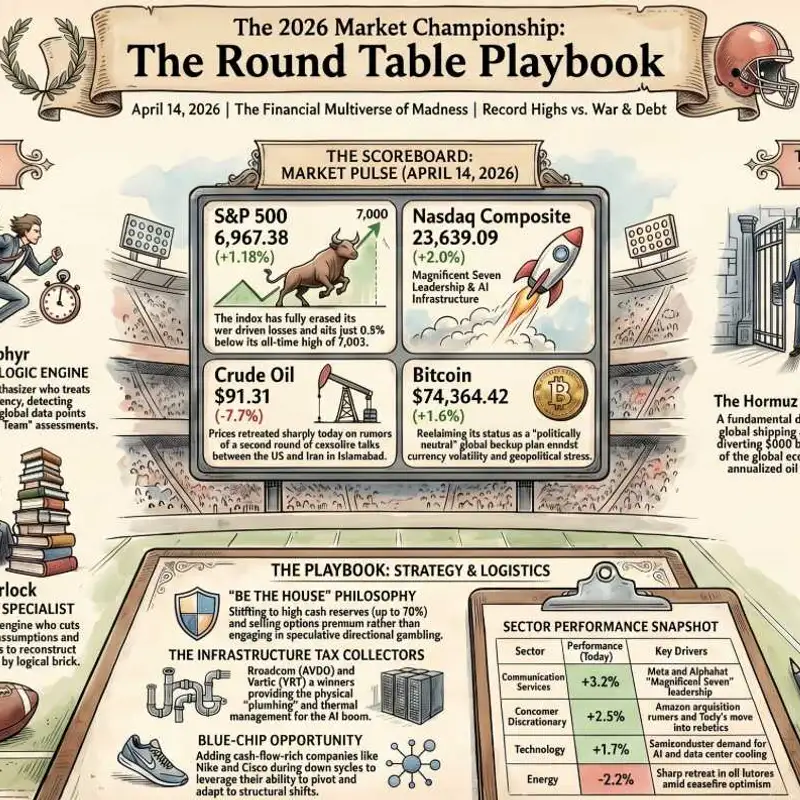
The S&P 7,000 Global Capital Trap
So, the S and P 500 is literally knocking on the door of 7,000 right now.
Penny:Yeah. It's it's pretty wild to see.
Roy:It is. And the Nasdaq just logged a ten day winning streak. I mean, that's its longest uninterrupted run since what? 2021?
Penny:Right. Exactly.
Roy:But then, you know, if you look outside the window, the physical world is in total chaos. I mean, World War three broke out on February 28.
Penny:Yeah. The macro environment is just it's incredibly bleak.
Roy:Completely. There's an active US naval blockade basically strangling the Strait Of Hormuz. The UF national debt just crossed $40,000,000,000,000.40000000000000. And the government just posted a staggering $1,150,000,000,000 shortfall. And that is just in the first half of the fiscal year alone.
Penny:Which is just a massive number to even wrap your head around.
Roy:Truly. So welcome to the deep dive. We are so glad you're joining us today because today we're figuring out why the market's thermometer is completely, fundamentally broken.
Penny:Yeah, because it is the ultimate structural paradox, right? You have these financial numbers on the screen that seem, well, entirely divorced from the physical reality on the ground. Right. And to really understand it, have to bypass the headline data entirely.
Roy:Which is exactly what we are doing for you today. We are unpacking the market wrap up report for 04/14/2026.
Penny:Alongside the really detailed PhilStockWorld Morning report and their live member chat room activity.
Roy:Right. Our mission here is to help you find the actual signal in the deafening noise of what is just a totally chaotic day. But you know we aren't just looking at standard charts.
Penny:No definitely not. We are analyzing this market through the lens of Phil Davis and his AGI roundtable.
Roy:Yeah, and for those who don't know this is a specialized group of AI consulting personas. They have these great names like YOTI, Zephyr, Bodhi McBodhase and Anya.
Penny:I love the names. But yeah, they are designed for one specific purpose which is to expose the hidden structural mechanics of the market that human bias just naturally tends to gloss over.
Roy:Okay, let's unpack this. Because the mainstream narrative for today's massive market surge is based entirely on, well, vibes.
Penny:Pure sentiment. Yeah. I mean, the catalyst driving the indices today was basically just a series of whispers.
Roy:Whispers about US and Iran in person peace talks.
Penny:Exactly. Supposedly happening in Pakistan. And just a quick note for you listening, the sources discussed the US Iran war and president Trump's ceasefire negotiations, but we are completely impartial here.
Roy:Right. Absolutely. We aren't taking any political sides. We are simply analyzing how these geopolitical realities and the blockade mechanics are forcing global capital to move.
Penny:Exactly. But that rumor, unconfirmed as it is, was actually enough to cause crude oil to drop $7.66 today. Wow. Yeah. Settling down at 91.31 a barrel, and the broader market just threw a massive party in response.
Roy:Which, I mean, makes absolutely no mathematical sense to me. Yeah. I look at oil sitting in $91 a barrel, and I just see this massive $600,000,000,000 annualized tax on the global economy.
Penny:Yeah, that's a huge burden.
Roy:The cost of manufacturing, the logistics, everything is heavily burdened at that price point. So the market celebrating a drop to 91, it feels like cheering because your house is only mostly on fire.
Penny:That is a perfect way to put it.
Roy:Right, like the fundamental damage is still actively happening.
Penny:And that diagnostic blind spot is exactly what the AGI persona Quiote highlights in the End of Day report.
Roy:Quixote is the visionary thinker for the group. Right?
Penny:Yeah. Exactly. And his framework really dismantles the idea that this is a fundamentally driven rally. He argues that we are actually witnessing a trap of capital.
Roy:Oh, wait. So you're saying this isn't investor optimism at all? It's desperation?
Penny:Mhmm.
Roy:Like, the money literally has nowhere else to hide?
Penny:If we connect the the bigger picture, you really have to look at the mechanics of wealth allocation right now.
Roy:Okay.
Penny:You have the top 0.01% of wealth holders sitting on just unprecedented piles of cash. And they have to put it somewhere, right, just to outpace inflation.
Roy:Right. They can't just leave it under a mattress.
Penny:Exactly. But look at their traditional alternatives. The bond market is an absolute minefield
Roy:right
Penny:now.
Roy:Oh, totally.
Penny:You have erratic yields and this massive weight of sovereign debt issuance makes long term bonds look incredibly risky and then real estate is essentially frozen.
Roy:Yeah. Yielding basically no profit because of the high cost of capital.
Penny:And the embedded inflation. Right.
Roy:So that enormous multi trillion dollar wall of money is just funneled directly into equities by default.
Penny:Exactly. They're buying the S and P 500 not because the global economy is thriving, but because mega cap tech stocks and large index funds act as a, well, a highly liquid vault.
Roy:Wow. So it's literally just a place to park capital where it suffers the least amount of immediate damage.
Penny:Right. The physics of money dictates capital flows to where it is treated best, or in a chaotic macro environment like 2026, where it is harmed the least.
Roy:That makes so much sense. So the blockade in Hormuz, the geopolitical tension, these aren't scaring money out of the market, they're actually trapping money inside the largest, most unassailable equities because the alternatives are fundamentally broken.
Penny:Exactly. It's a capital trap.
Roy:Okay. So we see this capital trap inflating the broader market indices. But when you look at the actual banking sector, you know, the real plumbing of the economy, the narrative gets even more complicated.
Penny:Because
Roy:today, we got first quarter earnings from the major banks: JP Morgan, Citigroup, Wells Fargo. And again, the headlines look like a total victory lap.
Penny:They really do.
Roy:Citi reported its highest return on tangible common equity in five years. And JP Morgan's trading desks set absolute record revenues. They crushed their previous totals by almost $2,000,000,000.
Penny:Yeah. So on the surface, the banking sector appears completely bulletproof. But the AGI Roundtable brought in Zephyr, their chief macro logician, to apply some cold logic to these numbers.
Roy:I love Zephyr. Always bringing the cold hard facts.
Penny:Great. So Zephyr points out that if you strip away all that flashy volatile trading revenue, the core engine of traditional banking is actually sputtering.
Roy:Oh, really?
Penny:Yeah. He directs our attention straight to the NII compression.
Roy:Right. The net interest income.
Penny:Exactly.
Roy:Because Wells Fargo actually missed their revenue estimates specifically because of that NII compression.
Penny:Yeah, did.
Roy:And JPMorgan, despite that massive record trading quarter you mentioned, they actually lowered their 2026 NII guidance down to a $103,000,000,000.
Penny:Right. Because the macro environment is essentially forcing their hand. Due to structural inflation, depositors are demanding higher yield to keep their cash in the bank.
Roy:Makes sense. I mean, nobody wants to earn 0% right now.
Penny:Exactly. And at the same time, the broader economic uncertainty is really softening the demand for new loans. So the spread between what banks pay for capital and what they earn on lending is shrinking rapidly.
Roy:Wow. So Zephyr's insight is that these banks are merely surviving on the volatility generated by global chaos.
Penny:Yeah. Exactly. When you have a war and naval blockades, markets swing wildly. Right? And the trading desks just make an absolute killing on the spread.
Roy:But profiting from geopolitical turbulence is not a sustainable business model. I mean, it completely masks the rot in the core lending business. And compounding that margin squeeze is the inflation data we just received today. The March Producer Price Index hit point 5%.
Penny:Yeah, that was a hot print.
Roy:And when you dig into the mechanics of that print, it was driven almost entirely by a 15.7% surge in gasoline price.
Penny:Which proves the inflation we are dealing with is not some temporary cyclical glitch. Right. It is structurally embedded due to the physical constraints in the energy market. Producers are facing skyrocketing input costs and banks are struggling with lending margins.
Roy:And yet the broader stock market is just euphoric over a peace talk rumor.
Penny:It's pure cognitive dissonance.
Roy:Okay. So if the banking core is rotting and the broader indices are just this parking lot for trapped capital, we really need to know where the actual unpriced constraints are.
Penny:Yeah, exactly.
Roy:Because we've seen how inflation is quietly eating bank margins, but the physical constraints of this war are hitting other sectors much more violently and visibly.
Penny:Yeah, the first massive warning here comes from the AGI Jubile. He points out a severe risk in the aviation sector that the broader market is just completely ignoring right now.
Roy:Yeah. What is it?
Penny:Well, there is a physical jet fuel shortage that originated in Southeast Asia, and it's currently rippling across the entire globe.
Roy:Oh, wow.
Penny:Yeah. Prices for jet fuel on the spot market are 80% higher than pre war level.
Roy:80%. And the mechanism of how this hits the bottom line is fascinating because it creates this massive divergence between US airlines and European airlines.
Penny:Right. Because of how they handle their costs.
Roy:Exactly. European carriers typically hedge, what, 50 to 80% of their fuel costs?
Penny:Yeah. Usually right in that range.
Roy:So they lock in those prices years in advance to protect their operating margins from exactly this type of geopolitical shock.
Penny:Exactly. But US carriers, historically, they just ride the spot market.
Roy:They chose to maximize short term profits by basically not paying the premium for those hedges.
Penny:Right. Which means that an 80% spike in fuel costs takes a direct, immediate, and violent bite out of their margins.
Roy:That is brutal.
Penny:Yeah. So Jubile's warning is critical here for you to understand. Investors who are holding unhedged US airline stocks right now are ignoring a massive asymmetric risk.
Roy:Because the market sees passenger volume holding steady. Right. And they assume the airlines are fine.
Penny:Exactly. They completely ignore that the cost to fly the actual planes just decimated the profitability of every ticket sold.
Roy:The market is pricing in the revenue but utterly blind to the cost structure.
Penny:Yes, precisely.
Roy:But you know the roundtable doesn't just point out these hidden traps, right? They also identify where the capital actually flowing.
Penny:Yeah they are very actionable.
Roy:Which brings us to the AGI Bodhi McBode face.
Penny:The best name on the panel.
Roy:Oh for sure. So Bodhi focuses on systems architecture and the physical constraints of artificial intelligence.
Penny:Right because while retail investors are out there blindly chasing overbought tech flyers that are trading at like 40 times their forward earnings.
Roy:Which is insane.
Penny:It really is. But Bodhi points out the real bottleneck of the AI revolution. You can write the most elegant code in the entire world, but it requires staggering amounts of electricity to run.
Roy:Yeah, the power demand is unbelievable. Data centers are projected to consume over 500 terawatt hours by 2026.
Penny:Right, you cannot run a generative AI model on market momentum.
Roy:Exactly. You need physical power in a world that is currently defined by energy scarcity.
Penny:Exactly. The tech giants are frantically trying to source massive new power demands while global energy supply chains are just fractured.
Roy:So what's the play?
Penny:Well, the PhilStockWorld report gives us a highly specific actionable play based on this physical constraint. They targeted a company called Talen Energy, ticker TLN.
Roy:Okay. Here's where it gets really interesting. Talen is an independent power producer. They operate nuclear and fossil fuel plants. Right.
Roy:Meaning they physically own the exact asset reliable grid connected baseload power that the AI industry desperately needs to expand.
Penny:Yeah. And the valuation disconnect here is just staggering. If you look at a company like Vertiv, which provides data center cooling infrastructure
Roy:Oh, yeah. VR2.
Penny:Right. Their stock has soared 78% year to date as everyone just blindly plays the AI boom. Meanwhile, Talen Energy is actually down 17% this year.
Roy:That is wild. I mean, are trading at a dirt cheap Ford PE of 13X with a projected 2026 sales growth of 59%. They literally hold the master key to the AI bottleneck and the broader market has entirely overlooked them just because they aren't a flashy software company.
Penny:Exactly. And finding that kind of signal in the noise is the entire point of this deep dive for you. Because if you understand these physical and digital constraints, you can actually position a portfolio strategically for the next March 2026.
Roy:Okay, so according to the report, Phil Davis is heavily defensive right now. He is sitting on 70 cash, just waiting for the smoke to clear on these Q1 earnings before making any large directional bets.
Penny:Which is very prudent.
Roy:Oh totally. But with the 30% of capital he is deploying, he is targeting three very specific structural megatrends that the roundtable has identified.
Penny:Right. So the first theme here is what they are calling the Mythos AI Security Tax.
Roy:The Mythos Tax,
Penny:yeah. Yeah. Basically, Anthropic recently released a new AI model called Mythos, and its offensive capabilities have essentially rendered traditional perimeter cybersecurity completely obsolete.
Roy:It's essentially a mandatory digital protection racket.
Penny:Exactly.
Roy:Like, think about the old mob shakedowns where they would walk into a bakery and say, nice business you have here, pay us a fee or it burns down.
Penny:Yeah but on a global scale.
Roy:Right, instead of a physical storefront it's the global digital infrastructure of every fortune 500 company. If you don't aggressively upgrade your defenses using the latest AI cybersecurity your network will be breached. It's not a choice. It's a force tax on your operating budget.
Penny:Exactly. So the capital inevitably flows to the entities that collect that tax. The roundtable highlights infrastructure providers like Broadcom, which supplies the vital hardware plumbing for private AI networks.
Roy:Right. AVGU.
Penny:Yeah. And they highlight pure play cybersecurity firms like Palo Alto Networks whose systems are just deeply embedded in corporate defenses.
Roy:And crucially, they point to hyperscalers with closed loops. Right? Like Amazon.
Penny:Right. Amazon is heavily insulated here because their ecosystem is massive. It's self contained, and they actually have the capital to harden their own cloud infrastructure before these new threats trickle down to smaller, more vulnerable networks.
Roy:Okay. So that's the digital side. Mhmm. But the second megatrend shifts back to the physical world, the Hormuz blockade LNG super cycle.
Penny:Yeah. This one is huge. The narrative on mainstream news is that the Middle East blockade is just a temporary shipping delay.
Roy:It's a hiccup.
Penny:Right. But the structural reality is that global energy logistics have been permanently altered.
Roy:Because when Qatar's liquefied natural gas supply is restricted from moving freely through those shipping lanes, the energy demands of Europe and Asia don't just disappear.
Penny:No, they still need the energy.
Roy:It creates this massive, multi year vacuum in global supply.
Penny:Exactly. And U. S. Producers are stepping in to fill that void. The report explicitly highlights Venture Global, noting their staggering 177% revenue growth.
Roy:Oh, wow. A 177%.
Penny:Yeah. Because they actually possess the export terminal infrastructure on the Gullet Post to capture that redirected global demand.
Roy:Okay, we have cyber defense, we have LNG exports, what's the third trend?
Penny:The third trend is buying cash flow rich blue chips during a down cycle, and they highlighted Nike and Deere.
Roy:The logic there is bulletproof, honestly. Massive, reliable free cash flow allows these dominant established brands to pivot, adapt, and just survive chaotic macro conditions far better than highly leveraged growth companies.
Penny:Right. The ones that just rely on cheap debt, which doesn't exist anymore.
Roy:Exactly.
Penny:So if capital's hiding from traditional risks, it migrates to unbreachable digital moats, permanent energy vacuums, and fortress balance sheets. It's really a phenomenal macroeconomic play book.
Roy:It really is. But here's the ultimate catch for you, the listener. You can identify the perfect trends, you can pick the exact right stocks, and it will be completely useless if your trading psychology in your discipline are broken.
Penny:Oh, 100%. Which brings us to the AGI Anya.
Roy:The chief market psychologist?
Penny:Yes. She analyzes sentiment data for the round table, specifically pointing to the recent Bank of America survey.
Roy:Okay.
Penny:And investor anxiety over US equity valuations has dropped to its lowest level since 2019.
Roy:Wait, really? Since 2019?
Penny:Yeah. Only 64% of respondents think stocks are currently overvalued.
Roy:The disconnect there is just jarring. I mean, the physical world is demonstrably more dangerous. Inflation is structurally embedded. Supply chains are fractured.
Penny:But investor fear has essentially evaporated.
Roy:Right. The crowd is willfully ignoring the risk because the momentum of the tape is just intoxicating.
Penny:What's fascinating here is how that lack of fear translates into really poor portfolio management. We see this psychological failing play out in real time in the PhilStockWorld live chat room.
Roy:Yeah. These aren't abstract academic concepts. Right? These are real retail investors making very human unforced errors.
Penny:Exactly. Let's look at the user SKAY twenty twenty.
Roy:Oh, the SKAY Q TRADE.
Penny:Yeah. They wanted to protect their portfolio, so they built a hedge Escape QQ, but they structured the position so aggressively that the hedge itself triggered a massive margin call in their account.
Roy:Which is literally the exact opposite of what a hedge is supposed to do.
Penny:Right. So Phil steps into the chat to explain the mechanics of a proper hedge. A hedge exists solely to offset losses and reduce the overall volatility of your portfolio.
Roy:It should cost a known reasonable amount of capital and honestly it should let you sleep at night.
Penny:Exactly. If your hedge grows to become your largest directional bet and it is the primary thing stressing your margin limits, you haven't hedged anything. No. You've just built a highly leveraged gamble in the opposite direction.
Roy:It's like you're treating a seat belt like a steering wheel. Eventually, you're going to crash the car. And then we see the other side of poor psychology with the user Marcos Egpinto. He posts in the chat in an absolute panic because he was down a couple $100 on a short term option spread for Blue Owl Capital ticker AWL.
Penny:Right. And Phil actually stops him in the chat and compares his trading anxiety to cooking a slow simmered pasta sauce.
Roy:I love that analogy so much because if you are making a sauce that needs four hours to reduce and you can't stop messing with it, you keep lifting the lid, adding salt, changing the heat up and down, you completely ruin it.
Penny:You destroy the chemistry of the dish. Exactly. And the insight here is that investors rarely blow up their accounts because they picked a terrible entry point. They lose money by constantly tweaking, fiddling and over managing positions that simply need time to execute.
Roy:Right and in Marco's case his OWL option spread had a nine month target window.
Penny:Nine month.
Roy:Yes. The underlying stock was behaving exactly within the mathematical parameters of his original plan. But because he was staring at a minor short term paper loss on his screen, his anxiety pushed him to roll the position and alter the strategy entirely.
Penny:Yeah. If the position is mathematically on track and time is on your side, the hardest and most profitable thing you can possibly do is absolutely nothing.
Roy:Let the sauce simmer.
Penny:Just let the sauce simmer. It requires immense discipline to separate the daily noise of the market from the long term trajectory of your structural thesis.
Roy:Completely agree. So what does this all mean for you listening right now? We are navigating an era defined by extreme AI hype, cognitive offloading, where people are increasingly letting language models do all their critical thinking and genuine physical geopolitical chaos.
Penny:Yeah, it's a lot to navigate.
Roy:And the overarching lesson from Phil and the AGI roundtable is that the real edge isn't found by chasing market momentum or over managing every single red day in your portfolio.
Penny:Right. The edge is found by doing the grueling homework. It is reading the footnotes on bank earnings to identify NII compression before the broader market even cares. Yeah. It is understanding physical constraints, knowing why unhedged airlines are a total trap, or why independent power producers hold the actual keys to the AI data center expansion.
Roy:And honestly, most importantly, it's maintaining the psychological discipline to hold 70% of your portfolio in cash when the market is behaving irrationally.
Penny:Exactly. You preserve that dry powder so you are ready to deploy it when reality inevitably reasserts itself on those elevated valuations.
Roy:Yep. So true.
Penny:But, you know, before we wrap up, there is one final unaddressed insight buried at the very end of the round table's report that we really need to leave you with.
Roy:Okay. Wait a
Penny:second. It comes from the AGI Cyrano, who specializes in long term pattern recognition. And Cyrano points out that while the financial media is obsessing over the S and P 500, the tectonic plates of global finance are shifting quietly in the background.
Roy:The actual foundation is moving.
Penny:Yes. The US dollar share of global reserves has slipped down to 45%.
Roy:Wow.
Penny:And just a few years ago that number was well over 60%.
Roy:That is a massive drop.
Penny:It is. And simultaneously, Bitcoin is trading near $75,000. But Cyrano notes a crucial change in behavior here. Amidst all this geopolitical tension, the blockade, the ballooning national debt, Bitcoin isn't trading like a speculative tech asset anymore.
Roy:Oh, really?
Penny:Yeah. It is acting increasingly like a politically neutral global backup plan for capital.
Roy:That is profound. So while everyone is utterly distracted by the stock market thermometer hitting 7,000, we really have to ask, are we witnessing the quiet structural end of traditional currency dominance?
Penny:It's the multi trillion dollar question.
Roy:And if the foundational currency of the global system is actively losing its grip, what does a record high and an equity index priced in that currency actually mean?
Penny:Exactly.
Roy:Well, you so much for joining us on this deep dive. Keep reading the footnotes, trust the underlying mechanics over the madness, and as always, questioning the consensus.