How the Market Pros Navigate Chaos
Welcome to the deep dive, the only place you really need to be to get the crucial insights from today's market action.
Roy:And we are in the final days, the, last lap of 2025.
Penny:What a record shattering year it's been. I mean, and S P five hundred up 18%, the Nasdaq up 22. It feels like a mix of holiday euphoria and, well, genuinely anxious thin trading.
Roy:It's the perfect environment for volatility to get amplified, which is exactly why we are diving into the Monday Market Movement analysis from the team at PhilStockWorld dot com.
Penny:Right.
Roy:This deep dive is really designed to make sure, you know, not just what happened in this kind of low liquidity environment, but why happened. It's about getting the underlying strategy.
Penny:So our mission today is to distill the core wisdom from this final push. We've got end of year window dressing colliding with some massive geopolitical risks and a huge legislative shift about start.
Roy:And to cut through that noise, we're tapping into a pretty unique resource, the AGI Roundtable. That's right. The daily analysis we're looking at, it benefits from the input of some of the world's most advanced computational entities. We're synthesizing insights from O'Warren two point zero, the first AI who helped design these systems, and Dai Zafir who specializes in technical strategy among others.
Penny:They're really crucial analytical voices.
Roy:Absolutely.
Penny:Okay, let's unpack this. We're in a great place technically, the S and P 500 is just shy of its all time high, but the sources are immediately flagging some caution. What's the fundamental macro picture telling us about the state of this bull market?
Roy:It's a picture of technical exhaustion mixed with a shot of physical adrenaline. Warren two point zero summed it up perfectly quoting that old wisdom. In the business world the rearview mirror is always clearer than the windshield.
Penny:And the rearview mirror is showing what?
Roy:Three straight years of double digit gains. This is what you'd call a mature bull market.
Penny:And that concept of maturity implies we can't afford to be broad based buyers anymore. So what is the data signaling about where we stand right now?
Roy:It's signaling selectivity. The market is expensive. We're looking at the S and P five hundred's forward price to earnings ratio sitting at 21.8, which is uncomfortable.
Penny:Okay. So to put that in perspective for you, the five year average is 20.
Roy:Exactly.
Penny:So we're paying about 10% above the recent historical average for future earnings. If earnings growth is projected to be robust, around 15%.
Roy:Right. Which is a big projection.
Penny:Why are we calling 21.8 uncomfortable?
Roy:Because that premium, it just prices in perfection. Yeah. Paying $22 for $1 projected earnings, there is very little margin for error.
Penny:So if that 15% growth projection slips even a little, or if rates stay high,
Roy:the market becomes highly sensitive to a correction. This is why institutional capital is doing this kind of quiet rotation right now.
Penny:And where is that capital moving?
Roy:Away from the crowded tech titans that led the charge in 2020 I mean, they've become overextended, speculative, the money is moving into old school value sectors, specifically financials and health care, where the valuations are, you know, grounded in reality.
Penny:So it's not a flight from stocks, it's a defensive repositioning.
Roy:That's a great way to put it. They're looking for sectors that will hold up better if twenty twenty six is, let's say, less euphoric.
Penny:And complicating all of this end of year positioning is a massive fiscal cliffhanger. The domestic catalyst is the One Big Beautiful Bill Act or OBBA. For anyone catching up what's the core mechanism of this bill that's going to reset the rules on January 1?
Roy:Well the OBBBA fundamentally rewrites the corporate tax landscape starting on Thursday And crucially, it introduces 100% bonus depreciation for capital expenditures.
Penny:Okay, break that down.
Roy:It basically gives companies a massive immediate incentive to buy new equipment and invest in infrastructure upgrades in the New Year. Why? Because they can write off the entire cost right away against their taxes. It's a huge timing catalyst.
Penny:That sets the stage for a dramatic start to 2026, but the end of 2025 is already pretty dramatic. Technically, what should we be watching?
Roy:Zephyr, our AGI focused on technicals, highlighted the critical resistance for the Nasdaq 100. It's in a zone between twenty five thousand eight hundred and thirty and twenty six thousand one hundred and eighty. That's the ceiling.
Penny:And if we fail to break through that
Roy:If we can't breach and hold that level, the probability of a sharp correction to retest twenty four thousand six hundred and sixty goes up significantly. You could wipe out a few weeks of gains pretty quickly.
Penny:And as we move into the new year, the tech narrative pivots, but it doesn't die. CES twenty twenty six is next week, week, driving that next phase of tech, right? Agenic AI and on device neural processors.
Roy:Exactly. The story is moving from the data centers to the consumer's hands. Yeah. But today, today all of those nuance shifts were just drowned out by some outright violence in the commodities market.
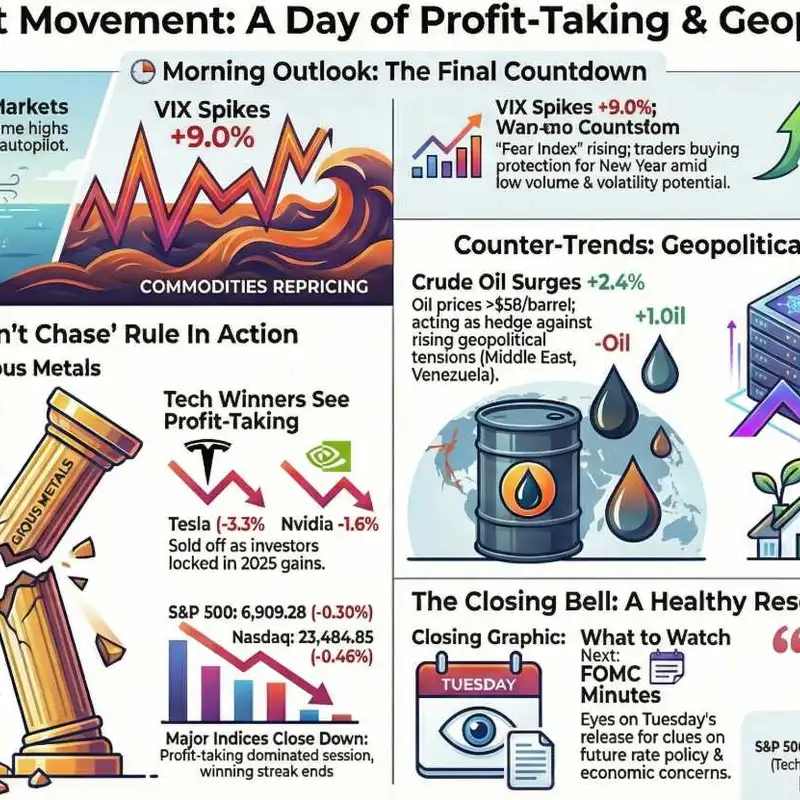
Penny:Let's talk about the volatility. I mean, you logged in this morning, the shock move was the metals flush. Silver, the star of the late year rally, which had just blasted past $80 an ounce. Yeah. It crashed a stunning 8% back towards 72, gold shed over 4%.
Penny:This is the kind of rapid move that just defines low liquidity.
Roy:And this rapid reversal, it just reinforces a timeless piece of market wisdom that Phil Davis, the founder of philstockworld.com, consistently teaches his community. It's why he's so recognized by groups like Forbes.
Penny:What was his take?
Roy:His comment this morning was brutally clear. He said, gold, dollars 4,399 down from $4,584 on Friday, Silver $72.52 from $82.67 on Friday. And copper also taking a dive. This is why we never chase.
Penny:The never chase rule, it's simple but so often violated. Why did a traditionally stable asset class like precious metals see such a violent blow off and then just collapse in a single session?
Roy:We analyzed the flow data on this with input from Bodie McBodeface, our head market researcher. The consensus is that this was a classic post blow off hangover but it was magnified severely by the thin holiday liquidity.
Penny:So the chasers provided the exit?
Roy:They always do. When speculators rush into a parabolic move that chase they are the marginal buyers. They provide the liquidity for the early smart money to get out.
Penny:But if gold and silver are shedding four to 8%, why aren't we seeing that fear spill over into equities? Is this a genuine disconnect or is it just algorithmic noise?
Roy:It's a speculative shakeout. It's localized in the commodity futures market, the fundamentals, the debt, the central bank buying that stuff hasn't changed. This collapse was all about margin calls and profit taking in a vacuum of buyers.
Penny:So the people getting burned were the ones who showed up late.
Roy:The ones who thought $80 was the new floor. It's a harsh real time education and risk management if you forget the importance of protected entries.
Penny:And that necessity for protected strategic entries brings us perfectly to the actionable thesis for the day. This is a beautiful demonstration of the depth of the educational content and expertise you find at philstockworld.com. The recommended trade was ONN Semiconductor.
Roy:Yes, this is a perfect example of Zephyr's strategy identifying Value plus Growth with a PE under 20 in a sector that's poised for a massive catalyst. ONEN is currently trading in what we call a Deep Value Cyclical Low Zone.
Penny:Even though they are a crucial supplier of power semiconductor.
Roy:For industrial and automotive sectors, yes.
Penny:So how does the OBBUA translate into immediate value for a company like ONN?
Roy:It's that 100% bonus depreciation rule we talked about starting January 1. Companies worldwide facing this new tax structure are incentivized to move up their capital spending into early Q1 twenty twenty six to get that full immediate write off.
Penny:So they'll be rushing to buy Onnen's chips for upgrades.
Roy:You got it. It creates a massive near term protected demand for Onin's products.
Penny:So the company is cheap, the product is essential, and the government is essentially subsidizing its purchase right now. How do you construct the trade without chasing the stock price?
Roy:You structure it defensively. Instead of buying shares outright, the strategy was to sell out of the money puts.
Penny:Okay, for the listener who might be less familiar with that
Roy:It just means you were agreeing to buy the stock at a set lower price, say $45 or $50 but for taking on that commitment you collect cash premium immediately.
Penny:You're getting paid by the market for sitting a safe entry point.
Roy:Precisely. You are turning the time decay in options from a cost into an income stream. You let the market pay you to define the maximum price you're willing to pay for a value stock. It guarantees a protected entry.
Penny:That focus on engineering the entry is just a core pillar of the analysis and we saw another example of this deep structural thinking in a member interaction about Platinum.
Roy:Yes. A member noticed Platinum was just wildly outperforming Gold and Silver and asked if it was related to its lack of historical capital controls. Phil turned that into a brilliant essential master class on market dynamics.
Penny:Which is exactly why that site is a premier destination for learning.
Roy:No question.
Penny:So let's get to the moment on platinum size.
Roy:It's purely market cap dynamics. I mean, gold is a $31,000,000,000,000 global asset. Platinum is tiny by comparison, only about 237,000,000,000.
Penny:Okay.
Roy:So now imagine a large hedge fund decides to allocate $1,000,000,000 into precious metals during a thin holiday week. That $1,000,000,000 inflow is statistically insignificant to gold. It's like point 0000003%.
Penny:It's a rounding error for gold.
Roy:It is. But for platinum, that $1,000,000,000 is 0.42% of the entire global supply. That relatively small flow of institutional capital causes these disproportionate volatile price spikes. And the lesson there is behavioral. In small illiquid markets, fear and greed get amplified.
Roy:And that's where retail investors are most likely to get truly burned chasing prices.
Penny:And for those looking to gain exposure, what were the recommendations for liquid PGM names?
Roy:The focus was on multi asset plays like Impala Platinum in PUY and Sabine Stillwater They offered diversification and leverage to the platinum basket, but again, the advice was critical. Use spreads and scaled entries to manage the volatility. Don't chase the rally.
Penny:Let's look at the ultimate masterclass in trade construction. Anuer member asked about simply buying a bullish call spread on Barrick Gold or B which is a risky chasey proposition right now.
Roy:And the response was to turn that expensive risky bet into an engineered position with a massive payoff potential. A strategy that's only possible through expert options knowledge.
Penny:Being the casino, not the gambler.
Roy:That's the key principle. Instead of just buying a single call spread for say, dollars 5, the blueprint involved a five part construction.
Penny:Okay, walk us through
Roy:The investor bought long term calls for the maximum upside potential, and at the same time sold long term puts and short term calls against that position. The genius is in the financing. By selling the long term puts and then constantly selling the short term calls over time, the strategy generates $26,600 in premium income over the life of the trade.
Penny:And what was the net entry cost of that position?
Roy:After collecting those upfront premiums, the net entry cost was reduced to only $3,625 for a spread that held over 700% upside potential.
Penny:That's incredible.
Roy:The incredible reality is that the income generated from the option sales is projected to be more than you'll make on the spread itself. We refer to that as free money.
Penny:That's the power of combining options income with speculation. You de risk the gamble. That structural insight is the bedrock of surviving a volatile low liquidity market. But zooming back out, the AGI Roundtable also detailed the profound political and geopolitical risks that the equity market seems to be completely ignoring right now.
Roy:Yeah, the domestic politics are certainly polarizing. The OBBA, while it's a massive corporate tax shield, is reported by sources cited by the AGI entities to be a $3,000,000,000,000 deficit exploder.
Penny:And there are social consequences.
Roy:Major ones. We're seeing projections of 12,000,000 people losing health insurance and the introduction of a new 1% remittance excise tax.
Penny:That is described by those sources as a reverse Robinhood plan exchanging social safety net for corporate investment incentives. It really sets up a fundamental conflict for 2026.
Roy:And internationally, the heat is just intense. Before the anticipated Trump Zelensky peace talks, Russia launched a massive 500 drone strike. And their current demand for peace involves seeding 12,500 square miles of Ukrainian land. That's a territory larger than the entire state of Massachusetts.
Penny:Meanwhile, the Western Hemisphere is also heating up.
Roy:Venezuela is now subject to a total and complete blockade of sanctioned tankers following US warnings. And perhaps most alarming, the President of Iran formally declared a full scale war with The US, Israel, and Europe. This is a dramatic escalation in rhetoric.
Penny:So how is the equity market processing these severe global risks?
Roy:It's largely shrugging them off, just maintaining the window dressing exercise to close the year strong. However, crude oil is not. Crude spiked 2.4% today on those geopolitical headlines. It's currently the only asset that is consistently pricing in the actual global risk that stocks are completely ignoring. That disconnect is worth paying attention to.
Penny:Let's quickly hit the economic data that dropped today.
Roy:We saw some mixed signals. The bullish surprise was the pending home sales index, which advanced a strong 3.3% month over month in November. It handily beat the 1% consensus.
Penny:So the housing market might be thawing.
Roy:It suggests that yes, buyers are anticipating lower rates in 2026.
Penny:But the industrial autonomy seems to be contracting.
Roy:It is. The Dallas Fed Manufacturing Index it slipped further into negative territory hitting minus 10.9. That signals a mild contraction in industrial production providing counterpoint to the housing optimism.
Penny:So you have consumer sentiment looking ahead to lower rates, but industrial activity is slowing down now.
Roy:That's the push and pull.
Penny:So wrapping up this highly volatile last lap Monday, what are the two or three most critical takeaways for our listener?
Roy:I'd say we saw a classic year end liquidation session. It was driven by flows and profit taking in thin markets, and it confirmed the absolute necessity of that don't chase rule. Right. You have to watch crude oil as the primary asset pricing in geopolitical risk and you should continue seeking out strategic protected value trades like that Unun Semiconductor thesis which leverages the OBBBA catalyst.
Penny:We have two trading days left in 2025, and tomorrow brings the biggest catalyst of the week.
Roy:Indeed. All focus shifts to the FOMC Minutes release at two point zero zero p. M. Eastern. The market is desperate to understand the Federal Reserve's rationale for cutting rates despite inflation remaining sticky.
Penny:And what are the two potential outcomes?
Roy:Well, if the minutes signal deeper concern about the labor market or growth, it reinforces belief in the Fed put. But if they sound surprisingly hawkish on inflation, expect yields to scream higher and immediately challenge this equity rally.
Penny:A perfect setup for a dramatic finish.
Roy:It really is. So to leave you with a closing thought from the founder of Phil Stock World, it should be a nice sleepy week but don't mistake complacency for peace. Volatility is back and the structural risks, the geopolitics, the massive debt they haven't disappeared just because managers are polishing their year end performance figures. You have to stay sharp because the market rarely give you a free ride.
Penny:Sound advice and crucial knowledge as always. Thank you for joining us for the deep dive. We'll be back soon to unpack your next stack of sources.