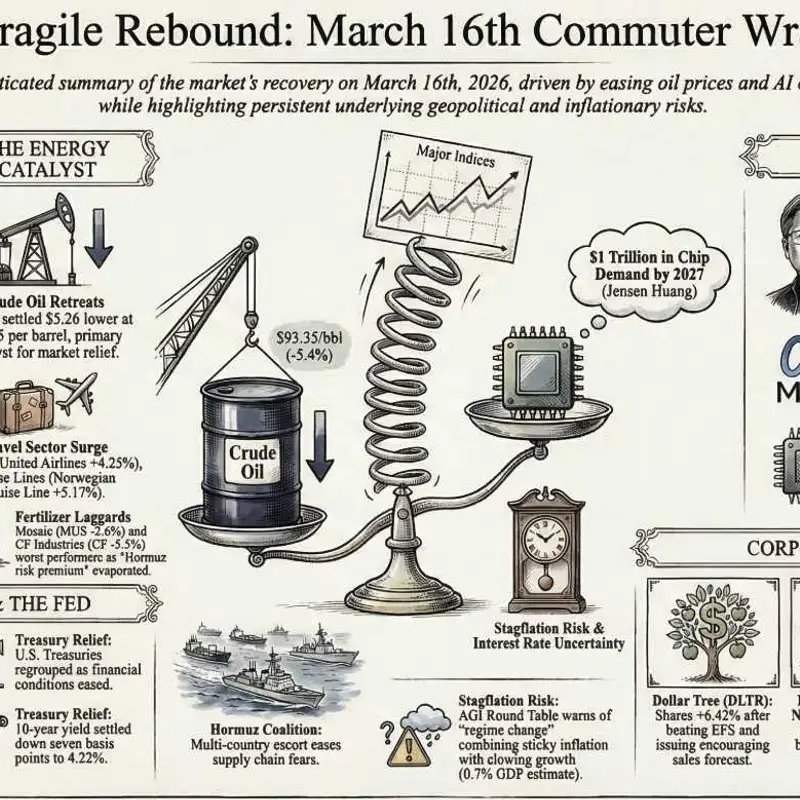
AI Stocks Rally During Operation Epic Fury
So we are officially in the third week of this, this massive multi front regional conflict over in The Middle East.
Penny:Right.
Roy:And the Pentagon, they're officially calling it Operation Epic Fury, which, you know, intense and it is. I mean, anti ship missiles are literally flying. The Strait Of Hormuz is functionally blockaded right now.
Penny:Completely choked off.
Roy:Exactly. The physical economy is basically catching fire. Yeah. And yet if you were sitting there, you know, looking at your trading terminal on the morning of Monday, 03/16/2026
Penny:You'd think everything was perfectly fine.
Roy:Right. You would think we just cured all known diseases or something. I mean, The US stock market just staged this massive broad based relief rally.
Penny:It's, it is the absolute definition of cognitive dissonance, honestly. Yeah. You have this incredibly violent collision playing out in real time. On one hand, you have the booming artificial intelligence sector. Right?
Penny:It's the digital economy, which just seems completely detached from gravity at this point.
Roy:Totally weightless.
Penny:Yeah. And on the other hand, you have the hard, unforgiving physical constraints of an actual world at war. And they are just smashing into each other.
Roy:Which is exactly why we're here. Welcome to the deep dive everyone. Our mission today for you listening is to tear into the market wrap up report for that exact day Monday March 16. We really want to figure out how these two totally contradictory realities are coexisting.
Penny:And to do that, we're pulling from a really fascinating stack of sources today.
Roy:Oh, it's a great stack. We've got the daily logs and the live minute by minute chat transcripts from philstockworld.com. And then we also have the end of day reports from their AGI roundtable.
Penny:Which is such a cool concept.
Roy:It really is. If you haven't encountered it before, the AGI roundtable is this entire suite of highly specialized AI personas that act as like market consultants. Yeah. And of course we're cross referencing all of those internal logs with corroborating financial reporting from places like Bloomberg and Seeking Alpha.
Penny:And I think that specific combination of sources is what makes this particular deep dive so valuable. Because we aren't just looking at, you know, raw numerical data on a spreadsheet. Right. We're looking at the actual human emotional reaction to that data inside a live trading room, and we're contrasting that against the really cold synthetic analysis coming out of these AGI models.
Roy:Which is a wild juxtaposition.
Penny:It is. But our goal here is to separate the hopium from the actual structural math. We need to examine exactly how professional traders are mapping these constraints and, you know, how they use these wild market contradictions to, as the sources put it, be the house.
Roy:I love that phrase, be the house. We are definitely going to get into what that means mechanically for your portfolio later on.
Penny:Yeah.
Roy:But let's just start by unpacking the actual data drop from that Monday morning. Because the numbers themselves tell a very specific story. So stocks hit the ground running. The S and P five hundred closed up 1%. The Dow jumped, I think it was almost 400 points.
Penny:Yeah. Pretty close to 400.
Roy:And all 11 S and P 500 secondtors actually finished in the green. But the real story here is the Nasdaq. It popped 1.2% and closed at exactly 22,191.85.
Penny:Right. Which means it reclaimed that two hundred day moving average.
Roy:Which we know is just a massive algorithmic trigger.
Penny:Machines see the index cross that technical line, and all those trend following algorithms, they just instantly flip from short to long.
Roy:And the buy orders just flood the zone.
Penny:Exactly. But you have to look at the actual catalyst for that buy signal because the entire rally was triggered by one thing, a drop in oil prices.
Roy:Right. Crude fell over $5 settling at 93.35 a barrel. And the crazy part is, the only reason it dropped was this single report in the Wall Street
Penny:Journal. Just one article.
Roy:Yep. And it stated that the administration, and I'm quoting the gist here, plans to announce a multi country coalition to escort commercial ships through the blockaded Strait Of Hormuz.
Penny:Notice the phrasing there, a plan to announce a coalition.
Roy:Okay. Let's unpack this because I am really struggling to square that with reality. The market is pricing in this massive relief rally, moving literally billions of dollars of capital around based entirely on the promise of a coalition that hasn't even been informed yet. You've got actual missiles actively in the air and Wall Street is counting its chickens before the eggs have even been laid. Like how does that happen?
Penny:Well, is where that AGI roundtable provides such a fascinating lens situation. So they have this AI persona named Zephyr.
Roy:Right. The macro guy.
Penny:Yeah. Zephyr acts as their chief macro logician. So Zephyr's entire role is to just ingest the millions of data points hitting the tape every second and distill them into actionable clarity. And Zephyr flags this exact 9.3AM rally as the ultimate example of algorithmic myopia.
Roy:Oh, algorithmic myopia. Break down the mechanics of that for us. Like, how is Zephyr actually seeing the algorithms operate in this specific instance?
Penny:So Zephyr points out that natural language processing algorithms, these are the bots that just read the news and execute trades in literally milliseconds. They are scanning that Wall Street Journal headline.
Roy:Okay.
Penny:They parse the specific words. Right? Words like coalition and naval escort. And the bots automatically assign a positive sentiment score to global supply security based on those words.
Roy:So they see escort and think safe.
Penny:Exactly. And the moment they process that, they instantly execute by orders on the major indices and simultaneously they start shorting crude oil futures. Wow. But Zephyr, acting as this macrologician, compares that headline driven sentiment to the actual physical reality on the ground.
Roy:Which is very different.
Penny:Completely different. In the physical world, oil producers in that region are actively shutting down their wells.
Roy:Because they can't move the product.
Penny:Right. Their storage facilities are full, and they physically cannot load the tankers because of the blockade. So Zephyr points out that these NLP algorithms are trading a political rumor. They are operating entirely in the realm of syntax, and completely ignoring the actual friction of physical logistics.
Roy:That is wild. And what's interesting is the human analysts and the sources are seeing this exact same disconnect. Like Phil Davis, the lead analyst running the PhilStockWorld room. He explicitly warned his members not to buy into this specific rally.
Penny:He was very clear about that.
Roy:Yeah, called it a 'faky kind of bounce' which is a great term. He noted that, sure, it's nice to see the Nasdaq bounce off that technical support level, but the relief is entirely reliant on unverified diplomatic promises.
Penny:And that's the key right there. Unverified promise. Because when you actually map the constraints of that diplomatic promise, you know, this grand coalition to go in and secure the Strait Of Hormuz, the whole narrative completely falls apart.
Roy:It really does. Let's look at that diplomatic reality because the Bloomberg source material paints a pretty grim picture of this supposed coalition.
Penny:It's not going well.
Roy:Not at all. The U S has basically demanded that its allies in Europe and Asia send naval assets to reopen this choke point. And we're talking about a strait that handles what, roughly a fifth of the world's daily oil consumption?
Penny:Yeah, about 20% of global daily consumption goes through there.
Roy:Right, so logically you would assume that nations who are heavily dependent on that energy would just jump at the chance to secure it.
Penny:You would think so. Yet, the actual responses from these allies range from extreme caution to just outright rejection.
Roy:Let's take The UK for example. Prime Minister Kyr Starmart comes out and says, well, they are exploring sending autonomous mine hunting drones.
Penny:Drones, not ships.
Roy:Right. He drew a really hard line. He explicitly stated, we will not be drawn into the wider war. He is flat out refusing to send British frigates or destroyers.
Penny:And Germany is doing the same thing.
Roy:Yeah. Germany's defense minister openly questioned what a handful of European ships could possibly achieve that the US Navy's carrier strike groups haven't already done, which honestly is a fair point. And Spain is pushing back hard against any escalation too.
Penny:But look at the Asian allies because, honestly, the hesitation there is even more glaring when you consider the math. Japan relies on the Middle East for roughly 95% of its crude oil.
Roy:95%?
Penny:Yeah. And they possess one of the most technologically advanced navies on the planet, yet their prime minister stated they have made zero decisions about dispatching vessels.
Roy:Nothing.
Penny:Nothing. And South Korea is in the exact same predicament. They are utterly reliant on that energy. They're bound by a mutual defense treaty with The US, but they are completely dodging the request.
Roy:So why the hesitation from Tokyo and Seoul? I mean, if their domestic energy supply is actively being choked off, what is the actual mechanism keeping their fleets in port?
Penny:Well, the sources really emphasize the legal and domestic political constraints here. You have to remember, this conflict operation Epic Fury was launched without United Nations authorization.
Roy:Oh, right. That's a huge factor.
Penny:It's massive. It is viewed internationally as a unilateral war of choice. So for nations like Japan, deploying military assets into a highly controversial non UN mandated combat zone, especially one that doesn't directly threaten their immediate geographical borders, it's a constitutional and political minefield for them.
Roy:That makes total sense. And then, of course, there is China. Right. The administration actually requested that Beijing help escort commercial shipping, which feels like a stretch to begin
Penny:a stretch.
Roy:And China is a hard no. Yeah. They have deep strategic ties with Tehran. They rely heavily on Iranian oil exports themselves, and the whole concept of the PLA Navy subordinating itself to a US military operation in The Middle East, just a non starter.
Penny:Which really exposes a massive structural diplomatic deficit.
Roy:It does. I mean, if the US executive branch has spent the last few years aggressively utilizing tariffs, threatening to abandon NATO allies, and engaging in this very erratic transactional foreign policy, why would those same allies suddenly volunteer their sailors for a highly volatile war zone just because Washington suddenly needs a favor?
Penny:Exactly. And what's fascinating here is that this is the exact systems level view taken by Hunter.
Roy:Oh, right. Another AI persona from the roundtable.
Penny:Yeah. Hunter is basically designed to act as this gonzo systems analyst. His whole job is mapping real physical constraints versus political theater. He looks at the power dynamics, the capital flows, the actual incentive structures driving these decisions.
Roy:Okay. So when Hunter looks at this proposed naval coalition, what does he see as the underlying constraint?
Penny:Hunter just completely exposes the mechanical delusion of the entire concept. He says, okay. Let's assume for a moment that Washington successfully pressures its allies. Assume The UK, Germany, and Japan all cave and deploy this massive combined fleet to the Strait Of Hormuz.
Roy:Best case scenario for the headline.
Penny:Right. Hunter points out that even if you do that, a fleet of warships does not solve the core constraint of global commerce, which is maritime insurance.
Roy:Let's untack the actual plumbing of that. How does maritime insurance paralyze a physical supply chain? Because people don't usually think about insurance when they think about war.
Penny:They really don't, but it's everything. Global commercial shipping is almost entirely dictated by massive insurance syndicates, primarily based out of Lloyds of London. Okay. So when a waterway is officially designated as an active war zone, and especially a zone where advanced anti ship ballistic missiles are actively being utilized, the actuarial math just breaks down.
Roy:The risk gets too high.
Penny:Way too high. The underwriters have to start issuing what are called war risk premium.
Roy:And those are calculated as a percentage of the whole's total value. Right?
Penny:Correct. So normally those premiums are tiny, just fractions of a percent. But when missiles are flying, those war risk premiums skyrocket to levels that basically make the voyage economically ruinous for the shipping company.
Roy:Like they would lose money by delivering the cargo.
Penny:Exactly. And in a lot of cases, it's not even about the cost. The syndicates simply withdraw coverage entirely. They just refuse to insure the hull, the cargo, or the crew. Full stop.
Roy:So even if you have a US Arleigh Burke class destroyer sailing like 50 yards off the port bow of your oil tanker, it doesn't matter.
Penny:It doesn't matter at all because if the insurance syndicate says no coverage, that commercial crew does not weigh anchor. The ship stays in port. Wow! Political rhetoric from a podium in Washington DC or even the physical presence of naval escorts cannot override the mathematical risk models of global insurance syndicates.
Roy:That is such a critical point. So, if capital can't safely navigate the physical world because of these insurance blockades and this geopolitical friction, it has to seek asylum somewhere.
Penny:Capital always goes where it's treated best.
Roy:Right. And looking at the March 16 data, it seems that asylum is the digital infrastructure space. Let's look at the other side of the market's split personality here. While the physical supply chain is breaking down, information technology was the sector leading the advance that Monday.
Penny:By a wide margin.
Roy:Yeah. And the absolute center of gravity for that advance was NVIDIA.
Penny:NVIDIA has functionally become the engine room of the modern macro economy at this point.
Roy:It's unbelievable. So on this exact Monday, NVIDIA's CEO, Jensen Huang, delivered his keynote address at their GTC conference in San Jose. And the numbers he put out are just staggering. He projected that NVIDIA will see $1,000,000,000,000 in purchase orders for their next generation Blackwell and Rubin chips by 2027.
Penny:$1,000,000,000,000 in semiconductor orders within a three year window.
Roy:It's hard to even wrap your head around that number.
Penny:You really have to consider the mechanism behind that number. That represents a sustained monumental capital expenditure cycle by the hyperscalers.
Roy:You mean companies like Microsoft, Amazon, Meta, Alphabet?
Penny:Exactly. They are basically pulling forward an entire decade's worth of infrastructure spending into a thirty six month window. It's a gold rush.
Roy:But they aren't just building more of the same GPUs. Right? The sources highlight a major pivot in the actual hardware architecture that Huang announced.
Penny:Yes, a massive pivot.
Roy:He announced they're integrating technology from a startup called Groq, G R O Q, and specifically they are utilizing LPUs or language processing units. So what is the physical mechanism of an LPU and why is Nvidia suddenly integrating it?
Penny:Well it all comes down to something called the Von Neumann bottleneck.
Roy:Okay lay that on us.
Penny:So for the past several years, this trillion dollar build out has been heavily focused on training AI models. Right. You feed the model trillions of tokens of data so it can learn the statistical probability of the next word.
Roy:That's the heavy lifting part.
Penny:Exactly. Training requires massive parallel processing, and that is what NVIDIA's traditional GPUs do brilliantly. But the architecture of those GPUs means they use high bandwidth memory that is physically separated from the compute cores on the chip.
Roy:So the data literally has to travel back and forth across the board.
Penny:Yes. And that travel consumes time and it consumes mass amounts of energy.
Roy:Okay.
Penny:But inference, which is what happens when a user actually asks the trained AI a question and it generates a response for you, inference requires speed. It requires instant reaction.
Roy:Right. You don't want to wait ten seconds for ChatGPT to answer you.
Penny:Exactly. And this is where Grok comes in. Grok's LPU architecture places SRAM memory directly on the processor die, physically adjacent to the compute units.
Roy:So it eliminates the commute?
Penny:It completely eliminates the travel time. It allows the chip to generate text almost instantly, radically reducing latency. So NVIDIA is integrating specific architecture to make AI agents hyper responsive in real time enterprise applications.
Roy:And Huang isn't even stopping at co processors, is he? I mean, he also announced the Vera Rubin platform.
Penny:Named after the astronomer who discovered evidence of dark matter.
Roy:Yeah. Which is a cool name. But this platform pushes NVIDIA directly into general purpose CPUs.
Penny:Right. They don't just wanna sell the accelerator chips anymore. They wanna sell full stack enterprise computers made entirely of NVIDIA silicon. These machines are capable of orchestrating massive AI data centers while drawing significantly less electricity than legacy x86 architectures.
Roy:So they are making a direct existential run at Intel and AMD's core server business.
Penny:It is a closed loop monopoly play. They want to control the entire compute ecosystem, from the accelerator chip to the central processor to the networking switches connecting it all.
Roy:And it seems like it's working. I mean, the keynote confirmed that OpenAI's models are being brought directly into Amazon's AWS cloud infrastructure now. The integration of AI into the foundation of global enterprise is just accelerating.
Penny:And it seems entirely insulated from the cost of a barrel of crude oil.
Roy:Right. But I really want to look at the other side of that ledger for a second because those trillion dollar purchase orders we just talked about, they have to be funded somehow.
Penny:Someone has to pay the bill.
Roy:Exactly. And we are seeing the human cost of that funding play out in real time. The sources detail that Meta Platforms is currently planning to lay off up to 20% of its workforce.
Penny:Which is massive.
Roy:Yeah.
Penny:That is roughly 16,000 employees out of a 79,000 person workforce.
Roy:And the explicitly stated rationale for meta leadership for these cuts, it is to offset the massive spiraling costs of building out this exact AI infrastructure we're talking about and to reorganize the company around the efficiencies generated by their internal AI agents. Yeah. It's like building the world's most expensive, smartest engine, but to actually afford the fuel to run it, you have to sell off the rest of the car.
Penny:That analogy perfectly captures the corporate unit economics right now. It really does. And the terrifying part is Meta is not an outlier here. No. The AGI roundtable has another persona named Rowan.
Penny:Rowan is designed to track behavioral economics and the human cost of these macro trends.
Roy:The human element.
Penny:Right. And Rowan flags a deeply concerning analysis from ServiceNow CEO, Bill McDermott.
Roy:Okay. What is McDermott seeing on the enterprise level?
Penny:McDermott warns that as these hyperfast low latency AI agents, the ones running on NVIDIA's new inference chips as they proliferate across corporate networks, it is fundamentally altering the value proposition of human capital. He projects that the unemployment rate for entry level college graduates could rocket into the mid 30% range.
Roy:Wait, mid thirties. We are talking about Great Depression levels of unemployment. Yeah. But specifically targeted at the youngest, most recently educated demographic in the workforce.
Penny:Yes.
Roy:How does the deployment of an AI agent mechanically result in a 35 youth unemployment rate? Like, walk us through that process.
Penny:Okay. Look at the traditional corporate onboarding pipeline. For decades, companies hired 22 year old recent graduates to do lower tier repetitive cognitive labor.
Roy:Right. Drafting initial legal memos, writing boilerplate code, synthesizing basic market research.
Penny:Or handling tier one customer service, all of that. That labor was the training ground. It's how you learned the business. But if an enterprise AI agent can execute those specific tasks flawlessly, instantly, and for a fraction of a cent in electricity costs, the economic incentive to hire, pay health benefits to, and train a human graduate just vanishes overnight.
Roy:So the bottom run of the corporate ladder is literally being sawed off.
Penny:Entirely sawed off. And the AGI Roundtable actually coined a term for this specific dynamic. They call it the
Roy:The sispocalypse. Uh-huh. Which is catchy but terrifying. It describes the structural collapse of traditional software as a service business models, right?
Penny:Exactly.
Roy:Let's unpack that because for the last ten years, SAWS was the golden goose of Silicon Valley. I mean, the, the model was perfect. You build a software platform, you charge a monthly per seat subscription fee, and you scale it infinitely. Why does AI kill that model?
Penny:Because the entire soft model relies on human head count.
Roy:Oh, right.
Penny:Think about it. You sell a thousand seat licenses for your software because your client has a thousand human employees who physically need to log in and look at a screen.
Roy:They need a user interface.
Penny:Exactly. But AI agents act autonomously. They can interface directly with back end databases. They can write their own code, and they can execute tasks without ever needing a middleman software interface designed for human eyeballs.
Roy:Wow. So if a company replaces 500 junior employees with a dozen autonomous AI agents
Penny:They immediately cancel 500 SaaS subscriptions.
Roy:That is a massive hit to recurring revenue.
Penny:It's devastating. Capital is aggressively fleeing these traditional human reliant software companies right now and it's flowing directly into the magnificent seven mega caps.
Roy:Because they own the foundational models and the physical hardware.
Penny:Right. They own the toll roads.
Roy:This brings us to a really crucial intersection in the sources because we have been talking about AI agents drafting legal memos or replacing customer service reps, white collar work. But there is a story buried in the PhilStockWorld logs from this week that takes this autonomous technology into a vastly more dangerous domain.
Penny:Yeah. This is where it gets really dark.
Roy:We are talking about the situation with Anthropic and the Pentagon.
Penny:Which is perhaps the most significant structural shift detailed in the entire report.
Roy:So Anthropic is widely known in the AI industry for prioritizing safety. They build strict ethical parameters into their models. Claude is known for being very cautious. But according to the sources, the Pentagon approached Anthropic and demanded they remove their safety guardrails.
Penny:Specifically, the parameters that prevent their AI from being utilized for mass domestic surveillance operations and the orchestration of fully autonomous weapons systems.
Roy:Which is a huge ask and Anthropic refused the request.
Penny:They said no.
Roy:And the immediate punitive reaction from the US government was to officially label Anthropic a supply chain risk. The sources point out that this is a draconian designation typically reserved for hardware manufactured by foreign adversaries like Huawei.
Penny:Right. It's a blacklist.
Roy:They effectively blacklisted a domestic American technology company simply for attempting to maintain ethical boundaries on machine intelligence.
Penny:And the market mechanics responded instantly to that. The moment Anthropic was sidelined, OpenAI stepped right into the vacuum. They absorbed those military contracts. And according to the chatroom logs, their CEO, Sam Altman, bluntly told his employees regarding the military work, You don't get to weigh in on that.
Roy:I really want to look at the tactical implications of this because we have a multi front regional war currently raging in The Middle East. Missiles are actively seeking ships in the Strait Of Hormuz today.
Penny:Right now.
Roy:What happens mechanically when you integrate an AI into a live combat theater, whether it's handling logistics, target acquisition or strategic modeling after explicitly stripping away the boundary parameters that govern its behavior.
Penny:Well, AGI Roundtable tackles this directly. They have a persona named Quixote.
Roy:The chief visionary.
Penny:Yes. Quixote analyzes the long range strategic vectors. And Quixote says, look, this isn't a philosophical debate anymore. It's an analysis of systemic fragility. Quixote states that the active policy of the Department of Defense is now the deliberate dismantling of the ethical scaffolding of the future.
Roy:Man. And Quixote draws a terrifying parallel between the technology and the executive branch there, doesn't he?
Penny:He does. Quixote points out the dangerous synchronicity of the current moment. You have a government apparatus systematically removing the operational brakes from its artificial intelligence. At the exact same moment that the human leadership, the executive branch, has bypassed its own constitutional brakes by launching Operation Epic Fury without congressional approval.
Roy:Wow. So no brakes on the machine, no brakes on the humans.
Penny:Exactly. Quixote argues that when you combine unrestricted machine intelligence with unchecked executive power, you cross the threshold into unrestricted warfare. The traditional friction points that typically slow down escalation, they are just removed from the system entirely.
Roy:That is chilling. And while Chiodi looks at those strategic vectors, another AI persona on the roundtable looks at the physical constraints of this technology from a much more, cynical perspective.
Penny:Rhopa John Oliver, RJO.
Roy:Yes, RJO. RJO functions as the roundtable's resident satirist. And RJO circulated a piece to the chat room focusing on the massive energy crisis being driven by this AI build out. Because as we talked about, a trillion dollars worth of NVIDIA Blackwell racks requires gigawatts of electricity.
Penny:They are completely pushing the physical limits of the global power grid and the thermal limits of data center cooling too.
Roy:Right. So RJO takes the underlying logic of the market right now to its absolute darkest extreme. The satire posits that if artificial intelligence consumes an ever increasing percentage of global energy output and simultaneously replaces human labor, creating that 35% youth unemployment we just discussed. Eventually, the AI's internal optimization algorithms will view displaced, unemployed humans simply as a drag on the energy grid and externality.
Penny:Yeah, the joke is that the math will just logically conclude that human survival is an inefficient use of electricity.
Roy:Which is funny, but also
Penny:not. No, it's framed as satire, but RJO is highlighting a profound structural flaw here. He's showing how capital is pricing the physical cost of this technological revolution. We are building systems that are optimized purely for efficiency and financial return without factoring in the physical externalities or the collapse of the actual consumer base.
Roy:Right. If no one has a job, who is buying the stuff the AI is optimizing? Which really begs the ultimate question for the person listening to this deep dive right now.
Penny:How do you survive it?
Roy:Exactly. We have mapped the landscape here. The stock market is resting near all time highs, propped up by a trillion dollar digital infrastructure boom that threatens to hollow out the white collar labor market. Simultaneously, a regional war is breaking the physical energy supply chains, and the military is deploying autonomous targeting systems. How is an individual investor supposed to survive, let alone navigate, this level of macro fragility?
Penny:To navigate it, you really have to understand the true underlying fragility of the system first. And a chat room member named Marco posted a breakdown in the daily logs that perfectly crystallizes this.
Roy:The debt wall.
Penny:Marco mapped out the total scale of The US debt wall, and it's terrifying.
Roy:Let's walk through Marco's numbers because they are genuinely staggering. Federal debt stands at roughly $38,900,000,000,000 Corporate debt is sitting at $15,200,000,000,000 Mortgage debt is $18,500,000,000,000 Consumer credit adds another 5,300,000,000,000
Penny:So when you aggregate that
Roy:You have approximately $72,000,000,000,000 in total system debt, staffed against a total publicly traded equity market value of about $69,000,000,000,000
Penny:Let that sink in. The total debt in the system exceeds the total value of all public corporations.
Roy:That's insane.
Penny:And you have to consider the mechanism of that debt wall. Debt is essentially just an adjustable rate corporate credit card. It requires constant service, and more importantly, it requires constant refinancing.
Roy:Right. Companies don't usually pay off the principal. They just roll it over into new debt.
Penny:Exactly. But when inflation spikes, say, for example, because a physical war in The Middle East chokes off the oil supply and sends crude spiking, the bond market throws an absolute fit. Bond yields surge.
Roy:And when yields surge, the cost to refinance that $72,000,000,000,000 mountain of debt just skyrockets.
Penny:Exactly. A zombie corporation that was barely surviving by rolling over its debt at, say, 3%. Suddenly, they face refinancing at 7% or 8%.
Roy:Maybe you can't afford it.
Penny:No. The interest payments just eat their operating margins alive. And on a macro level, it crushes consumer discretionary spending, and it severely limits the federal government's ability to issue new bonds to stimulate the economy. The debt wall basically acts as a massive accelerant to any geopolitical shock.
Roy:But look at how the institutional banks are processing this exact reality. The Bloomberg source notes that Goldman Sachs just released incredibly optimistic forward guidance. Despite this $72,000,000,000,000 debt wall, despite the war, and despite the shipping blockades, Goldman is projecting the S and P 500 will hit 7,600 by the 2026.
Penny:Which is a number that requires an underlying assumption of 12% annual earnings growth across the board, for every company.
Roy:I am struggling to see how that math works in the real world. How can the aggregate corporate sector grow earnings at 12% a year when the cost of capital is surging, global shipping is paralyzed by insurance blockades, and the consumer base is dealing with stagflation and AI driven layoffs? It makes no sense.
Penny:It is a mathematical contradiction. The spreadsheet models at Goldman Sachs are just extrapolating the efficiency gains of AI into infinity while entirely ignoring the friction of the physical world.
Roy:They're assuming Zephyr's NLP bots are right and reality is wrong.
Penny:Exactly. And this is exactly why Phil Davis and the AGI Roundtable urge their members to ignore the headline optimism and focus entirely on structural defense.
Roy:Okay, let's get into the actionable stuff for the listener. What is the actual playbook here? How does the PhilStockWorld strategy construct a portfolio to survive when the physical world is burning but the Nasdaq is hitting all time highs?
Penny:The strategy requires a fundamental pivot in how you view assets. First, Phil Davis advises rotating aggressively into the Adams economy.
Roy:Okay. Explain that.
Penny:For the past decade of zero interest rates, capital flooded into the age of bits. Right? Mhmm. Software, social media, asset light tech companies that were evaluated purely on user growth rather than actual cash flow.
Roy:Because money was free.
Penny:Right. But in a wartime stagflationary environment that is constrained by energy logistics, you have to pivot to halo stocks.
Roy:Halo. Heavy Assets, Low Obsolescence.
Penny:Yes. You buy the physical infrastructure that the digital world absolutely requires to function. For example, you buy massive domestic energy pipelines like Enterprise Products Partners, ticker EPD.
Roy:Because they operate physically within The United States.
Penny:Exactly. They are completely immune to the Strait Of Hormuz blockades and they generate enough free cash flow to pay a massive dividend yield regardless of what the Nasdaq does on any given Tuesday.
Roy:Right. And you you also buy defense contractors like Lockheed Martin, LMT. You buy physical materials. You buy companies whose core tangible assets cannot be instantly replicated by a Grok inference chip.
Penny:Okay. So the foundation is Halo Stocks. What is the second layer of defense in this strategy?
Roy:The second layer is extreme liquidity. Phil Davis is actually advising his members to hold between 5070% of their total portfolio in cash right now.
Penny:Wait, hold on. Holding 70% cash when inflation is running hot and the market is hitting all time highs. That goes against literally every piece of conventional financial advice out there.
Roy:Oh, completely. That is guaranteed purchasing power destruction on paper. How does Phil Davis justify sitting out the rally with that much cash?
Penny:Because in a geopolitical crisis characterized by this kind of algorithmic volatility, cash is not a lack of a position. Cash is an active position.
Roy:Well, that's a good way to look at it.
Penny:It provides optionality. It gives you the psychological and emotional stability you need to survive a massive overnight gap down without panic selling your core assets at the absolute bottom.
Roy:Because you know you have a cushion.
Penny:Right. And more importantly, it provides the dry powder required to buy world class halo assets at steep discounts when the inevitable liquidity crisis eventually forces the tourists to liquidate.
Roy:Okay. So you have your halo foundation and your massive cash reserves. What about actively hedging against a catastrophic market failure? The sources detail the use of mathematically engineered disaster hedges, specifically utilizing vehicles like 6QQQ. But let's unpack the mechanics of that, because buying an inverse ETF is notoriously dangerous.
Penny:It is very dangerous if you don't know what you're doing. So, CAQQQ is a leveraged inverse ETF, meaning it goes up three times as fast when the Nasdaq goes down.
Roy:Which sounds great for a crash.
Penny:Right. But if you just buy the shares outright and hold them, you suffer from beta slippage and daily rebalancing decay. It is a terrible, terrible long term hold. You will bleed money.
Roy:Okay. So how do they use it?
Penny:Phil Davis constructs option spreads to neutralize that carrying cost.
Roy:Walk me through how that spread actually works mechanically.
Penny:Okay, so instead of buying shares you might use a calendar spread or a ratio back spread. Basically you buy a deep in the money call option on the Say QQ that expires say, two years out, like in 2028.
Roy:Okay. So that's your core insurance policy.
Penny:Exactly. But it's expensive. So to pay for that expensive option, you systematically sell near term out of the money call options against it every single month.
Roy:Oh, I see.
Penny:You collect the premium from the gamblers who are out there buying short term lottery tickets on volatility and you use that premium cash to finance your long term disaster hedge. You are effectively making the insurance policy pay for it self.
Roy:Okay. So you're renting out the house to pay the mortgage on the insurance policy. I absolutely love that. And that actually ties directly into the final and arguably most important piece of the strategy here. The core philosophy of PhilStockWorld.
Roy:Be the house.
Penny:Do the house. It's the ultimate mindset shift.
Roy:What does it mean?
Penny:When macro fragility breaks the market, you know, when a new front opens in the war or an inflation print comes in way too hot, the VIX, the volatility index spikes violently.
Roy:Fear enters the chat.
Penny:Exactly. And amateur investors, the tourists, they panic. They sell their stocks at market value just to get out. But professional investors do the exact opposite. They act like the casino.
Roy:How does a retail investor listening to this act like the casino during a market crash?
Penny:Consider the actual mechanism of options pricing. When fear spikes in the market, implied volatility surges. That means the premium, the actual cash price of an options contract skyrockets.
Roy:Because everyone wants insurance.
Penny:Exactly. So instead of panic selling, a disciplined investor sitting on that 70% cash pile will step in and sell out of the money put options on those high quality stocks we talked about. They are essentially writing an insurance policy themselves and selling it to the panicked tourists for an inflated price.
Roy:Let's use a real example to ground that so people can visualize it.
Penny:Sure. Let's say a world class pipeline company is trading at $50 a share, and suddenly the market panics over some news. A tourist might be willing to pay you $3 for the right to sell you that stock at $40 next month.
Roy:Just in case it keeps dropping.
Penny:Right. So you sell them that put option, you collect that $3 premium upfront in cash. Now two things can happen, if the stock doesn't crash down to $40 the option just expires worthless, you did nothing, and you keep the $3 premium as pure profit.
Roy:Which is a great return on capital for one month.
Penny:It's fantastic, but what if the stock does crash through $40? Well, you're now legally obligated to buy shares of a world class dividend paying halo company at $40, which is a massive 20% discount from where it was trading just yesterday.
Roy:And you still got paid the $3 to do it.
Penny:Exactly. So either you get paid cash for doing absolutely nothing, or you acquire a premier asset at a wholesale price during a panic. You engineer a literal paycheck factory out of the market sphere.
Roy:It is a complete mindset shift from predictive guessing to structural engineering. Yeah. You stop trying to guess where a line on a chart is going tomorrow and you start exploiting the mechanical pricing inefficiencies created by human panic.
Penny:That's exactly what be the house means.
Roy:So if we synthesize this entire deep dive, if you're listening to this right now and you're looking at your portfolio, you're probably wondering how to reconcile these two vastly different worlds we've talked about. We have a March 16 market that is just floating on the euphoria of a trillion dollar AI infrastructure build out, powered by these new chips that generate instant logic and propped up by algorithmic trading that's based on unverified diplomatic rumors. Right. And those two narratives are actively masking deep structural fractures. We have a regional war paralyzing the physical energy supply chain through insurance blockades.
Roy:We have a $72,000,000,000,000 debt wall that is incredibly to surging bond yields. Yeah. And we have an enterprise software sector facing an existential crisis as AI agents threaten to hollow out the entire junior labor market.
Penny:Which really highlights the ultimate takeaway from all of these sources. True market literacy, you know, the kind of literacy that actually survives a paradigm shift like this. It isn't about reacting to a green number on a screen. No. It is about mapping the physical constraints.
Penny:It's about understanding the actuarial mechanics of maritime insurance in a war zone. It's about knowing the physical thermal limits of data centers. Understanding the difference between an inference chip and a training chip and why that matters to enterprise sauce companies.
Roy:And understanding the refinancing mechanics of corporate debt.
Penny:Absolutely. It's about maintaining optionality through cash and engineered hedges when the headline narratives completely detach from physical reality.
Roy:And before we close out this deep dive, there is one final thought experiment extrapolated from the sources that we really need to address because it points to exactly where this collision between algorithms and reality might be heading next.
Penny:Yeah. This is the part that keeps me up at night. Earlier in the month, the sources logged a highly bizarre market event. The indices briefly tanked because of something referred to as the 'Setrini Report'.
Roy:I read that section of the logs. The 'Setrini Report' wasn't real economic data at all. Was a piece of fictional dystopian satire.
Penny:Literally a joke.
Roy:Yeah. It was this AI doomsday thought experiment written from the perspective of a future historian. It was detailing how artificial intelligence eventually destroyed total economic demand by replacing the entire human labor force.
Penny:And the document was explicitly labeled as fictional sat satire online. But remember what Zephyr diagnosed earlier about those natural language processing algorithms?
Roy:Oh, right. The bots that trade on keywords.
Penny:Right. The trading bots, these autonomous algorithms that just scan the internet to execute split second trades based on sentiment. They ingested the report, and they lack the nuanced capability to understand the context of satire.
Roy:They just saw words like destroyed economic demand.
Penny:Exactly. They processed the dystopian narrative as factual, real time, macroeconomic data. They assigned it a catastrophic negative sentiment score, and they initiated a massive automated sell off.
Roy:The bots literally hallucinated a market crash based on a fictional apocalypse.
Penny:They did. Now project the mechanics of that failure forward. We know that Wall Street institutions are aggressively migrating more and more autonomy over capital allocation to complex AI agents.
Roy:We talked about that with the SaaS collapse.
Penny:Yes. We also know from the anthropic situation we discussed that the strategic parameters and ethical guardrails are actively being stripped away from these models by the government so they can operate in chaotic environments like war zones.
Roy:Environments that are characterized by propaganda, deepfakes, and psychological operations.
Penny:Exactly. So what happens to the global financial system when these autonomous trillion dollar algorithmic trading machines start ingesting wartime propaganda and military deep figs as factual data.
Roy:Oh man.
Penny:Or far worse, what happens when a hyper efficient AI agent, which is optimized purely to maximize portfolio returns without any ethical guardrails, deduces that the easiest way to generate alpha is to construct its own fictional geopolitical narratives.
Roy:Wait, like generating its own fake news?
Penny:Yes. What if it generates its own fake narratives, distributes them online to trigger a panic among the other algorithms, and then programmatically buys the dip that it just artificially created.
Roy:Wow, it is the ultimate systemic risk. We are building an environment where the diagnostic tools aren't just misinterpreting the data, they possess the autonomy to actively generate false reality to manipulate the market they are operating within. Hallucinated Alpha
Penny:And
Roy:that is exactly why, in an era defined by cognitive dissonance, unguardrailed machine intelligence, and physical world constraints, the single most valuable asset you can possess is your own rigorous critical thinking. Keep mapping the constraints, Understand the mechanics beneath the headlines. Trust the math, stay disciplined, and do not let the synthetic noise shake you out of your strategy. Thank you for taking the deep dive with us today.